
This article is published in Aviation Week & Space Technology and is free to read until Nov 06, 2026. If you want to read more articles from this publication, please click the link to subscribe.
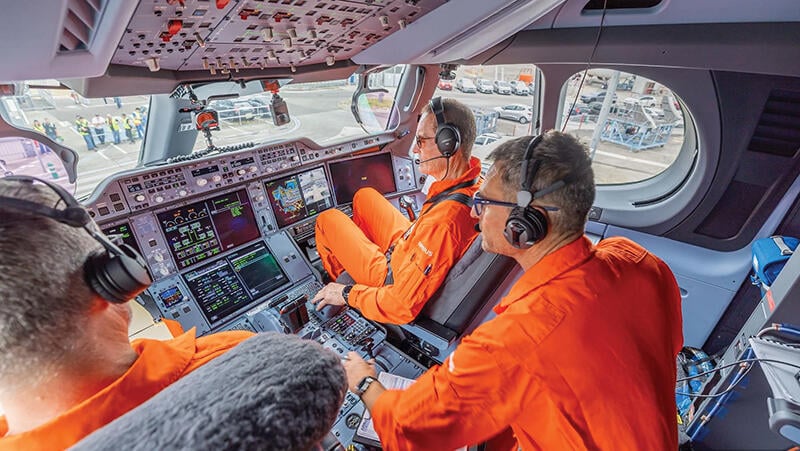
Flight and ground tests will increasingly be part of a hybrid testing approach, where virtual assessment will contribute to both certification and maturity testing.
Airbus is using many of its research and technology programs to prepare its next-generation narrowbody aircraft. In addition to onboarding new technologies, they could serve a parallel purpose: developing methods that combine real-life and virtual testing. Eventually, the airframer intends to cut testing in half.
Airbus has been making gradual progress toward a 2030 launch of a replacement for the A320, a project internally known as the eAction. Two dominant priorities of the program have emerged so far: 20-30% better fuel efficiency and a fast production ramp-up to an unprecedented level—around 100 aircraft per month. A third priority—quicker assessments, including the flight-test campaign—is just surfacing.
- Continuing progress in computing power enables increased simulation
- Engineers practice on research and technology programs
Spending less time on trials during the final development phase of a component, system or aircraft would lower nonrecurring costs and reduce time to market, which could improve sales. The next-generation single-aisle aircraft might then be even more attractive and generate revenues sooner.
Airbus is therefore studying ways to expedite evaluations during the entire development program. The airframer is aiming to halve testing lead times, Thierry Raffy, vice president of test and analytics engineering, said at the Aerospace Test and Development Show, held in Toulouse Sept. 29-30. The effort will include assessments of high-voltage electric architectures and new avionics concepts, he added.
That acceleration will be all the more challenging, as it will apply to innovative structures and systems, and certification requirements will continue to become stricter. “We need to test more, test more complex things, test earlier to ensure maturity and test faster,” Raffy said.
Airbus engineers are practicing a more advanced use of hybrid testing on research and technology programs such as the eXtra Performance Wing, or X-Wing. Airbus’ UpNext innovation arm is converting a Cessna Citation VII business jet by installing a high-aspect-ratio wing, the wingtip of which can fold to alleviate the loads caused by turbulence. Airbus test experts see the X-Wing as a suitable use case to progress toward hybrid testing, said Jean-Philippe Navarro, the airframer’s hybrid testing technical leader and an expert in advanced modeling.
Unsurprisingly, the approach—whether in research and technology or developing a new aircraft—involves more virtual testing, enabled by increasing computational power and improved digital modeling.
“We can do a big portion virtually, both for maturity testing and formal testing,” Raffy said. Formal testing refers to those assessments counting for certification. “When you want to do formal tests, you are entering the full compliance demonstration. Tomorrow, we will have different virtual testing solutions, adapted to each test.”
Equipment in Toulouse could be used more intensively in physical testing. Airbus has adopted a “follow the Sun” approach, in which overseas teams can operate test equipment remotely during their working hours, even if it is nighttime in Toulouse. The arrangement already involves company engineers based in India, and the airframer is looking at extending it to those in Canada, Raffy said.
Moreover, his team will carry on with coupling test rigs together between Airbus’ sites in Toulouse and Filton, England, for example. So far, the frequency of remote inputs has been the limiting factor. Airbus is considering using coupling for higher frequencies, including for power management.
The airframer plans to increase its use of testbed automation. In addition, suppliers may expect greater involvement in Airbus’ testing strategy.
A better use of test data could help gain maturity even before the first flight. With current data analysis, engineers miss some weak signals that could have prevented in-service issues. “We use less than 20% of our data,” Raffy said. “We need to continue to invest.”
While flight tests will remain decisive on any new program, their essence might change. “My dream is to go to flight test to check what’s important, not to discover [anything],” Raffy said. “When we deliver a product to the flight-test [department], the product will be almost ready for certification.”

Related Content




Comments