This article is published in Advanced Air Mobility part of Aviation Week Intelligence Network (AWIN), and is complimentary through Dec 13, 2026. For information on becoming an AWIN Member to access more content like this, click here.
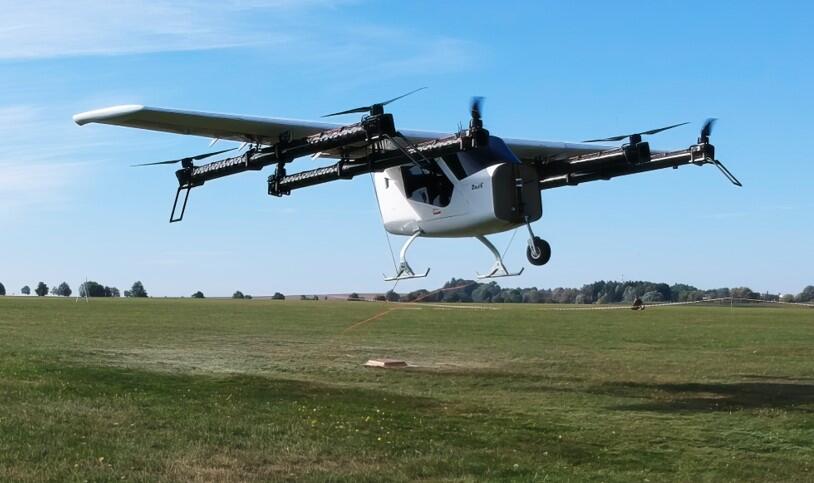
Zuri has flown a half-ton, 11-m wingspan demonstrator in hover mode.
Prague-based hybrid-VTOL startup Zuri is planning a major shift from years of subscale demonstrators to a full-envelope tiltrotor prototype flight campaign in 2026.
Founder and CEO Michal Illich says the company has deliberately avoided the urban air mobility (UAM) approach taken by eVTOL startups Joby, Archer and others. Instead, Zuri has opted to pursue a regional hybrid VTOL from day one, based on a conviction that the purely electric urban air taxi mission will prove unprofitable for years to come.
Illich says that he believes UAM missions under 100 km (62 mi.) will not yield meaningful time savings over ground transportation when first- and last-mile travel to and from vertiports is factored in. Zuri instead has chosen to target 90-min. missions in the range of 500 km, although the aircraft has a design range up to 700 km, with cruising speeds of 350 kph and space for five passengers or a 300-kg (660-lb.) payload.
“It usually doesn’t make sense to fly very short missions,” Illich tells Aviation Week. “By the time you reach the vertiport, board, fly 10 min. and deplane, a car would likely have been just as fast. From the very beginning, we saw that batteries were not enough—and would not be enough for decades—so we designed a hybrid from day one.”
Zuri has built 15 battery-powered subscale vehicles and has flown a half-ton, 11-m (36-ft.) wingspan demonstrator in hover mode over the last several years. The second-generator demonstrator, expected for early 2026, will feature eight large-diameter tiltrotors (four on a main wing and four on a V-tail) and a hybrid powertrain. The aircraft will be used for cruise testing and full envelope expansion, including transition flights. The company is currently validating the engine-generator system on the ground.
Illich says that large-diameter rotors are the optimal solution for VTOL aircraft due to their lower disk loading. “Large rotors give you low disk loading, and that’s the whole game. If your disk area is big, the lift is efficient, and the noise drops dramatically. Once you accept the physics of disk loading, the architecture almost chooses itself. Big open rotors produce lift with far less induced noise and power penalty than the smaller, ducted concepts.”
Zuri to certify under a blend between European Union Aviation Safety Agency (EASA) CS-23 and SC-VTOL special condition rules, although Illich says the timeline will depend on future financing. The company plans to finalize investment terms soon with AAMG, the group that previously explored investing in Lilium after its insolvency filing late last year. Next year, Illich says that Zuri has a single major objective—to get the tilt-rotor hybrid demonstrator flying.
“Ninety percent of the company is focused on getting the hybrid tiltrotor demonstrator flying next year,” he says. “We’ve been quieter and more cautious than many others, but the next 12 months will be extremely exciting as we bring all of the elements together.”
Illich says the company has been intentionally understated publicly, focusing on engineering maturation rather than market hype and publicity. But with a full-scale prototype entering the build phase, he expects a visibility inflection point next year. Robert Demmer, Zuri’s marketing lead, says the goal is to open a “continuous technical dialogue” with industry observers—not to overpromise, but to demonstrate steady progress with tangible hardware.
“We’ve been a little quieter than some of the big names in this space, but that’s intentional,” Illich says. “We’d rather be cautious about what we say and focus on building the hardware.”

Related Content