This article is published in Advanced Air Mobility part of Aviation Week Intelligence Network (AWIN), and is complimentary through Dec 19, 2026. For information on becoming an AWIN Member to access more content like this, click here.
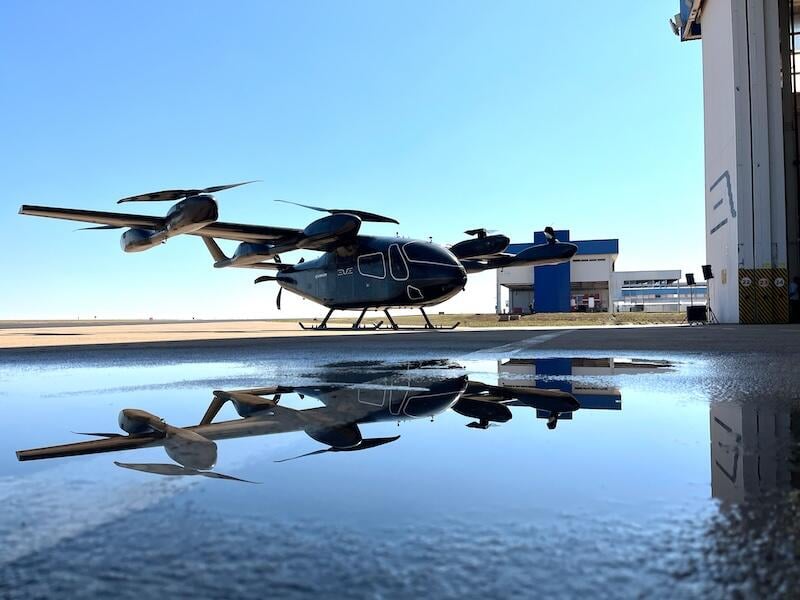
Revo has placed an order for 50 aircraft from Eve Air Mobility.
Global helicopter operator OHI is positioning its Brazilian subsidiary Revo to be an early adopter of eVTOL air taxis, targeting initial commercial operations in Sao Paulo in the 2027-29 timeframe using aircraft from Eve Air Mobility.
Speaking to Aviation Week, OHI Group CEO Jeremy Akel described eVTOLs not as a replacement for helicopters, but as a new layer in a broader low-altitude transportation ecosystem that he predicts will take at least a decade to gain public trust and reach a critical scale.
“In the long term, this really does become the preferred mode for urban mobility,” Akel said. “But it’s not a switch that flips overnight. The technical challenges get solved and the regulations will come, but public trust and the ability to operate at scale—that’s going to take a while. To get full, scaled operations, we’re talking about another decade.”
Revo has placed an order for 50 of Eve’s EVE-100 lift-plus-cruise eVTOLs, part of a deal worth up to $250 million that also includes Eve’s Vector urban air traffic management platform and access to Eve’s TechCare MRO service. First deliveries are envisioned by late 2027, after Eve hopes to receive type certification from Brazilian regulator ANAC.
Asked about the partnership with Eve, Akel said it was natural given the proximity in Brazil, as well as trust in Eve’s parent Embraer and its certification and MRO capabilities.
“What differentiates Eve is Embraer,” Akel said. “They know how to certify an aircraft. They’ve been doing it for years. Some of the newer OEMs are making progress, but we don’t have the same confidence in their timelines. Eve is taking a very methodical approach to certification. They’re less worried about that first flight and more concerned about certifying the different components from a design perspective, which we agree with … And as an operator, TechCare gives us a clear line of sight on the economics.”
Akel said he views Sao Paulo as a “natural sandbox” to prove out advanced air mobility, thanks to the city’s large existing helicopter network with several hundred helipads and its dense concentration of high-net-worth individuals who are accustomed to air taxi services. He observes the market there includes weekday corporate traffic layered with strong weekend demand to outlying “Hamptons-like” leisure destinations, creating a stable pattern for Revo’s future eVTOL services.
“There’s helidecks on almost every building in Sao Paulo, so there’s no shortage of ability to create a network,” Akel said. “Our main shuttle today is an 8-min. helicopter flight downtown; an eVTOL could do it in about six. That’s a perfect early route. Where things get trickier are the longer Hamptons-type destinations outside the city. That’s where today’s battery technology starts hitting its limits. Over time we can do those routes, but not on day one.”
Despite his bullishness on urban air mobility, Akel said he does not see eVTOLs displacing helicopters in Revo’s operations. Range, payload limitations and the need for scale will keep helicopters firmly embedded in the network for many years. Akel said that situation will persist until battery endurance makes significant improvements.
“This is not a replacement product—it’s an integrated product,” he said. “You need helicopters in the network for years because early eVTOLs won’t have the endurance for every mission. If you want a real business that’s viable, you’ll be forced to have a mixed fleet. That stays true until battery density gives significantly more range.”
Although technology, infrastructure and regulations are advancing, Akel predicts that the primary barrier to eVTOL adoption will be public trust in the safety credentials of the new technology.
“The biggest barrier isn’t batteries or airspace—it’s public trust,” he said. “When people decide whether to get on an aircraft, there’s an emotional component. You’re not just solving technical problems—you’re solving human psychology.”
To help overcome the trust issue, Akel said OHI will lean on its long track record of safety gained from decades of helicopter operations.
“We fly dual-engine aircraft with two pilots, and we run at offshore standards—which are basically one step below Part 21,” he said. “Those same standards apply to Revo today. The idea is: If Revo is flying it, it’s safe. And the customer won’t have to think about whether it’s electric or burning Jet-A.”

Related Content