This article is published in Business Aviation & AAM Report part of Aviation Week Intelligence Network (AWIN), and is complimentary through May 17, 2026. For information on becoming an AWIN Member to access more content like this, click here.
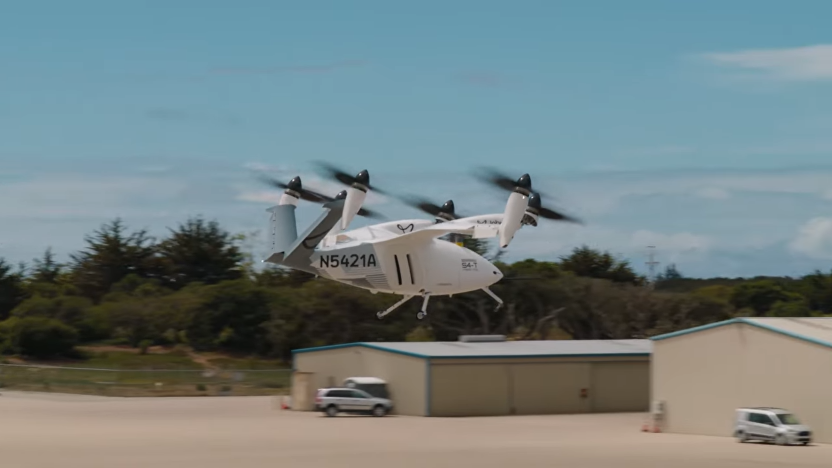
What appear to be cooling slots have been added to the fuselage of the S4-T since its first flight.
Joby Aviation plans to conduct a demonstration flight of its S4-T hybrid-electric vertical-takeoff-and-landing (eVTOL) uncrewed aircraft for the U.S. Army next week at its plant in California.
Joby has partnered with mission equipment integrator L3Harris Technologies to offer the autonomous, turbine-hybrid version of its S4 tiltprop eVTOL air taxi for defense applications.
The prototype S4-T made its first flight at Marina, California, on Nov. 7, and on April 16 Joby posted a video on YouTube showing the aircraft taking off vertically and rapidly transitioning to wingborne horizontal flight.
Joby and L3Harris are proposing the S4-T as a Group 4+ uncrewed aircraft system (UAS) for three Army missions: reconnaissance, surveillance and target acquisition, advanced teaming, and launched effects, says Robert Smith, director of intelligence, surveillance, and reconnaissance (ISR) business development at L3Harris.
“We plan at some point on missionizing [the aircraft] to be able to do an ISR role, an electronic attack/electronic warfare role, and a ground-attack launched-effects-type role as well. So multi-mission, multi-mode,” he says. “It’s modular, it’s scalable, and it’s not vendor locked. It’s not tied to that mission system; you do a lot of different roles.”
The maximum gross weight of the S4-T is 6,700 lb. “With 500 lb. of mission equipment, we still have 2,100 lb. [of payload], so we have a lot of weight capacity to bring on launched effects and different sensors,” Smith says.
With a jet-fuel turbogenerator and batteries producing electricity to power the six tilting propellers, cruise speed is 164 kt. and dash speed up to 180 kt. Maximum endurance without auxiliary tanks is 5+ hr. and with extended-range tanks is 10+ hr.
“You could use the same electric propulsion units and have a larger wing, and then you are scaling for longer range,” he adds.
The demonstration for the Army is planned to include Joby’s piloted S4 eVTOL air taxi, which is undergoing flight testing for FAA type certification. Joby flew its first FAA-conforming S4 in March and anticipates FAA Type Inspection Authorization flying this year.
PM UAS, the Army’s program management office for uncrewed aircraft, is expected to release a request for proposals this summer for a Group 4+ short/vertical-takeoff-and-landing (S/VTOL) UAS to replace the fixed-wing General Atomics MQ-1C Gray Eagle.
“That’s what we’re looking for,” Smith says.
The service launched an S/VTOL “challenge” program on Dec. 14 to open a dialogue with industry as it shapes requirements for the new aircraft. Interested companies were required to submit white papers describing their proposed aircraft by Jan. 8.
“We can deliver by fourth quarter 2028. That’s when they want prototypes to go to two different Combat Aviation Brigade units that are Transforming in Contact units,” says Smith, referring to the Army’s initiative to accelerate the fielding of new technologies.
“They’re going to get six total prototypes, probably from two or three vendors … and they’re going to use those for a year. They’re just going to wear those things out, test them out,” he says. “On the backside of that, they’ll really understand what they want for the long term for an eventual program of record down the road.”
Among other competitors, Anduril is developing a hybrid-electric VTOL aircraft with Joby rival Archer Aviation, Boeing has proposed the CxR Collaborative Transformational Rotorcraft uncrewed tiltrotor concept, and Lockheed Martin company Sikorsky is developing the Nomad family of hybrid-electric tailsitting VTOL uncrewed aircraft.
Brian Everstine contributed to this report from the Army Aviation Association of America's Army Aviation Mission Solutions Summit in Nashville, Tenn.