This article is published in Advanced Air Mobility part of Aviation Week Intelligence Network (AWIN), and is complimentary through Dec 09, 2026. For information on becoming an AWIN Member to access more content like this, click here.
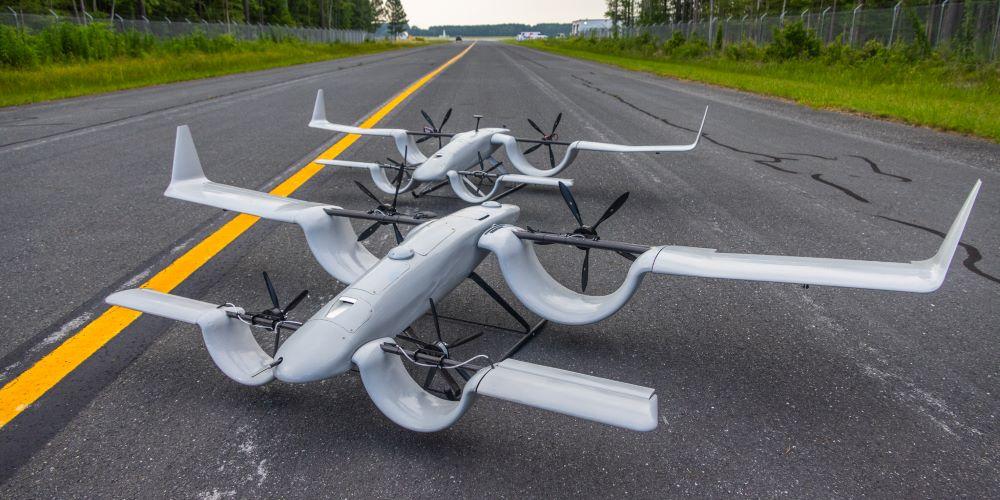
HopFlyt has built and flown two 10-ft. wingspan prototypes.
Developed in the 1940s by American inventor William Ray Custer, the channel wing aircraft features a main wing with a U-Shaped section with a propeller mounted inside.
The idea was to enable short takeoff and landing (STOL) performance by accelerating air through the channel and generating very high lift at low or even zero forward.
Early prototypes were built and tested in the early 1950s, but the idea never gained traction. There were issues related to control authority and lift-induced drag in cruise. But more than a half century later, the concept has been revived by Maryland-based startup HopFlyt, as part of its in-development hybrid-electric VTOL, initially designed as a middle-mile cargo UAV called Cyclone.
HopFlyt believes it can solve the technical problems encountered by Custer. The control authority issue that made his concept hard to maneuver at low speeds can be overcome by using multiple electric props on canard wings to guarantee strong airflow over control surfaces and provide differential thrust.
“We can individually change the tilt angle of each propulsion unit,” Chief Engineer Neil Winston said. “None of them are tied together. They can all be individually activated.”
At low speeds and in hover, yaw control comes from differential tilt, while forward and aft motion is produced by tilting the propellers and allowing the aircraft’s pitch to stabilize its attitude. Roll and lateral movements are controlled by left-right differential thrust.
The company says its biggest breakthrough comes from abandoning the traditional wing-and-tail layout that limited Custer’s design.
“Really, what’s solved a lot of the original problems is not putting channel wings in a traditional wing-tail configuration, but putting it into a wing canard configuration,” Winston says. “Then you have a lot of control methods that are more analogous to a multicopter. That’s what solves a lot of low-speed control, and that’s augmented by traditional control surfaces where we have elevators and ailerons. So, we take that and combine it with the ability to individually actuate the tilt angle of all the propulsion units, and that provides the low-speed control authority.”
In terms of the channel wing’s lift-induced drag, the company also believes it has found a solution. “Of course, there is additional drag due to the increased surface area and structure. However, in a powered situation the L/D ratio is about three times higher than when it’s unpowered,” he said.
HopFlyt’s current prototype has a 30-kW Monarch 5 turbogenerator from UAV Turbines that powers the electric propulsors. Future versions will use a piston engine instead of a turbine, although the underlying architecture will remain the same. The battery is used for VTOL and hover and can support 4 to 5 min. of hover time, with the turbine/piston engine powering the aircraft in forward flight.
The company has built and flown two 10-ft.-wingspan, electric prototypes, and is in the process of building a 20-ft.-wingspan version, with first flight targeted in March. The larger aircraft will fly first in an all-electric configuration with a weight ballast for the hybrid engine, and two subsequent prototypes will have the hybrid powerplant on board.
The Cyclone can carry 250 lb. of cargo on a 100 nm roundtrip, or 50 lb. up to 850 nm. In addition to cargo, the company is designing a military-focused, longer-endurance variant for resupply and surveillance and reconnaissance missions.
While the aerodynamic benefits of the channel wing are intriguing, HopFlyt emphasizes to customers potential cost savings up to 90% when compared to helicopters, particularly in the medical deliveries sector.

Related Content