This article is published in Advanced Air Mobility part of Aviation Week Intelligence Network (AWIN), and is complimentary through Jan 20, 2026. For information on becoming an AWIN Member to access more content like this, click here.
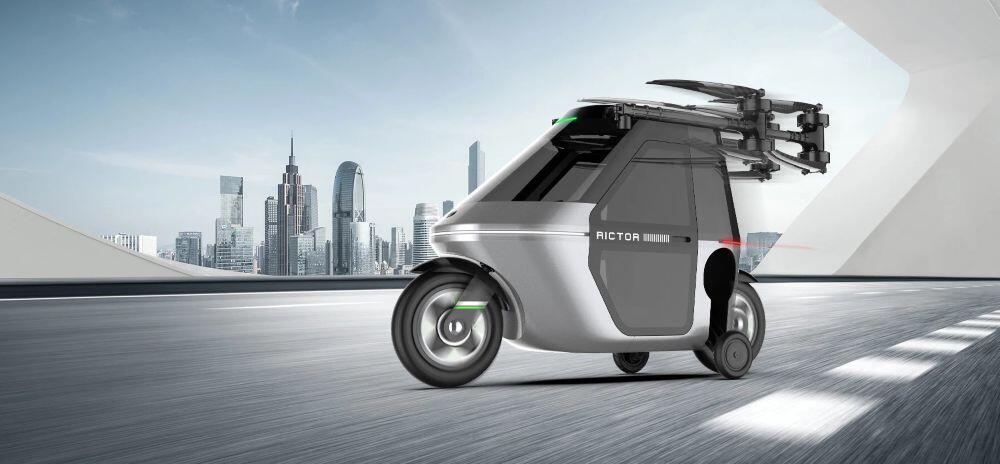
Rictor’s Skyrider X1 is a single-seat eVTOL amphibious flying motorcycle.
Since China’s EHang debuted an autonomous single-seat multicopter at CES in Las Vegas in 2016, the annual consumer technology megashow has become a favored venue for product unveilings by the nascent advanced air mobility (AAM) industry.
After the EHang 184 was displayed a decade ago, the focus shifted to commercial air taxis. Bell unveiled its Nexus hybrid-electric vertical-takeoff-and-landing (eVTOL) concept at CES in 2019 and Hyundai followed in 2020 with its S-A1 design.
Bell returned to CES in 2020 with an updated all-electric Nexus 4T concept, Japan’s SkyDrive displayed its SD-03 demonstrator, and Hyundai’s Supernal division followed in 2024 with its S-A2 production design. But the air taxi market has proved more challenging than headlines from those shows anticipated.
Textron eAviation put assembly of a Nexus demonstrator on hold in 2025 while Hyundai paused all work at Supernal as it reassessed the market and its design. Of other eVTOL developers that used CES as a showcase, Surefly has gone, Volocopter has new owners and GM’s Cadillac eVTOL concept is history.
Held on Jan. 6-9 in Las Vegas, CES 2026 saw a shift in AAM focus back toward the show’s core consumer audience, with the debut of several electric ultralights aimed at the recreational flying market, including designs from Chinese companies CoolFly, Navee and Rictor.
A maker of electric cycles, Rictor unveiled the Skyrider X1 amphibious flying motorcycle. Expected to sell for $60,000, the single-seat, two-wheel eVTOL has four pairs of coaxial propellers on folding arms above the cockpit. Maximum speed is 100 kph (60 mph) and flight endurance up to 40 min., the company says.
Features include automated route planning, automatic takeoff and landing with manual control as an option, triple-redundant flight controls, an integrated emergency parachute and onboard 50-kW charging station.
Rictor also offers the X4 single-seat eVTOL, which closely resembles the Jetson One but at a fraction of the price—$40,000 versus $128,000. The X4 is designed to comply with FAA Part 103 ultralight rules, which do not require a pilot’s license. First deliveries are scheduled for the second quarter.
Coolfly unveiled a Part 103 ultralight eVTOL in which the single occupant stands on a platform housing four ducted fans. Designed to fly at altitudes only up to 30 m (100 ft.) at 100 kph, the $100,000 vehicle features automated route planning and obstacle avoidance, as well as gravity-sensing flight control based on the pilot’s posture.
Electric scooter manufacturer Navee revealed in model form another wrinkle on electric air mobility in the shape of the WaveFly 5X, a wing-in-ground-effect seaplane designed to take off and land on water and cruise just above the waves at speeds up to 85 kph with a maximum flight time of 70 min. With one or two seats, the $100,000 aircraft has tandem wings and four props, two forward and two aft.
Other eVTOL exhibitors at CES 2026 included U.S. startup Leo Flight, which displayed the JetBike, a single-seater with four arrays of 12 electric ducted fans mounted at the corners. Intended as a Part 103 ultralight, the $100,000 aircraft is designed to fly for 10-15 min. at up to 60 mph and an altitude of around 15 ft. Israel’s Air also displayed a prototype of its Air One eVTOL two-seat light sport aircraft at CES 2026.


Comments