This article is published in Advanced Air Mobility part of Aviation Week Intelligence Network (AWIN), and is complimentary through Feb 19, 2027. For information on becoming an AWIN Member to access more content like this, click here.
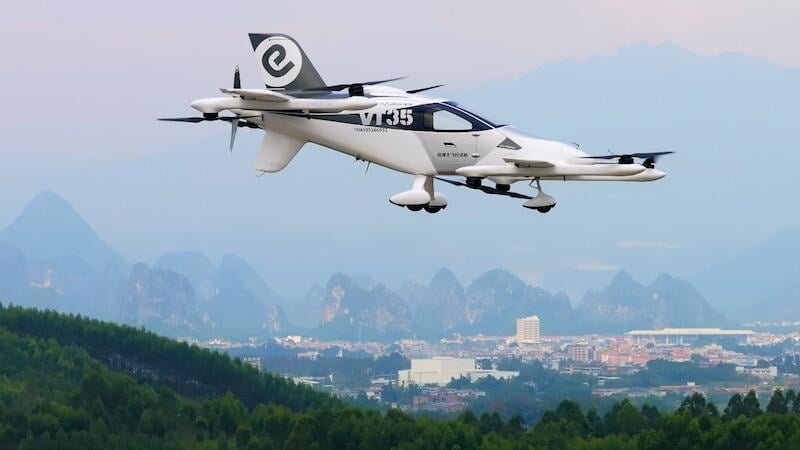
The VT35 is a lift-plus-cruise, autonomous intercity eVTOL.
China’s EHang says it expects an accelerated certification timeline for its long-range VT35 autonomous eVTOL, leveraging experience gained from certifying the EH216-S multicopter, as it scales manufacturing capacity and broadens its mission set beyond passenger services.
Speaking to Aviation Week, EHang’s COO Zhao Wang described a multi-pronged strategy centered on gradual commercial rollout of the EH216-S, industrial expansion at the company’s Yunfu production facility and continued development of the lift-plus-cruise VT35, which is intended to serve regional and intercity markets.
In March 2025, the Civil Aviation Administration of China (CAAC) granted air operator certificates to two EHang-affiliated operators: its wholly owned subsidiary, Guangdong EHang General Aviation; and Hefei Heyi Aviation, a joint venture with the Hefei municipal government, clearing the way for commercial passenger services.
EHang General Aviation is primarily focused on training and operational preparation for customers, while the joint venture in Hefei is “open to individual customers where they can purchase tickets, check in and conduct regular commercial flights,” Wang says. The two operators are currently performing trial operations with the EH216-S, including aerial sightseeing tours, as part of a phased strategy building toward commercial passenger services.
In contrast to the short-range multicopter EH216-S, the VT35 is a two-passenger uncrewed lift-plus-cruise aircraft targeted for intercity travel. It features eight distributed lift propellers and a pusher propeller for cruise. The aircraft is now undergoing envelope expansion testing and performing regular transition flights between thrustborne hover and wingborne cruise, Wang says.
EHang submitted its type certification application for the VT35 to CAAC in March last year. Wang said that certification could proceed faster than the three-year effort required for the EH216-S, noting that the earlier program required regulators to establish new standards for passenger-carrying autonomous eVTOL aircraft.
With those standards now in place—and with substantial commonality in components and systems between the two aircraft—Wang believes the VT35 certification process will benefit from the certification of its smaller counterpart.
“Back when we were certifying EH216, there were no existing standards for these types of aircraft, so it took us three years to get it done,” Wang says. “Now that we already have a standard existing, experience with the process and we are using similar components that are already certified by the CAAC, we think the certification of VT35 will go faster.”
Wang also disclosed that the VT35 may feature a hybrid-electric powertrain option, although current development efforts remain focused on battery-electric propulsion. “If the hybrid-electric power system is proven to be safe and environmentally friendly, then we’re up for it,” Wang says. “But for now, we’re focusing our research resources mainly on battery development.”
As certification work advances, EHang is expanding industrial capacity at its primary manufacturing base in Yunfu, Guangdong Province. According to Wang, the facility has doubled its production area and added a new line incorporating greater automation. While current annual production is approximately 200 aircraft, he projects capacity could rise to 1,000 aircraft per year—or potentially more—once expansion is complete.
The new line will focus on automated production of major components, supplying final assembly both in Yunfu and at additional facilities under development in other Chinese provinces, according to Wang. The company has previously announced plans for expanded production in Hefei and Weihai, Shandong Province, supported by municipal government partnerships tied to Beijing’s Low-Altitude Economy initiative.
Wang also describes an upgraded firefighting variant of the EH216 that eliminates the onboard cabin, allowing for increased capacity for flame retardant. Earlier firefighting versions required a crewmember onboard to aim and deploy fire suppressant. The new configuration enables remote operation using camera systems and virtual interfaces, freeing space for additional firefighting material.
Wang describes firefighting as a system-level solution involving multiple aircraft types, including rapid-response surveillance drones to assess incidents; initial suppression aircraft carrying up to 200 liters (44 gal.) of fire suppressant; and a heavier-lift platform designed for tethered operation to ground-based fire trucks for sustained high-volume fire suppression.
The strategy reflects EHang’s broader diversification effort. While the company is best known for achieving the world’s first type certification for a passenger-carrying autonomous eVTOL with the EH216-S, Wang noted that it currently maintains numerous product variants across passenger, logistics, firefighting and drone light show markets.
EHang has conducted demonstration flights with the EH216-S in multiple international markets in East Asia, Europe, Latin America and the Middle East, and is prioritizing entry into countries where regulatory pathways may be more accessible in the near term, Wang says.
But he also acknowledges that entry into the U.S. and European markets would require alignment with stringent regulatory requirements, and that aircraft may require configuration adjustments to meet those standards.
“For international markets, our strategy is to enter countries where certifications are relatively easy to get, like Thailand and Brazil,” Wang says. “As for the U.S. and Europe, we need to fit our aircraft with the local regulations from FAA and EASA, and we think we can do that, but it will take more time.”

Related Content