This article is published in Aerospace Daily & Defense Report part of Aviation Week Intelligence Network (AWIN), and is complimentary through Jul 30, 2026. For information on becoming an AWIN Member to access more content like this, click here.
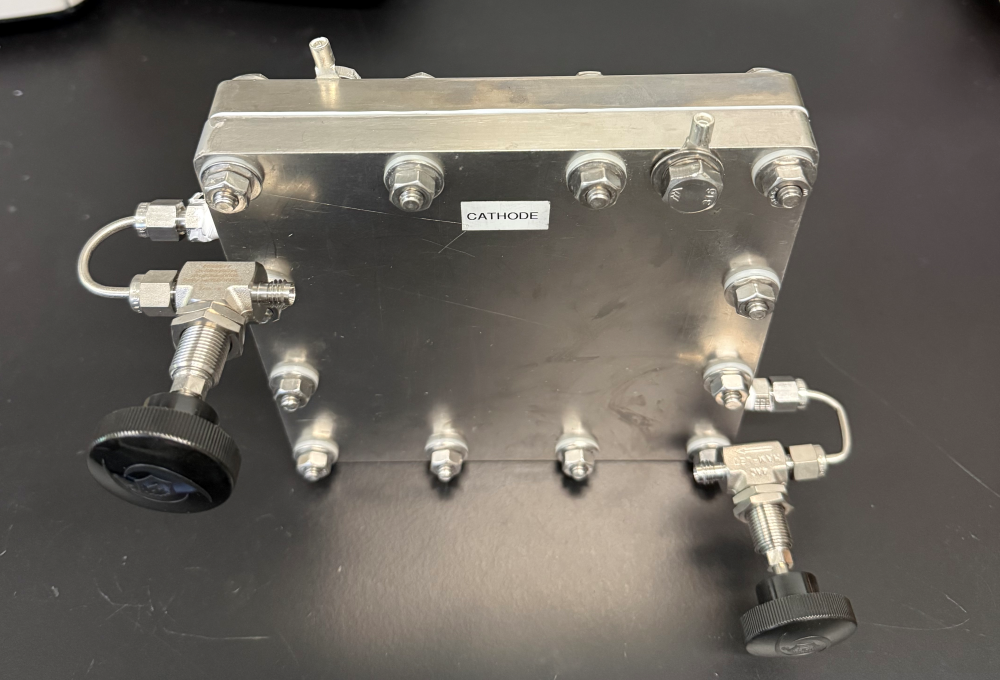
Air Energy's prototype lithium-air battery has demonstrated 1,000 Wh/kg.
A U.S. startup has secured funding to begin scaling up a battery chemistry that promises to enable a three-four times improvement in drone performance and allow larger electric regional aircraft.
Chicago-based Air Energy is partnered with the Illinois Institute of Technology to develop the solid-state lithium-air battery under a U.S. Energy Department research project.
The team is developing a 1 kWh prototype battery module with a target energy density of 1,000 Wh/kg–three-four times that of conventional lithium-ion batteries–under the Advanced Research Projects Agency - Energy’s (ARPA-E) Joules-1K program.
The Illinois Tech team, which includes the National Laboratory of the Rockies and RTX Technology Research Center, is one of six awarded contracts in January for the two-year second phase of Joules-1K, which is planned to include drone flight tests.
After validation of the solid-state lithium-air battery chemistry under Phase 1 of Joules-1K, Air Energy has raised an oversubscribed seed funding round led by Resolute Venture Partners, an early investor in SpaceX and Tesla, to scale up the technology.
In a lithium-ion battery cell, the reactants are stored in the anode and cathode. A lithium-air cell has a lithium metal anode, but oxygen from the atmosphere is used as the reactant at the cathode and not stored in the cell. This reduces weight and increases energy density to 1,000-2,000 Wh/kg at the cell level compared with 260-340 Wh/kg for lithium-ion.
In lithium-ion, energy is stored by the intercalation, or insertion, of lithium ions into the layered structure of the electrode. In lithium-air, energy is stored in covalent bonds between the lithium and oxygen. The process is reversible, making the battery rechargeable, says Mohammad Asadi, co-founder and chief technology officer.
“Lithium can bond three different ways with oxygen: one-electron transfer, which makes lithium superoxide; two-electron transfer, which makes lithium peroxide; and four-electron transfer, which makes lithium oxide,” he says.
Air Energy’s solid-state lithium-air cell uses a ceramic-polymer composite solid electrolyte that enables a four-electron reduction-oxidation reaction. “When you have four-electron transfer, you can store more energy in the same volume and the energy density goes much higher,” Asadi says. The solid electrolyte is also safer than flammable liquid electrolytes used in lithium-ion cells, its structure deterring lithium dendrites and thermal runways.
After completing their $1.5 million Joules-1K Phase 1 project, demonstrating 1,000 Wh/kg at the cell level and 1,000 capacity-limited charge-discharge cycles, the Illinois Tech team was awarded a $3.2 million Phase 2 contract to develop prototype pouch cells for drones.
“In Phase 2, the goal is to scale this technology up,” says Benjamin Drake, co-founder and CEO of Air Energy. “We’re taking a design for manufacturing approach. We’re building out an early-stage R&D prototype line and derisking the roll-to-roll processes that would enable this technology to be used on conventional battery manufacturing equipment.”
Including the balance of plant required at pack level to enable and control the flow of air to and from the cells, pack-level energy density is currently around 700 Wh/kg. The Joules-1K target is 1,000 Wh/kg at the pack level, including balance of plant. “And we have a pathway to go beyond that, hitting a target of 2,000 Wh/kg down the road,” Asadi says.
Following validation of manufacturing processes and scale-up on the R&D line, Air Energy is evaluating plans for a pilot production line in Chicago, potentially at the MxD National Center for Cybersecurity in Manufacturing. This pilot-scale manufacturing capability would be targeted to begin in 2027, the company says.