
Vindlér®: Bringing Dark Vessels Back into the Light
For the U.S. Navy, the world’s oceans are increasingly shadowed by ships that don’t want to be found. These “dark vessels” and other loosely coordinated shadow fleets slip through strategic waterways under neutral flags, disguise their identities and execute covert maritime operations largely undetected. By simply switching off their Automatic Identification Systems (AIS) or spoofing digital signatures, they create intentional blind spots – gaps for naval and intelligence forces that adversaries are all too willing to exploit.
Yet even the quietest vessel can’t fully hide its presence. Radar pings, push-to-talk radios and other everyday maritime systems all emit telltale radio frequency (RF) signals. And those signals are the key to restoring maritime transparency.
For decades, RF collection depended heavily on access – permissive airspace for drones, available aircraft and the assumption that AIS data was truthful. But as great power competition reshapes the maritime domain, those assumptions no longer hold. Commanders need global coverage, persistent visibility and intelligence that arrives fast enough to matter.
That’s where space steps in.
When a radar switches on in the Western Pacific today, the first entity to notice may not be a nearby patrol aircraft, but rather, a satellite orbiting hundreds of miles overhead. Space-based RF detection has evolved into a force multiplier, offering a way to reach into denied or contested regions without risking aircraft or crew. But the value of that intelligence depends entirely on how quickly it moves from collection to a commander’s console. In naval environments governed by strict emissions control, slow intelligence might as well be no intelligence at all.
Historically, satellite architectures haven’t been built for speed. High‑orbit systems, designed for exquisite sensing, often take too long to deliver data. Even newer low-Earth orbit (LEO) constellations can struggle when downlink opportunities are sparse or inter‑satellite links are constrained. But commercial innovation is rapidly changing that paradigm.
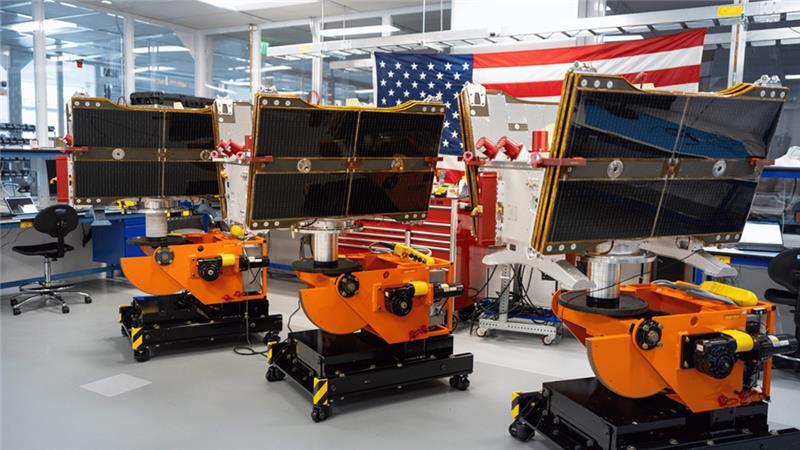
SNC’s Vindlér constellation is one example of how industry is pushing RF intelligence toward a new operational tempo. Built as a space-based RF detection and geolocation system, Vindlér collects across a wide frequency range, from VHF through Ka-band, and delivers results directly to the end user. Operating in LEO, the satellites benefit from stronger signals, lower latency and more frequent overflights of global ground stations.
Vindlér also tackles bottlenecks that have plagued legacy systems. With high-capacity downlinks, robust crosslinks and automated onboard processing, Vindlér can compress and analyze RF data before it ever touches the ground. According to SNC, this architecture allows intelligence to move from collection to operators in as little as four hours – far from the multi-day delays that used to be standard.
Industry analysts increasingly agree that future RF architectures must be built around speed. Detecting a signal is only the first step. Getting it off the spacecraft, routed through the network, processed and into the hands of decision makers without delay is the real challenge. As adversaries expand their own shadow fleets and refine their use of low-visibility operations, the Navy must ensure that its intelligence pipeline keeps pace.
RF collection can no longer be viewed as a sensing problem alone. It is an end-to-end race, one that rewards those who collapse the distance between detection and decision. And in that race, space-based systems like Vindlér are helping bring dark vessels back into the light.