This article is published in Aviation Week & Space Technology and is free to read until Jul 18, 2026. If you want to read more articles from this publication, please click the link to subscribe.

Is SpaceX’s Mars Mission Based On An Unproven—And Dangerous—Premise?

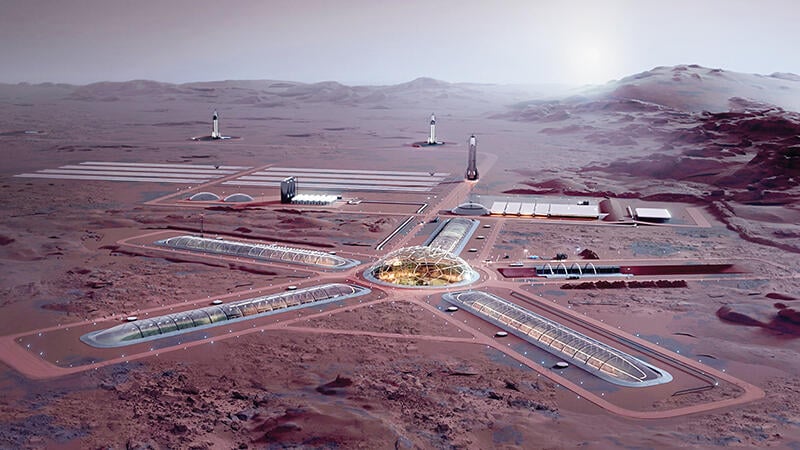
Mars colony concept

A “self-sustaining civilization” on Mars depends on human reproduction there, a little studied subject.

Credit: SpaceX concept

The mission of SpaceX and founder Elon Musk is to make humanity multiplanetary by settling a “fully self-sustaining civilization on Mars.”

A lot of money and engineering time has been invested in transporting humans to the red planet, including more than $15 billion on Starship development. Musk envisions a flotilla of several thousand Starships launching at roughly two-year intervals to transport Martian colonizers to settle the new world.

Yet very little public thought or research has addressed the biological, technical and ethical problems of creating a “self-sustaining civilization”—a goal that necessitates reproducing and raising children on a planet that is hostile to all forms of life.

Indeed, SpaceX’s plans to settle more than a million humans on Mars may be based on a faulty premise: that the short-term survival of highly trained astronauts in space proves that humans can live and reproduce on Mars.

This load-bearing assumption, if it collapsed, would likely change the calculus for SpaceX investors and for early space settlers motivated by founding a new civilization—some of whom Musk says “will probably die in the beginning.”

SpaceX has said little about the biological effects of living on Mars and much less about the consequences for pregnancy and child development. “We don’t actually even know if it’s possible to have children on Mars,” says Scott Solomon, an evolutionary biologist and teaching professor of biosciences at Rice University, who recently published Becoming Martian: How Living in Space Will Change Our Bodies and Minds. “If we could have them, we don’t know if they would grow up to be healthy adults.”

Astronauts living in microgravity on the International Space Station lose 1-2% of their bone mass per month; their muscles atrophy, and fluids pool in their heads, which is thought to cause vision problems.

Unlike Earth, Mars has a thin atmosphere and lacks a magnetic field, making its surface subject to several radiation types, including high-energy galactic cosmic rays, a form of ionizing radiation that can damage tissue and DNA, potentially harming babies during pregnancy, as well as children and adults. NASA puts a lifetime limit on astronaut exposure to radiation, Solomon notes. A Mars colony would require heavy shielding.

Martians might become physiologically unable to return to Earth and withstand the planet’s nearly three times greater gravity. Raised among a small group of settlers, these humans might also lack immunity to Earth’s diverse diseases. They might evolve into a separate species, Solomon says.

Musk’s motivations come from his interpretation of the Fermi Paradox: Despite the vastness of space, no alien intelligent life has been discovered, and thus, humans may be the only sentient beings in the Universe. Musk’s Mars mission is therefore messianic: “to preserve the light of consciousness” in case an asteroid, global warming, nuclear war or an artificial intelligence doomsday event stops the synapses of homo sapiens back on Earth.

Although Musk is passionately natalist on Earth, he has said relatively little about procreating on Mars, instead writing on social media that “we need to focus on getting there first.” But these questions need answering before launch. If off-world procreation is not possible, why try to send 1 million people to a dead-end civilization on Mars?

Trying to answer these questions is an ethical minefield. “You’re talking about doing medical experiments on children in dangerous situations,” Solomon says. Consequences might not be known for generations.

Studies on animals for multiple generations in the one-sixth gravity of the Moon could be a starting point. “But we haven’t even begun to do those,” Solomon says. NASA’s Artemis program is unlikely to have a long-duration Moon habitat for animal experiments before 2032.

Obvious health problems that researchers would look for in animal studies include growth deficits, fertility problems, malformations, organ-weight differences, behavioral abnormalities, survival issues and gross pathology.

Optimistically, it could be decades before science can produce answers, Solomon says. That timeline might conflict with the nearly 55-year-old Musk’s goal to colonize Mars before his death—an objective recently sweetened by SpaceX’s board, which granted him 1 billion additional shares that vest only if SpaceX hits market-cap milestones up to $7.5 trillion and establishes a Mars colony of at least 1 million people.

Humans may prove adaptable to life on Mars. No one knows, Solomon says. But what if scientific evidence shows that it is not possible? “If we discover, for example, that our reproductive biology just doesn’t work in a different gravitational field, that might be a showstopper,” Solomon says. “That might mean that we cannot ever truly live beyond our home planet.”

Editor’s note: This article was updated to add information about the additional shares the SpaceX board granted Elon Musk.

Garrett Reim

Based in the Seattle area, Garrett covers the space sector and advanced technologies that are shaping the future of aerospace and defense, including space startups, advanced air mobility and artificial intelligence.

Comments

4 Comments
Better to conduct this experiment on Mars than spend the money on killing humans in unnecessary wars on Earth.
For smaller settlements, the settlers could live in rotational gravity, close to 1G, in rotating circular ring structures much like space habitats. These would be horizontal, with access at the central foundation on the Martian surface. The thin atmosphere assures very low air drag and thus low power needed for rotation.
The planet blocks all cosmic radiation from below, and a tall berm of soil and rocks around the ring would block radiation from the sides. Then additional shielding on the ring structure, such as polyethylene, would complete the radiation protection.
A couple of thoughts:
No one is sending anyone anywhere, they would be signing up and likely paying significantly to participate in this grand and very hazardous endeavor. The ethics of raising a child in an extraterrestrial environment is on the parents.
It would be an order of magnitude cheaper to build a true variable g facility in LEO to determine the effects of other acceleration fields on biology. We are still remarkably ignorant on this subject. This was one of the Apollo follow-on programs but never realized.

Many questions could be answered by building Kirk Sorensen’s relatively affordable Tether-Based Variable-Gravity Research Facility.
https://www.artificial-gravity.com/JANNAF-2005-Sorensen.pdf

Surface tension and hydraulic forces are orders of magnitude greater than gravitational forces, I find it very unlikely that gestation would be impossible in Martian gravity. Returning to Earth after growing up on Mars probably would be a problem, but that’s an issue for future sociologists.