This article is published in Aerospace Daily & Defense Report part of Aviation Week Intelligence Network (AWIN), and is complimentary through Mar 30, 2026. For information on becoming an AWIN Member to access more content like this, click here.
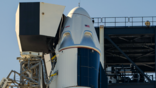
HOUSTON—With the fully stacked Artemis II Space Launch System (SLS) rocket and Orion crew capsule back on the launchpad March 20, there is more to come as NASA looks to ramp up its lunar mission cadence.
The SLS rocket and Orion capsule are atop their Mobile Launch Platform at NASA’s Kennedy Space Center for a planned April 1 launch of four NASA and Canadian Space Agency (CSA) astronauts on a 10-day mission around the Moon.
As February came to a close, the prospect for a March launch dissolved as NASA addressed an issue preventing the SLS upper stage helium flow to maintain environmental conditions and pressurize propellant for propulsion, prompting a rollback from the launchpad to the Vehicle Assembly Building (VAB).
“We have turned that around really quickly, in fact probably the fastest we have ever turned around in the VAB,” said Lori Glaze, acting deputy associate administrator for NASA’s Exploration Systems Development Mission Directorate. She spoke at a Lunar and Planetary Science presentation, “Artemis II and Beyond - Fireside Chat on the Nexus of Exploration and Discovery,” two days ahead of the mission hardware’s arrival at Launch Pad 39B. “Right now everything looks very good.”
Glaze reported on where the agency stands as it plans to move ahead with the Artemis program at an accelerated pace. She was joined by Jacob Bleacher, chief exploration scientist for her directorate; Brad Bailey, NASA’s Science Mission Directorate assistant deputy associate administrator for Exploration; and Joel Kearns, the deputy association administrator for exploration in the Science Mission Directorate.
As outlined by NASA Administrator Jared Isaacman on Feb. 27, the revised Artemis III mission will no longer attempt the first post-Apollo Moon landing with astronauts. Instead, it is to launch in 2027 for an Earth orbital demonstration of an Orion crew’s ability to launch and dock with one or both of the Human Launch Systems (HLS) being developed by Blue Origin and SpaceX to transport Artemis astronauts back and forth between lunar orbit and the Moon’s surface.
Two Moon landings with astronauts, Artemis IV and V, are planned for 2028, as NASA and its international partners move to establish a sustainable human presence at the Moon with a lunar south pole base camp.
“This is an incredibly ambitious schedule,” Glaze stressed. She noted that Artemis II, III and IV are intended to provide the Artemis program with a “muscle memory,” an experience base it can build on. “This is the right thing to do. This allows us to get into the right cadence.”
Regarding Artemis III, she explained that the new strategy is intended to reveal whether SpaceX’s or Blue Origin’s version of an HLS can get NASA back to the Moon with astronauts the soonest.
“Whoever can get there fastest will be providing the lander,” she declared.
The engines for the SLS core stage for Artemis III are in the VAB at Kennedy, and the upper elements of the large rocket are to be delivered to the VAB in April for assembly. The two solid rocket boosters will be shipped to the VAB soon for stacking. The SLS upper stage is ready and the Orion crew capsule is undergoing processing.
“We are on a really good path to start putting the rocket together once we get the Mobile Launch Platform back to the VAB,” she said, referencing the large platform upon which the SLS and Orion are stacked in the VAB for transportation to the launchpad.
Glaze emphasized the launch team is also working to accelerate development of the spacesuits for the Artemis IV Moon landing mission, and that the Orion capsule and its European Space Agency-provided service module are ready for integration. “There’s a lot of work going on with the SLS pieces as well,” she added.
During the presentation, Glaze and her colleagues addressed questions about the lunar south pole as the preferred landing region for crew missions. They explained that it remains the preferred destination, while the agency intends to explore elsewhere on the Moon with its Commercial Lunar Payload Services missions with their science and robotic payloads.
Glaze also addressed a question about the future of the planned internationally partnered, lunar-orbiting, human-tended Gateway space station, which the White House budget request for 2026 sought to cancel.
“We are continuing activities on Gateway,” Glaze said. She noted that the Working Families Tax Cut legislation, also known as the One Big Beautiful Bill that was signed into law by President Trump last July 4, provides several years of Gateway funding.