This article is published in Aerospace Daily & Defense Report part of Aviation Week Intelligence Network (AWIN), and is complimentary through Mar 14, 2026. For information on becoming an AWIN Member to access more content like this, click here.

Space Force Readying Launch Of AFRL Cislunar SSA Satellite

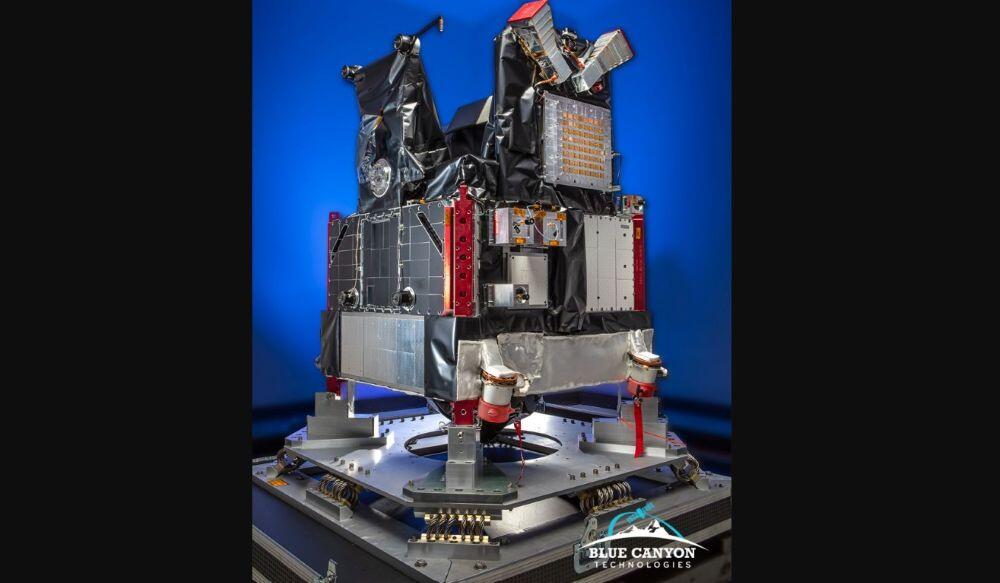
The AFRL and SSC Oracle-M satellite, with a spacecraft built by Blue Canyon Technologies, is ready for launch vehicle integration. Credit: Blue Canyon Technologies

The AFRL and SSC Oracle-M satellite, with a spacecraft built by Blue Canyon Technologies, is ready for launch vehicle integration.

Credit: Blue Canyon Technologies

AURORA, Colorado—A new U.S. military satellite built to track objects in cislunar space could fly by the end of 2026. But the U.S. Space Force is reviewing the launch schedule as the mission was slated to launch on a United Launch Alliance (ULA) Vulcan rocket.

The Air Force Research Laboratory (AFRL) is leading a pathfinder program with Space Systems Command (SSC) called Oracle-M, for a satellite to provide persistent situational awareness in cislunar space and demonstrate new tracking and navigation capabilities. Since successfully completing a hot fire test in March 2025 at Edwards AFB, California, the team has passed all of its preparatory steps and is now awaiting launch vehicle readiness, an SSC spokesperson tells Aviation Week in a Feb. 25 email.

At this point, the Oracle-M space vehicle has been placed into storage at Kirtland AFB, New Mexico, and is awaiting launch, the spokesperson said. The team has completed ground system end-to-end testing and an operations team rehearsal. The next milestone would be launch vehicle integration.

SSC has manifested the payload on the USSF-12 mission, with a classified satellite as its primary payload, the spokesperson said. That mission was originally targeted for launch in December 2026 on a ULA Vulcan rocket, but the Space Force is now reviewing the launch schedule, according to Systems Delta 80, the unit responsible for U.S. launch operations, as well as launch and test range systems and servicing.

Space Force officials confirmed Feb. 25 that the Vulcan rocket is grounded for all National Security Space Launch missions, as the service and ULA investigate the cause of a solid rocket motor anomaly during the Feb. 12 launch of USSF-87, a process which could take months to complete.

The Oracle-M mission, previously known as Defense Deep Space Sentinel, has a number of deliverables to help inform future deep space operations. AFRL is looking to showcase tracking and trajectory estimation for monitoring cislunar objects, cloud-based ground operations, and navigation and communications using commercial ground systems. It features a satellite bus built by Blue Canyon Technologies—now part of RTX—with solar arrays supplied by Redwire and a propulsion system built by Astra.

Both the U.S. and its competitors in space are increasingly focused on cislunar activities, both for civil missions such as the Artemis series to return U.S. astronauts to the Moon, as well as for national security activities. The Trump administration highlighted the area as a location for military space operations in a December 2025 executive order on space superiority.

“We want to make sure that we’re not surprised at cislunar space, and that some other actor doesn’t begin to use it for military advantage,” U.S. Space Command Commander Gen. Stephen Whiting told reporters at the Air and Space Forces Association’s Air Warfare Symposium here. The upcoming Oracle-M mission “will help us maintain space domain awareness there,” he said.

Vivienne Machi

Vivienne Machi is the military space editor for Aviation Week based in Los Angeles.