
NASA's Dawn Spacecraft Descends Toward Asteroid Ceres for Closer Look at Bright Spots
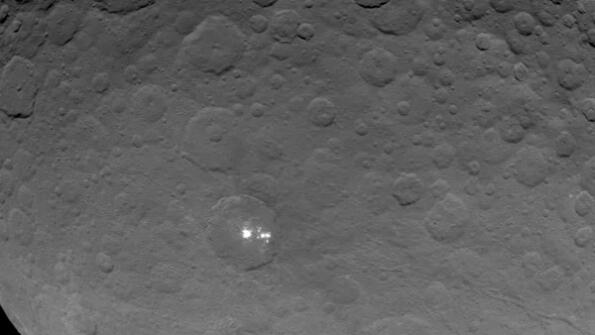
NASA's Dawn mission spacecraft is maneuvering for a closer look at puzzling bright features on the cratered surface of the large main belt asteroid Ceres in early June.
Images gathered May 16 with cameras from an altitude of 4,500 miles have again prompted speculation the spacecraft has spotted ice deposits on the 600 mile wide minor planet.
"Dawn scientists can now conclude that the intense brightness of these spots is due to the reflection of sunlight by highly reflective material on the surface, possibly ice," UCLA's Christopher Russell, principal investigator for the U. S. led, multinational Dawn mission, stated recently.
However, that remains to be seen as Dawn descends to an orbital altitude of 2,700 miles by June 6 for the next in a series of closer looks.
Other explanations for the mysterious features range from geysers to salt.
Launched on Sept. 27, 2007, the $472 million Dawn mission began the orbital phase of its visit to Ceres on Mar. 6. By late this year, the spacecraft is to circle Ceres from just 230 miles altitude until the primary investigation concludes in mid-2016.
On its way to Ceres, Dawn orbited another large asteroid, Vesta, from 2011 to 2012.