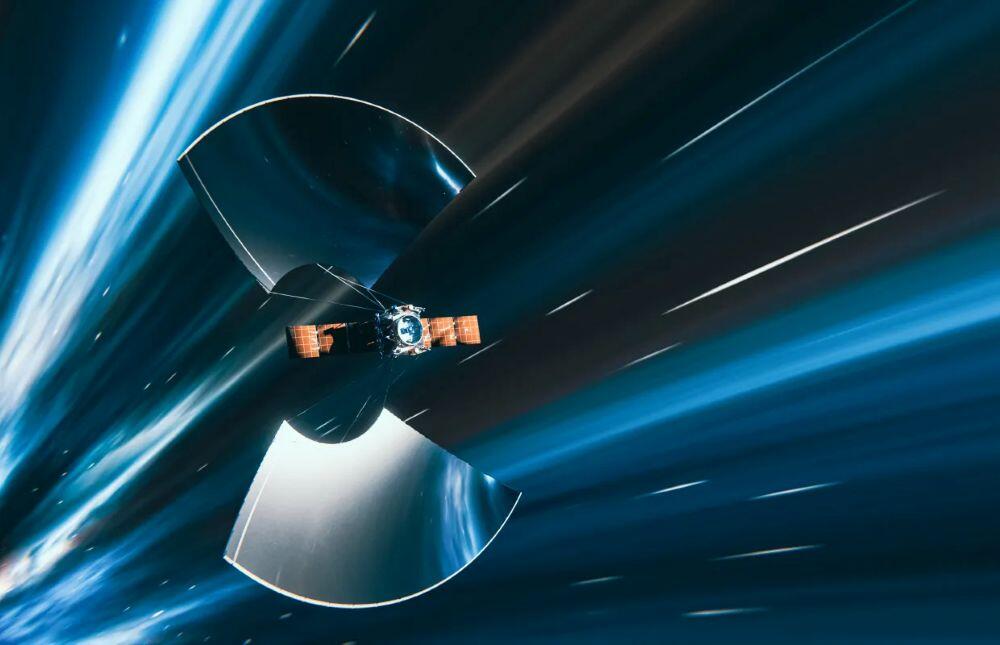
The mission will be the first test of the company's larger Supernova spacecraft.
Portal Space Systems has booked an entire SpaceX Falcon 9 launch in 2028 for its first Supernova, a thermal-propulsion-powered spacecraft.
The company partnered with Maverick Space Systems to sell off the surplus ESPA-class and cake-topper capacity on the medium-lift rocket to commercial rideshare customers, it said on Aug. 20.
Buying an entire rocket launch and then reselling the remaining capacity is a somewhat unusual tactic, but Portal Space Systems CEO Jeff Thornburg tells Aviation Week that it was done to control the launch timing.
“We knew the timeline our customers needed, and we weren’t going to ask them to wait until Portal had enough spacecraft to fill an entire rocket,” he says. “The choice was pretty straightforward: wait until we could fill the rocket ourselves or secure the launch now and find an intelligent way to use the remaining capacity.”
The Motus Via Sol mission will be the first for Supernova, a spacecraft that uses an array of mirrors to reflect sunlight onto a thermal battery to heat ammonia propellant that expands and is exhausted out of a nozzle.
Portal Space says the system generates up to 6 km/s of delta-v and can be used to maneuver quickly between orbits. It projects that in 3 hr. the spacecraft could move from low Earth orbit (LEO) to medium Earth orbit (MEO); in 17 hr. from MEO to geostationary Earth orbit; and in four days from LEO to cislunar space.
The customer and plans for the Motus Via Sol mission were not disclosed. Portal Space declined to comment but noted "our customers come to Portal because they need maneuverability."
Portal Space advertises its spacecraft as useful for a variety of missions that need maneuverability, including in-orbit servicing, national security space domain awareness, and low-cost lunar insertion for scientific applications, among others.
The company has also manifested a smaller spacecraft, the Starburst-1, on SpaceX’s Bandwagon-5 rideshare mission for October 2026.
“Rather than optimizing for long-distance transfers, [Starburst is] designed to maneuver repeatedly within an orbital regime, making it ideal for dynamic missions like inspection, rendezvous and proximity operations, and responsive retasking,” Thornburg says.
In April, Portal Space announced that it had raised a $50 million Series A funding round.

Related Content