This article is published in Aviation Week & Space Technology and is free to read until Oct 31, 2026. If you want to read more articles from this publication, please click the link to subscribe.
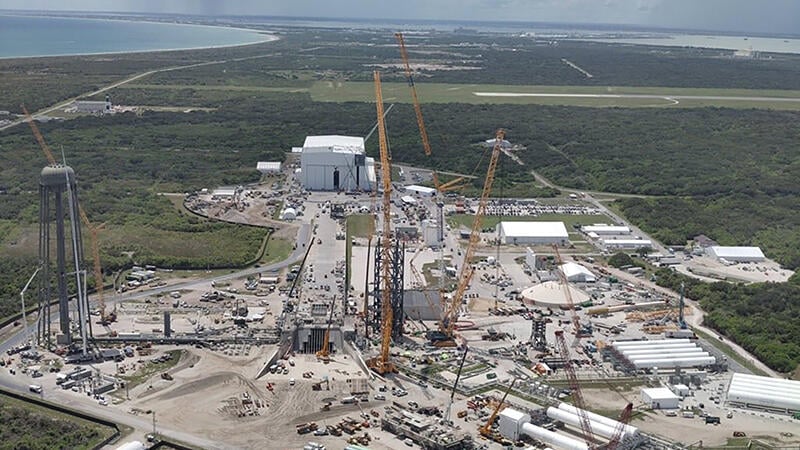
Blue Origin is rebuilding the launchpad after a test mishap and aims to fly the New Glenn again by year-end.
As launch customers scramble to secure flight options for their payloads, rocket-makers say the business is changing for the long term.
“Over the last few years, launch has been a race to the bottom in terms of price per kilogram, and I think that assumption—that that is how this model and market is going to work—is breaking right now,” Michael Creech, Firefly’s vice president for strategy and business development, said at World Satellite Business Week (WSBW) in Paris in mid-September.
More companies agree that the industry is hitting a turning point. “Price per kilogram has been a useful metric in the past, but I don’t really think that’s what our customers are telling us,” said Jordan Charles, Blue Origin’s senior vice president for New Glenn. Issues such as schedule dependability are gaining in importance, he added.
- The end of the Falcon 9 would be “very undesirable,” Space Norway executive says
- Isar Aerospace secures more launches fresh off first orbital mission
Northrop Grumman, which has teamed with Firefly on development of the Eclipse launch vehicle, echoed the sentiment. “I think the industry market is going to be resetting, recalibrating here over the next six months to two years,” said Nicole Jordan, Northrop’s head of strategy and business development for launch vehicles. The key is to ensure industry does not return to another race to the bottom, she said.
Launch customers are looking at the next few years with some anxiety. While new entrants are arriving on the market, mission setbacks have delayed or sidelined several systems. Satellite operators are growing concerned that SpaceX might sunset the Falcon 9, adding to a global launcher shortage.
While SpaceX has not said what the future holds for the backbone of global launch, Eva Birgitte Bisgaard, president of Eutelsat’s connectivity business, said there are rumblings that the rocket could be going away. That is driving the need for alternative suppliers, including in Europe, she said.
“It would be very undesirable,” Space Norway Satcom CEO Peter Olsen said.
SpaceX has multiple Falcon 9 launch agreements on contract, including for the Pentagon, that stretch out several years, but it is not clear how many new commercial customers this would support. The company has stopped offering new ride-share opportunities as it works to phase in the Starship launch system. The Starship promises a much lower price per kilogram to orbit than even the Falcon 9, but potential customers are uncertain whether SpaceX will use the capacity solely or even mostly for its own needs.
Given the demand picture, other launch service providers are looking to ramp up. “It’s very much a seller’s market right now from a launch perspective,” Charles said.
Blue Origin is making progress in rebuilding infrastructure destroyed or damaged when a New Glenn rocket blew up on the launchpad during engine tests in May. The company is looking to return not only to flight this year but “to flight at rate,” he said. “Our factories have not stopped,” Charles noted. “We’re pumping out second stages on a very rapid cadence right now. We’re actively building our seventh first-stage booster.”
Blue Origin also has continued to work on the next version of the launcher, the heavy-lift New Glenn 9x4, whose name indicates the number of engines on each stage. “We are actively producing the first articles,” Charles said. “Our goal for 9x4 is to be operating north of 100 launches a year.”
Meanwhile, Firefly plans two more flights of its Alpha rocket this year as it targets 12 launches annually. “We’re going to rapidly grow beyond that in the coming years,” Creech said.
Mitsubishi Heavy Industries (MHI), which suffered a launch setback in December with its H3 rocket, flew again in June and August. The company plans to boost the cadence of missions even beyond earlier plans given institutional and commercial demand, MHI Launch Services Director Kazuya Yufu said.
The maximum annual flight rate at one point was six missions per year, but MHI is ramping up to seven missions and aiming to go to eight, Yufu said. The company just signed launch service agreements with iQPS and ElevationSpace as ride-share opportunities, he noted.
Arianespace said talks at WSBW, following agreements in September for roughly 10 Ariane 6 launches, added impetus to take its flight cadence beyond 10 flights per year.
Demand for flights is so hot that Isar Aerospace has been able to secure orders for five dedicated launches from Seops Space on the heels of its inaugural orbital mission. Isar said rockets for flights No. 3 through No. 7 are in production, and it is almost sold out for launch slots in 2028.
Seops late last year placed its first order for Spectrum to support the company’s Waymaker ride-share program. The additional flights also are part of Waymaker.
Other new rocket systems are coming online, too. Rocket Lab plans to fly its reusable Neutron next year. European newcomers Rocket Factory Augsburg, MaiaSpace and PLD Space are among those aiming to launch before the end of next year. Several options are in development in Asia as well, including India’s Skyroot, which nailed its first orbital launch attempt in July.
Despite the potential for a surfeit of service providers, rocket companies remain upbeat that pricing will hold up and that other factors will come into play to allow multiple companies to survive. “For many countries, it becomes a matter of sovereignty, sometimes also of pride, to have their own rocket and to try to build and protect the market,” Arianespace CEO David Cavaillolès said.
“I think one assumption that’s going to prove wrong is that there’s only room for a few players in our industry,” Charles said. “We as an industry have to rethink how we fly” because launch demand will be so high, he contended. “We have to evolve how we launch rockets to be more like how we operate commercial airplanes out of airports.”

Related Content