This article is published in Aviation Week & Space Technology and is free to read until Sep 12, 2026. If you want to read more articles from this publication, please click the link to subscribe.
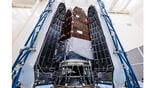
Array Labs’ space-based AMTI concept uses satellites as a distributed radar sensor.
Once the realm of theory, development and operation of space-based radar constellations as potential counters to stealth aircraft is drawing interest from more countries.
Japan’s Mitsubishi Electric signed a strategic partnership in July with U.S.-based startup Array Labs to develop satellite-based airborne-moving-target-indicator technology (AMTI) to sell to countries in the Asia-Pacific region.
The team is most immediately targeting requirements for the Japan Self-Defense Forces, Array Labs CEO and cofounder Andrew Peterson tells Aviation Week, declining to name a specific program.
- Array Labs aims for 90% solution to cut costs and speed development
- China has shown interest in the concept
“[Mitsubishi Electric] has all of the connections and all of the relationships inside the Japanese ecosystem and also internationally in the greater Pacific region,” he says.
Mitsubishi Electric is a major supplier of radars, air defense systems and missiles to Japan’s military. For example, the company manufactured the Japan Air Self-Defense Forces’ ground-based J/FPS-3 warning-and-control radar and the J/APG-2 radar for the Mitsubishi F-2 fighter.
A sufficiently large space-based AMTI constellation could help Tokyo track adversary aircraft—including from China, North Korea or Russia—across wide swaths of the Pacific Ocean.
Through Array Labs, Mitsubishi Electric gains access to a new technological approach. The company’s space-based AMTI concept uses radar satellites flying in a cluster in low Earth orbit as a distributed sensor to spot, track and classify aircraft.
The startup aims to keep the costs of its satellites relatively low by using ruggedized commercial off-the-shelf electronics instead of more expensive space-qualified components, Peterson says.
Array Labs also forgoes some of the fancier features of new phased-array architectures such as the typical phase shifter used for electronic beam steering, Peterson said in a previous interview. Instead, the flat-panel satellites use a modified phased-array radar that points its beams straight and uses reaction wheels to rotate the entire spacecraft physically.
That design allows the company to put a larger number of small power amplifiers across the radar panel, increasing thermal and power efficiency as well as peak power without the cost of a conventional phased array, Peterson has said.
The company is aiming for a 90% solution, a pragmatic architecture that trades perfection for faster design iteration and lower costs, he says. “They’re not crammed full of additional features that could be useful in certain circumstances,” Peterson says.
Array Labs’ radar technology is dual-use—it is also intended for space-based 3D-mapping of Earth’s terrain and infrastructure for commercial customers.
The company plans to launch multiple satellites in stages in 2027 and 2028 to demonstrate its space-based radar concept.
Space-based AMTI is a priority of the U.S. Defense Department. The ability to look down from orbit might help negate the stealth aspects of adversary aircraft and could also allow the Pentagon to watch a much wider swath of Earth. China has shown interest in the technology as well.
Array Labs says it has research and development contracts with DARPA and the U.S. Air Force and Navy.
The U.S. Space Force awarded SpaceX a $4.16 billion contract in May to establish an initial space-based AMTI constellation by 2028. The service also recently awarded initial contracts to eight other companies to join a vendor pool competing for future space-based AMTI work: L3-Harris Technologies, Lockheed Martin, Northrop Grumman, Rocket Lab, Systems and Technology Research (STR), Visto 360 AI, Wildstar and York Space Systems. The Space Force said on Aug. 4 it had awarded $615 million in AMTI contracts to Rocket Lab, STR and another business among those eight companies that it would not identify, citing operational security reasons.
Although there is talk in the U.S. military of replacing AMTI aircraft, such as the Boeing E-3 Sentry airborne warning and control system, Peterson expects the two types of platforms will work together, at least in the near term.
“I don’t think that all of the functionality that those aircraft provide will be provided from space in terms of their connectivity and their ability to assess what’s going on in real time,” he says.
Beyond AMTI, Peterson says the company’s satellites can be used for both ground and maritime moving target indication.
Array Labs’ strategic partnership with Mitsubishi Electric is part of a $21 million funding round “anchored by” the Japanese company, with additional funds from prior investors Catapult Ventures, Kompas VC and Y Combinator, the company says.
Array Labs is not in active conversations with other militaries in the region, but potential customers include Australia, India, New Zealand, the Philippines and Taiwan, Peterson says.