This article is published in Aerospace Daily & Defense Report part of Aviation Week Intelligence Network (AWIN), and is complimentary through Apr 28, 2026. For information on becoming an AWIN Member to access more content like this, click here.

USSF Fiscal 2027 Request Reveals Space Development Agency Shift

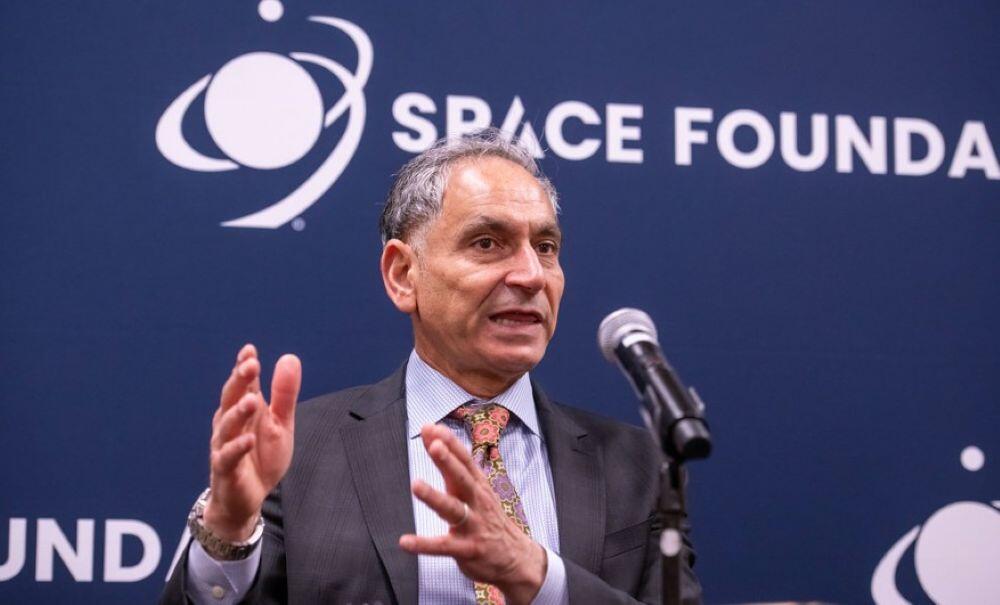
Acting Space Development Agency Director GP Sandhoo speaks to reporters April 15, 2026, at the Space Foundation’s annual Space Symposium in Colorado Springs. Credit: Space Foundation

Acting Space Development Agency Director GP Sandhoo speaks to reporters April 15 at the Space Foundation’s annual Space Symposium in Colorado Springs.

Credit: Space Foundation

One of the U.S. Space Force’s main acquisition offices could soon undergo a significant revamp, as one of its key mission areas may be absorbed into a larger service program and its acting leader could take on a new role.

The Space Development Agency (SDA) was first established in March 2019 to tackle two critical mission areas for the U.S. military under one proliferated satellite constellation in low Earth orbit (LEO): global data connectivity and new missile warning and tracking assets.

Now, the Space Force plans to absorb the Agency’s future work on the Transport Layer—a network of small satellites providing low-latency data communications—into a new program of record known as the Space Data Network (SDN). The service’s fiscal 2027 budget request, released April 3, includes $1.6 billion for the SDN to be funded via reconciliation, U.S. Air Force Deputy Assistant Secretary for Budget Maj. Gen. Frank Verdugo said in an April 21 media briefing.

The SDA is developing the Transport Layer and the missile warning/tracking-focused Tracking Layer via a spiral development model in batches it calls Tranches. While the Transport Layer Tranches 0, 1 and 2 have been funded and are in various stages of development, launch and operation, the Space Force is not including funding for the next phase, Tranche 3, in its 2027 budget request. The requirements that were being developed for Tranche 3 could instead be rolled into the SDN program, an Air Force spokesperson said during the department briefing.

The SDN has been described as a resilient data communications backbone that will notably support the Golden Dome for America layered missile defense architecture. Gen. Michael Guetlein, who leads Golden Dome development, named it as one of three key space programs that collectively received $10 billion in additional Golden Dome funding at the McAleese Defense Programs Conference on March 17.

The shift from the Transport Layer to the Space Data Network comes as the SDA has faced pushback for unsteady operations of its demonstration Transport Layer satellites—launched in 2023 under Tranche 0—and delayed launches for its Tranche 1 spacecraft, intended to be the first operational vehicles. The Agency launched 42 of 154 planned Tranche 1 Transport Layer satellites over two missions last September and October, then paused any further launches until at least May to focus on on-orbit performance, Acting Director GP Sandhoo said in March at the annual SATShow in Washington.

Establishing the mesh network for Tranche 1 has been a challenge, Sandhoo said at the March conference. Meanwhile, about 200 additional Transport Layer satellites are in development for Tranche 2 across four separate vendors, with launches due to begin in 2027.

The future of the Transport Layer has been in limbo for nearly one year, since members of Congress expressed concern that it would be passed over in favor of a joint Space Force-National Reconnaissance Office program known as Milnet. Verdugo described the SDN as “previously Milnet” in the budget briefing.

Speaking with reporters April 15 at the Space Foundation’s annual Space Symposium in Colorado Springs, Sandhoo said the SDN had “grown in scope” to include the Transport Layer, and to support a broader architecture than merely the SDA’s proliferated satellite constellation.

“When you see the term Space Data Network five years from now, that will include everything we’re doing on the Transport Layer at SDA,” he said.

Now in its seventh year, the Agency itself could be realigned within the larger Space Force acquisition structure, even as its programs continue under different organizations. Sandhoo is expected to be named as the new Portfolio Acquisition Executive (PAE) for missile warning and tracking, Space Systems Command Commander Lt. Gen. Philip Garrant told reporters April 15 at Space Symposium. That new entity would then manage the development of the Tracking Layer’s LEO-based constellation as well as other missile warning networks in higher Earth orbits.

Sandhoo endorsed the merging when speaking with reporters. “The whole mission comes to belong to a single PAE, and they are responsible for delivering that capability across all the orbital regimes,” he said.

Service officials cautioned that reorganization plans remain in flux, but made clear that a reshuffling of the SDA is in the works. “What that ends up looking like is TBD,” Sandhoo said.

Air Force Secretary Troy Meink told reporters the Department would like to maintain the rapid acquisition processes that the SDA and other similar organizations have normalized since their stand-up.

“What we want to do is get the same benefits, like the [Space Rapid Capabilities Office] and SDA, he said. “How do we just normalize that?”

Vivienne Machi

Vivienne Machi is the military space editor for Aviation Week based in Los Angeles.