This article is published in Aerospace Daily & Defense Report part of Aviation Week Intelligence Network (AWIN), and is complimentary through Sep 13, 2026. For information on becoming an AWIN Member to access more content like this, click here.
U.S. Space Command Commander Gen. Stephen Whiting gives a keynote speech Aug. 12 at the Space and Missile Defense Symposium in Huntsville, Ala.
With China rapidly maturing its space arsenal, the chief of U.S. Space Command (Spacecom) continues to call for the U.S. Space Force to invest in on-orbit offensive and defense capabilities.
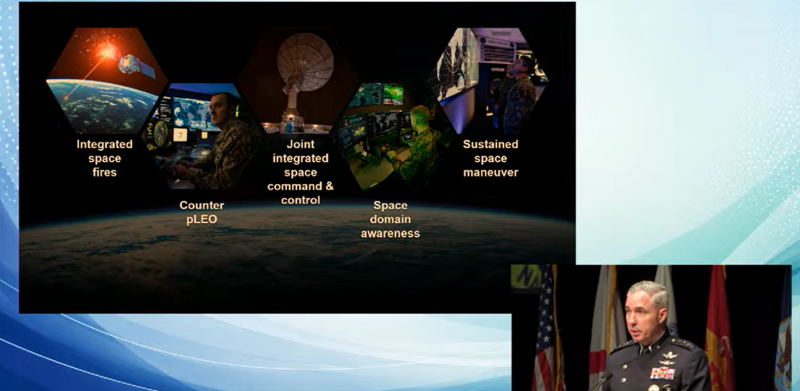
“Integrated space fires,” the service’s shorthand for coordinated kinetic and non-kinetic actions against adversary systems, tops Spacecom Commander Gen. Stephen Whiting’s wish list for the next five years, he said in his final keynote as command chief at the annual Space and Missile Defense Symposium in Huntsville, Alabama.
Whiting described Spacecom’s fiscal ‘29-33 integrated priority list as a “clear demand signal” describing the warfighting capabilities required to meet the command’s mission. Rounding out his top five greatest needs are counterspace proliferated low-Earth-orbit (p-LEO) systems; enhanced machine-to-machine connectivity for space battle management and more rapid decision-making; “dedicated” space domain awareness capabilities to protect orbital assets and support the space fire mission; and sustained space maneuvering.
Spacecom’s integrated priority list has consistently included some version of many of these capabilities for the past three years, particularly space fires, on-orbit maneuvering and command-and-control capabilities for battle management. But the need for such systems has grown more urgent as China is quickly improving its space capabilities, to include counterspace weapons, targeting, proliferated systems and on-orbit mobility, Whiting said.
“The ongoing greatest challenge [to the U.S. space mission] is just the speed at which China is moving to rapidly improve their space capabilities, and the threat that that potentially poses,” he said.
The command continues to build up a presence at the U.S. Army’s Redstone Arsenal in Huntsville, with 113 personnel currently working at the new headquarters, Whiting shared in his keynote. He expects 200 personnel to be in place by the end of 2026, with the full command transitioned over by 2032.