This article is published in Aviation Week & Space Technology and is free to read until Mar 07, 2026. If you want to read more articles from this publication, please click the link to subscribe.

Europe Seeks Unity of Purpose As Space Projects Mushroom

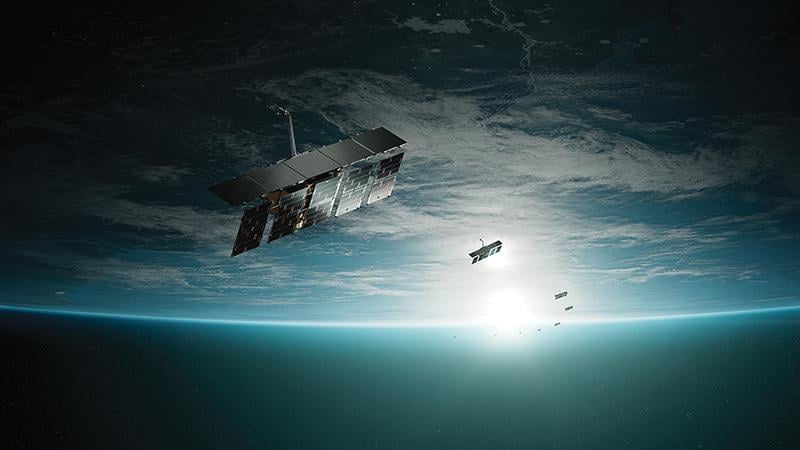
concept art of satellites over Earth

Iceye is promoting the idea of Europe deploying a 1,000-multisensor-satellite constellation.

Credit: Iceye

Europe has a new space challenge on its hands: keeping a multitude of military initiatives working in tandem.

The latest joke among European space officials is that they have gone from having too little money but plenty of time to having plenty of money but not enough time—all because of the threat from Russia and concerns about the U.S. Now there is a new twist: Europe may have gone from too few programs to too many.

Germany, for instance, plans to deploy a low-Earth-orbit (LEO) military constellation of over 100 satellites, even as the European Union works on the roughly 300-satellite, secure multi-orbit IRIS² system. Other countries across the region are buying spy satellites while the EU prepares its Earth Observation Governmental Service (EOGS) system. Underpinning the moves is a desire by states to wean themselves off dependence on the U.S.

  • A virtual space command could be coming soon to Europe
  • EU seeks faster IRIS2 deployment

“From one side, it’s good,” European Defense and Space Commissioner Andrius Kubilius said. “We individually are becoming stronger in space. But on the other hand, we risk also becoming more fragmented.”

These systems need to be able to work together from the get-go, he urged during his opening address at the annual European Space Conference on Jan. 26 in Brussels. He had a blunt message for the audience in the EU’s capital: “No single member state is stronger than Russia. If you protect only your own country, your own army, we shall not learn to fight as Europe. We will not deter Putin.”

Others echoed that message. “Despite intense geopolitical and economic pressure, Europe does not always act together through unified programs,” European Space Agency (ESA) Director General Josef Aschbacher told the gathering on Jan. 27. “Too often, we do the opposite, fragmenting and renationalizing our efforts. This weakens us.”

The leader of Germany’s Space Command, Maj. Gen. Michael Traut, said the country’s national LEO broadband constellation would be interoperable with the EU’s. “This increases our deterrent value,” he noted, because if one system is attacked, partners can help backfill capacity.

To help ensure that happens, the EU is planning the European Space Shield. That is one of the flagship initiatives Brussels unveiled in late 2025 to ensure harmonization between member states and the EU in certain defense and space programs. The plan, due in the spring, would cover secure and more resilient position, navigation and timing; communications; Earth observation; space surveillance; detection of radio-frequency interference and other activities.

“National sensors alone are insufficient,” Italian Air Force Chief Lt. Gen. Antonio Conserva said. “We need a federated European sensor network capable of eliminating blind spots.” He called space “one of the most advanced laboratories for the ambition of common European defense.”

Kubilius said he would like Europe to establish a virtual space command, where member states can mobilize and coordinate efforts during a crisis or conflict.

Data sharing can be a problem because of security considerations, which is why Germany is pushing a European initiative to allow the classified exchange of satellite imagery among all EU member states, German Defense Ministry State Secretary Jens Plötner said at the gathering. “Pooling and sharing must be our guiding principle,” he said.

The deliberations are unfolding as Europe works to finalize plans for two of the big programs at the heart of the coordination effort: the IRIS² system and the EOGS. The EU hopes to conclude a go/no-go review in April on the IRIS² project, including a move to accelerate the effort.

“I have asked all partners to step up and speed up on IRIS², and I’m confident we can deploy initial services by 2029,” Kubilius said.

To keep to the accelerated timeline, program officials are looking to field an initial batch of satellites that address some IRIS² requirements in 2029 and field the final standard around 2031, said Jérémie Godet, the European Commission’s head of secure connectivity.

The EU is deploying its effort to achieve secure, autonomous space capabilities through multiple steps. The first major milestone occurred in late January, when the Govsatcom program came online. Member states pool services over eight satellites from five countries through Govsatcom. Ukraine may be given access to the capacity, Kubilius said. That service should expand next year with added commercial capacity, he said, before the dedicated satellites come online.

The EU also plans to finalize requirements for the EOGS in the next few months. The requirements document will take another 2-3 months to finalize, said Mauro Facchini, head of Earth observation programs with the European Commission, noting that they are awaiting input from the European Defense Agency on member state needs. EU members late last year asked the commission to seek that input before finalizing the specifications.

The European Commission hopes to have the first elements of the EOGS program ready in 2028, leveraging systems or service contracts provided by member states. The first dedicated satellites are expected to come online in 2030 or slightly later. The goal is to field a secure, autonomous system with higher resolution and revisit rates than current European Earth observation systems.

To speed up the program, Europe is developing invitations for industry to help develop the project. ESA will serve as the program architect through its European Resilience from Space-Earth Observation program. The studies, due to be launched soon, follow those conducted by OHB and Telespazio, which were awarded in 2024 and concluded late last year.

The agency secured €167 million ($200 million) for the program during last year’s ministerial meeting and is hoping to boost that to around €350 million by keeping the government subscription window open until November, longer than usual. ESA has been working with draft requirements to develop program plans, said Simonetta Cheli, the agency’s director of Earth observation. An invitation to tender for the architecture study is due to be issued in late February; contracts would be due before June.

A second effort will simulate the optimal data distribution approach, Cheli said. The bidding documents for that effort are also due in late February. Another round of invitations to tender will go out to support about four in-orbit demonstration/validation activities.

Cheli said those have not been finalized but are likely to look at issues such as electro-optical imaging in low light conditions, multi-imaging on a single pass and data downloading.

European radar satellite provider Iceye used the forum to unveil its Constellation Europe concept. The proposed 1,000-spacecraft system would comprise synthetic aperture radar, electro-optical spacecraft and signals intelligence satellites, with a communications layer connecting the assets and other features, CEO Rafal Modrzewski told reporters.

“Creating an independent, sovereign European intelligence capability is the right starting place for us to ensure that we have the means to know what’s happening around us,” Modrzewski said, citing recent political developments, including around Greenland, as shaping his thinking.

The system could come online in 2028 and deliver world-leading service in 2030, he said.

Although Europe’s willingness to invest in space has increased dramatically over the past two years, Aschbacher noted that the region still risks falling behind. “To keep pace with international competitors, Europe must step up its efforts,” he said.

The U.S. spends six times more than all European actors combined, and China outspends Europe by 50%, Aschbacher said. Europe’s global share declined 50% in relative terms in 2019-24, he added.

Aschbacher celebrated that ESA has recently secured a record €22.1 billion in funding for 2026-28. “We are moving in the right direction, but others are moving just as fast, if not faster,” he added.

Robert Wall

Robert Wall is Executive Editor for Defense and Space. Based in London, he directs a team of military and space journalists across the U.S., Europe and Asia-Pacific.