This article is published in Aerospace Daily & Defense Report part of Aviation Week Intelligence Network (AWIN), and is complimentary through May 21, 2026. For information on becoming an AWIN Member to access more content like this, click here.

ESA Advances Laser Comms Demonstration With Kepler Contract

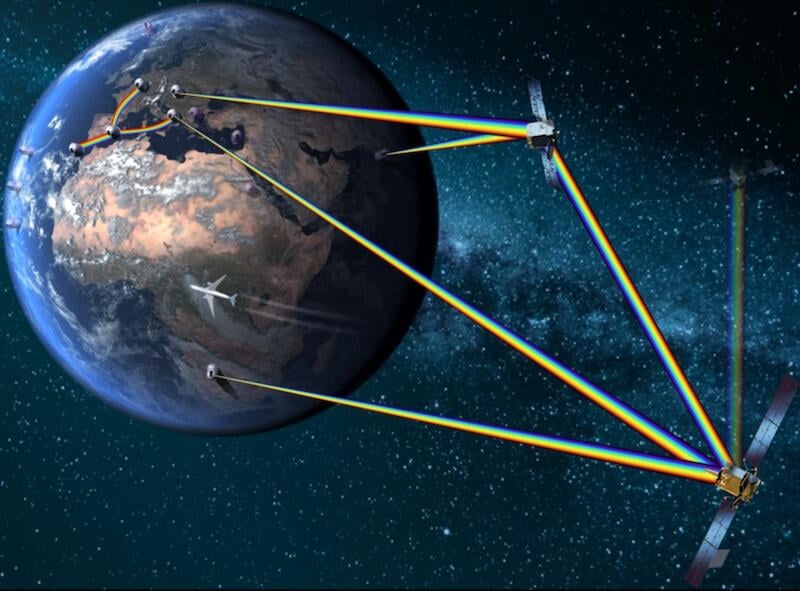
satellite comms illustration
Credit: European Space Agency

The European Space Agency (ESA) is moving forward on a program to advance space-based laser communications across multiple orbital planes with a contract to Kepler Communications.

Under the €18.5 million ($21.8 million) contract, Kepler will provide a satellite to host payloads from several European vendors and expand on the work ESA has previously undertaken with the Canadian space company under the High Throughput Optical Network (HydRON) program.

ESA bills the HydRON program as an effort to extend terrestrial fiber-optic communication networks to space, with the goal of integrating space-based laser links seamlessly into ground-based systems.

“HydRON will serve as the world’s first multi-orbital optical communications network with a terabit per second capacity, offering resilient and efficient data transfer to address the challenges of bringing connectivity to multiple users securely, quickly and reliably,” ESA’s head of Resilience, Navigation and Connectivity, Laurent Jaffart, said in a statement.

The program is structured into multiple parts, starting with creating a network of low-Earth-orbit (LEO) spacecraft able to pass data via optical links, with the second element bringing in ground-infrastructure communications and connectivity to spacecraft in higher orbits. Kepler leads the 10-satellite HydRON Demonstration System element, with Thales Alenia Space in charge of the LEO satellite collector to link to spacecraft in higher orbits or connect with ground infrastructure.

Now, ESA is moving forward on bringing different industry players into the mix. Kepler satellites are due to host a space situational awareness payload from Germany’s Vyoma, to monitor objects in orbit and help track satellites and debris. Several vendors—TESAT, MBRYONICS and Astrolight—are due to provide optical communication hardware, ESA said. The use of different link vendors is designed to demonstrate interoperability.

“With HydRON Element 3 and further HydRON evolutions, ESA will respond to the needs of its member states for high speed and secure communications across air, High-Altitude Pseudo-Satellite, maritime and—in the longer term—deep space communications,” says Harald Hauschildt, ESA’s head of the Optical and Quantum Communication office.

Robert Wall

Robert Wall is Executive Editor for Defense and Space. Based in London, he directs a team of military and space journalists across the U.S., Europe and Asia-Pacific.