This article is published in Aerospace Daily & Defense Report part of Aviation Week Intelligence Network (AWIN), and is complimentary through Mar 14, 2026. For information on becoming an AWIN Member to access more content like this, click here.
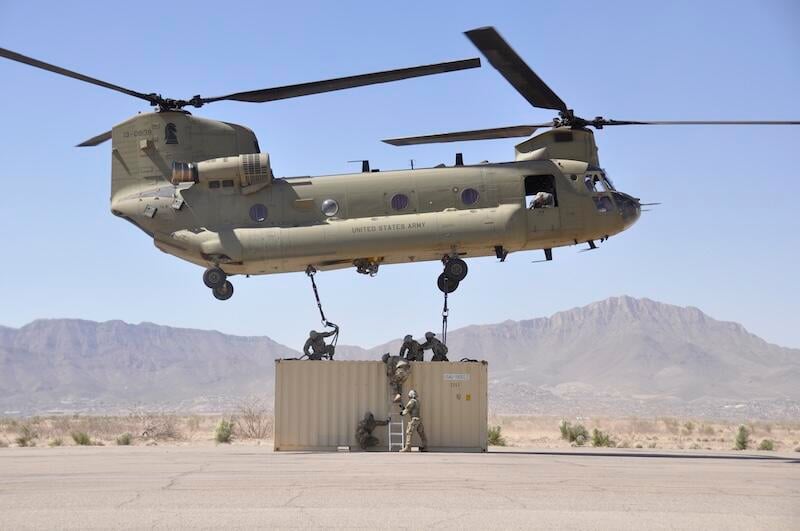
Soldiers assigned to Headquarters and Headquarters Company, Special Troops Battalion, 1st Armored Division Sustainment Brigade, attached a Conex box to a CH-47 Chinook during sling load training at Biggs Army Airfield, Fort Bliss, Texas, March 10, 2017.

AURORA, Colorado—For every other domain, the value of logistics is well-established. The newest service has spent the past few years fleshing out its own approach, an effort that is only growing in importance as the U.S. warns of a future conflict in space.
On Earth, warehouses play an indispensable role for supply chains. At the Air and Space Forces Association’s Air Warfare Symposium this week, logistics leaders were queried: Could the U.S. military someday use warehouses in space?
The U.S. and other nations want to build out their presence in cislunar orbits, and are competing to reach or, in the case of the U.S., return to the Moon. Traveling even further out to Mars, or deeper into the Solar System, could require long-term storage of fuel, food, building equipment and tools.
The Air Force Research Laboratory (AFRL) is also studying how to use rockets to deposit cargo around the globe, potentially replacing current airlift capabilities.
To date, AFRL has only handed out initial design and analysis contracts for its Rocket Cargo program. But U.S. military leaders have begun discussing options to get equipment into orbit, whether for in-space activities or to deposit on Earth at the opportune time.
When Maj. Gen. David Sanford led logistics, engineering and force protection at Air Mobility Command from 2022-24, the command discussed the viability of placing a 20-foot container that could hold equipment for future needs, he said on a Feb. 25 panel here.
The technology is getting there; “it’s just a matter of if we want to pursue it,” said Sanford, who now serves as the director of Logistics Operations and commander of Joint Regional Combat Support at the Defense Logistics Agency.
Two upcoming demonstrations for on-orbit mobility and refueling could help the U.S. military weigh the pros and cons of pre-positioning equipment in space, said Bradley Leonard, director of Installations, Logistics and Product Support at Space Systems Command (SSC). The command has partnered with commercial providers to test new refueling interfaces and maneuverable satellites to weigh the viability of in-space servicing capabilities for military purposes.
“At the end of the day, that provides combatant commands with options,” he said.
Gen. Dennis Bythewood, the commander of the Space Forces-Space, told reporters at the conference that he can visualize a scenario in which a space-based warehouse could relieve the strain on an increasingly constrained launch environment.
The punishing conditions of space could limit the types of equipment that could be staged on orbit, and the economics would still need to be fleshed out, he said. In fairness, he also noted that until today, he had not heard about the prospects of warehousing in space.
Space Force leaders have foot-stomped the need for more flexibility as the service stares down new threats on orbit and must protect ever-increasing numbers of deployed satellites. As on-orbit logistics advocates have highlighted the benefits of refueling satellites before the end of their service life or perform repairs, it is not difficult to see the benefits of having the repair kit on orbit already, rather than waiting for a launch window to send it up.