https://aviationweek.com/themes/custom/particle/dist/app-drupal/assets/AW_logo_horizontal_small_white.svg
Skip to main content
  • Market Sector
    • Aerospace
    • Air Transport
    • MRO
    • Defense
    • Space
    • Business Aviation
  • Markets
    • Aerospace
      • Aircraft & Propulsion
      • Connected Aerospace
      • Emerging Technologies
      • Manufacturing & Supply Chain
      • Advanced Air Mobility
      • Sustainability
    • Air Transport
      • Aircraft & Propulsion
      • Interiors & Connectivity
      • Airports & Networks
      • Airlines & Lessors
      • Safety, Ops & Regulation
      • Maintenance & Training
      • Sustainability
    • MRO
      • Aircraft & Propulsion
      • Interiors & Connectivity
      • Emerging Technologies
      • Supply Chain
      • Safety, Ops & Regulation
      • Workforce & Training
      • Sustainability
    • Defense
      • Aircraft & Propulsion
      • Sensors & Electronic Warfare
      • Missile Defense & Weapons
      • Supply Chain
      • Budget, Policy & Operations
      • Sustainability
    • Space
      • Launch Vehicles & Propulsion
      • Commercial Space
      • Space Exploration
      • Satellites
      • Budget, Policy & Regulation
      • Operations & Safety
    • Business Aviation
      • Aircraft & Propulsion
      • Interiors & Connectivity
      • Airports, FBOs & Suppliers
      • Flight Deck
      • Safety, Ops & Regulation
      • Maintenance & Training
      • Sustainability
    • In Focus
      • Middle East & Africa
  • Marketplace
  • Services
    • Services
      • Advertising
      • Marketing Services
      • Fleet, Data & APIs
      • Research & Consulting
      • Network and Route Planning
      • Marketplace
  • Store
    • Market Sector

      • Aerospace
      • Air Transport
      • MRO
      • Defense
      • Space
      • Business Aviation
    • Type View All Products
      • Intelligence Bundles
        • AWIN - Premium
        • AWIN - Aerospace and Defense
        • AWIN - Business Aviation
        • AWIN - Commercial Aviation
      • Market Briefings
        • Aerospace Daily & Defense Report
        • Aviation Daily
        • SpeedNews
        • The Weekly of Business Aviation
      • Directories
        • Air Charter Guide
        • Aviation Week Marketplace
        • Route Exchange
        • The Engine Yearbook
      • Data Services
        • AC-U-KWIK
        • Aircraft Bluebook
        • Airportdata.com
        • ASM Global Route Development
        • CAPA – Centre for Aviation
        • Catchment Analyzer
        • Defense Market Analyzer
        • Fleet Discovery Civil
        • Fleet Discovery Military
        • Fleet & MRO Forecast
        • MRO Prospector
        • Tracked Aircraft Utilization
      • Publications
        • African Aerospace
        • Air Transport World
        • Arabian Aerospace
        • Aviation Week & Space Technology
        • Aviation Week & Space Technology - Inside MRO
        • Business & Commercial Aviation
        • CAPA - Airline Leader
        • Routes magazine
  • Events
    • Recent webinars
    • Events View All Events
      • MRO
        • MRO Americas
        • MRO Asia
        • MRO Australasia
        • MRO Baltics & Eastern Europe Region
        • MRO Europe
        • MRO Greater China
        • MRO Latin America
        • MRO Middle East
        • MRO Southeast Asia
        • Military Aviation Logistics and Maintenance Symposium (MALMS)
      • Commercial Aviation/A&D
        • Aero-Engines Americas
        • Aero-Engines Europe
        • Aero-Engines Asia-Pacific
        • Engine Leasing Trading & Finance Europe
        • Engine Leasing, Trading & Finance Americas
      • Air Transport
        • Routes Americas
        • Routes Europe
        • Routes World
        • CAPA Airline Leader Summit - Airlines in Transition
        • CAPA Airline Leader Summit - Americas
        • CAPA Airline Leader Summit - Latin America & Caribbean
        • CAPA Airline Leader Summit - Australia Pacific
        • CAPA Airline Leader Summit - Asia & Sustainability Awards
        • CAPA Airline Leader Summit - World & Awards for Excellence
        • GAD Americas
        • GAD World
      • Aerospace and Defense
        • Defense Conference
      • Awards
        • Aviation Week 20 Twenties
        • Aviation Week Laureate Awards
        • ATW Airline Awards
        • Program Excellence Awards and Banquet
        • CAPA Asia Aviation Summit & Awards for Excellence
        • Space Tech Challenge Awards
  • About
    • About Aviation Week Network
      • Our Story
      • Content and Data Team
      • Aviation Week & Space Technology 100-Year
    • Contact Us
      • Subscriber Services
      • Advertising, Marketing Services & List Rentals
      • Content Sales
      • Events
      • PR & Communications
      • Content Licensing and Reprints
      • FAQ
  • Log In
  • Register
  • My Account
    • Profile
    • Sign Out
  • AWIN Access
  • My cart
    Back to
  1. Aerospace
  2. Program Management

Share

2016 Program Excellence Winners

Carole Rickard Hedden October 31, 2016

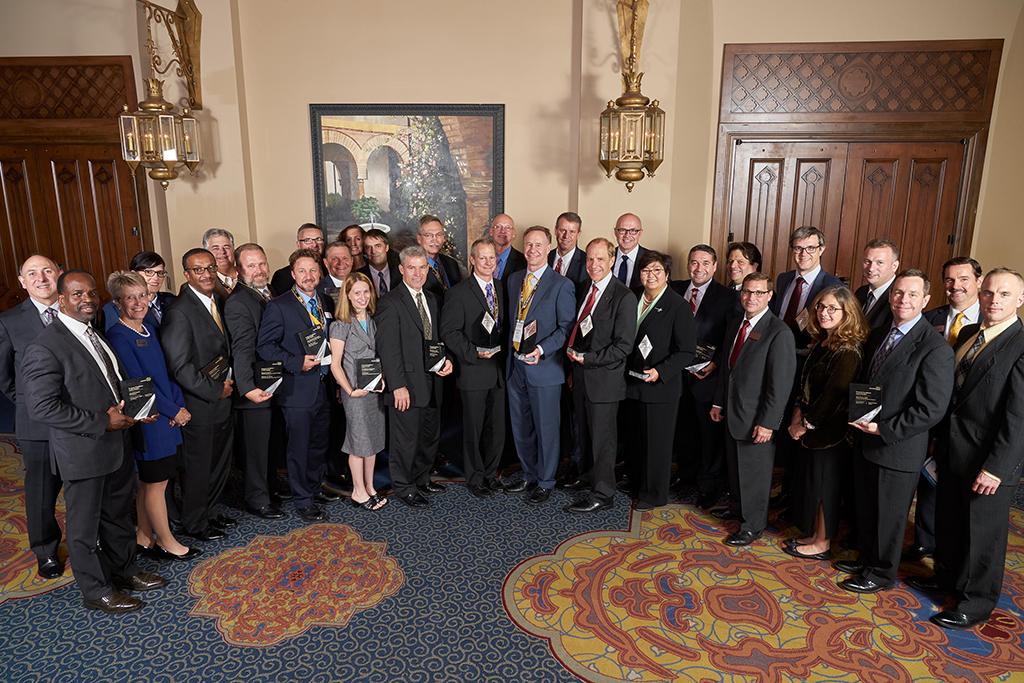
2016 Program Excellence Awards

Credit: Guy Mancuso Photography

Aviation Week’s 2016 Program Excellence winners, finalists and customers gathered for a group photo following the Oct. 26 banquet. The winners represent efforts across aerospace and defense, from cyber security and air traffic management to a telescope that will peer deeper into space than ever before.

Special Projects

Credit: Lockheed Martin

National Cyber Range

Program Leader: Patrick Lardieri, Chief Engineering/Lockheed Martin Fellow

The National Cyber Range helps Defense Department development programs understand and mitigate their system’s cyberattack surface in a broad system-of-systems operational environment, and helps cyberwarriors train to defend U.S. systems against adversaries with constantly changing tactics and technology. Among the unique aspects of this Special Project was a unique measure—“willingness”—which was the gauge for acceptance of help on a topic that affects every program but that isn’t usually fully understood as a program necessity.

Subsystems R&D/SDD

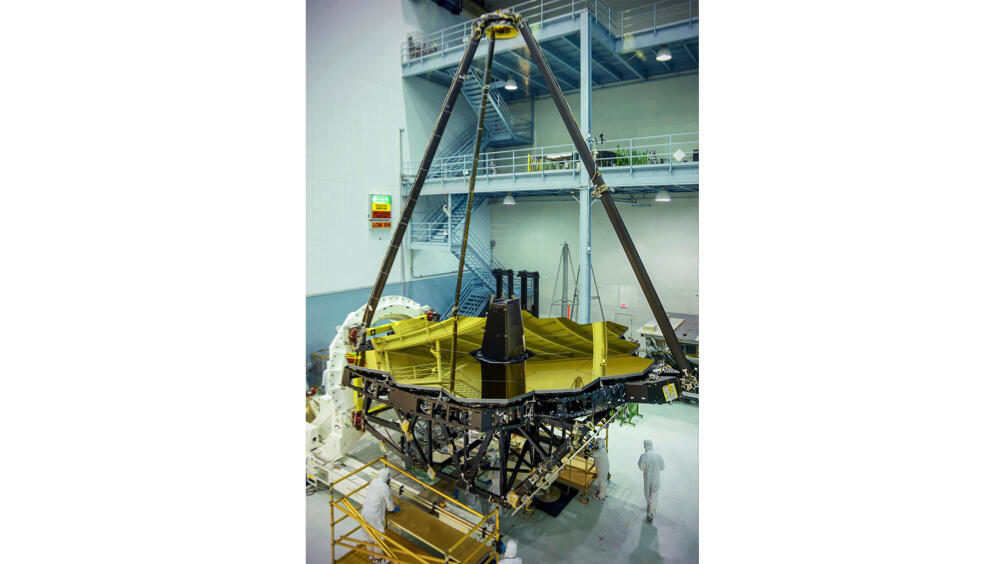
Credit: Northrop Grumman

James Webb Observatory Telescope Program

Program Leader: Scott C. Texter, Telescope Program Manager, Northrop Grumman

The Webb Telescope is intended to observe the birth and evolution of the first stars and galaxies, which came into existence after the Big Bang. In addition to developing this one-of-a-kind telescope, the team broke the cost/learning curve—the holy grail of program leadership. The telescope has, in effect, experienced an equivalent doubling of capability per unit cost, about every 4 years. Along the way to delivering to more than 13,000 requirements, the team refined best practices in supply chain teaming, handling and dispensing of risk, and putting into place predictive indicators to cover more than 50,000 logic-linked tasks.

Subsystem Level Production

Credit: Lockheed Martin

Mars Atmosphere and Volatile Evolution Mission (MAVEN)

Program Leader: Guy Beutelschies, MAVEN Program Manager, Lockheed Martin

Long ago, Mars had rivers, lakes, and oceans; today it is a barren desert, indicating the atmosphere was once much thicker than it is today. The Mars Atmosphere and Volatile Evolution (MAVEN) mission is designed to figure out what happened to the Martian atmosphere.  MAVEN represented an opportunity to demonstrate innovative management techniques for controlling costs. Planetary spacecraft are expected to meet all of their mission requirements, including the hard launch deadlines dictated by orbital mechanics. But to do so while under running budget by 8% is unprecedented. The team also worked to reduce complexity, while increasing the spacecraft’s flexibility in use.

Subsystem Level Sustainment

Credit: Lockheed Martin

Javelin Joint Venture (JJV) Life Cycle Contract Support Program  

Program Leaders: John Halvey, JJV President, Raytheon; and Richard Benton, JJV Vice President, Lockheed Martin

The program enabled successful missions in Southwest Asia, better than 99% mission reliability, and less than 2-day material availability while providing $45 million in savings over the past 2 years. The effort has a mix of both Firm-Fixed Price and Cost Plus Fixed Fee agreements. Modeling using real data from the previous contract versus directed Optempo and reliability failure projections allowed for extremely accurate supportability predictions—and improved overall performance.

System Level R&D/System Design and Development

Credit: Boeing

Boeing’s MH-47G New Build

Chuck Dabundo, Vice President of Cargo Helicopter Programs/H-47 Program Manager, Boeing Defense Space & Security

This team developed and delivered its first aircraft in less than 24 months—to the delight of the team’s Special Operations Command customer. The team transformed older CH-47 aircraft into new, long range, assault aircraft. Using a new airframe baseline developed for Canada, the program team designed a monolithic frame, reducing manufacturing time but also increasing the airframe’s strength and “tuning” that frame to reduce vibration. The close work between SOCOM, Boeing and suppliers allowed suppliers to plan more realistically, reducing time and cost. The engineering team used a new digital design approach to reduce errors and interference while improving first-time quality. This digital approach became part of the team’s DNA—modeling provided visual context, and enabled virtual reviews as the team moved forward.

System Level Production

Credit: Lockheed Martin

Mobile User Objective System Program

Program Leader: Iris Bombelyn, former MUOS program manager and current vice president of Protected Communications and Advanced EHF Programs, Lockheed Martin

This is the story of how a military space systems team dug deep into its commercial satellite roots, crafting a balanced approach to deliver on a fixed price commitment, achieving production efficiencies and extraordinary mission success. Lockheed Martin proceeded in advance of the contract options closure to acquire long-lead items at risk. This resulted in cost-per-hour savings, build over build, of 20-40% depending on the maturity/complexity of the part. Parts defects dropped 80% from first build to last. In addition, the satellite carries two payloads—one that is new-generation and a second that deals with legacy systems, providing an easy mode of transition. The team designed next-generation systems that took advantage of components, subsystems and spacecraft that were previously proven. Another philosophy was to provide opportunities for people to rotate within the program. Thus an engineer who started on the production floor could rotate into a systems engineering position on the program, and then support on-orbit mission test operations—creating a learning environment, but also keeping employees engaged with the mission. 

System Level Sustainment

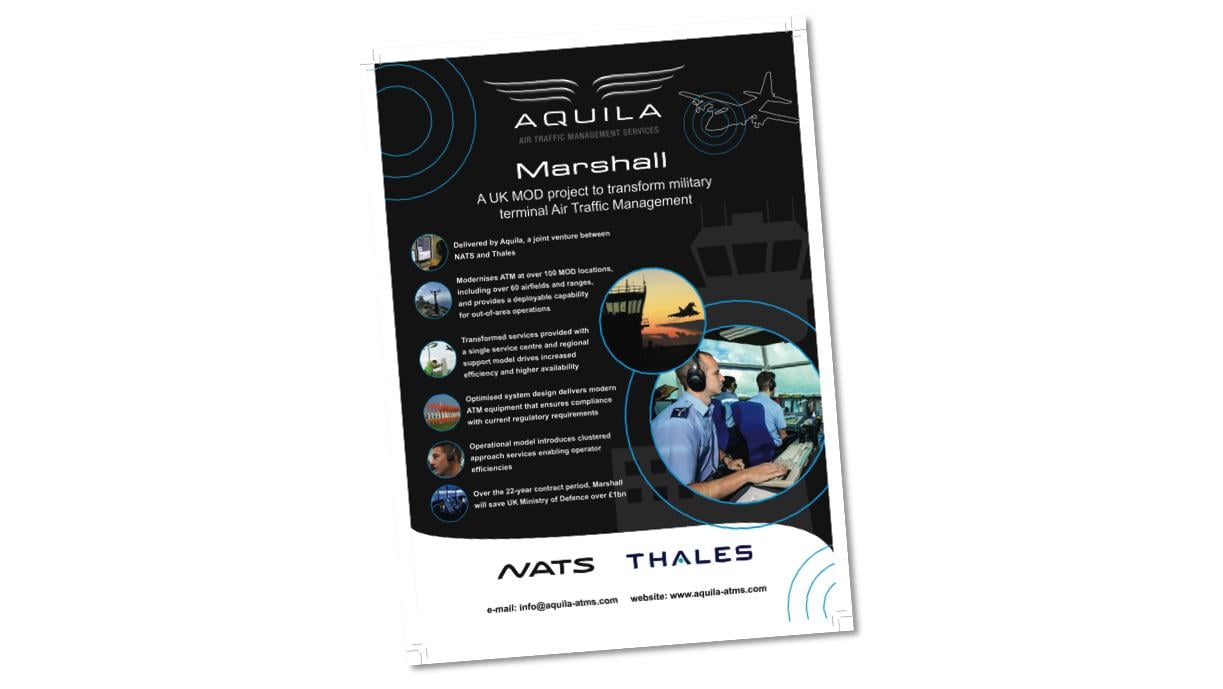
Credit: Aquila Air Traffic Management Services

Aquila Air Traffic Management Services’ Project Marshall/UK Defense Ministry 

Program Leader: Justin Barratt, managing director for Aquila Air Traffic Management Services

This program transformed terminal air traffic management for all UK Defense Ministry sites around the world to enable civil and military aircraft to operate safely in military terminal airspace with no loss of tactical freedom. Project Marshall combined 70 different projects into a single effort. The only requirement was output of flights handled, with no definition of the technology required included. With a combined effort from the Aquila program office, Thales and the UK’s National Air Traffic Systems, the team dramatically increased system availability and flight throughput, achieved required certification and has built in a process to continuously upgrade the operations. In all, Project Marshall has saved the British government £1 billion ($1.2 billion). 

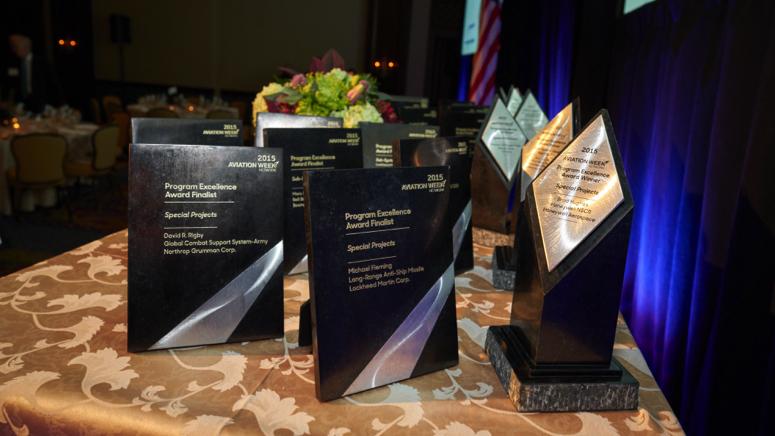
Group Trophies from 2015

Credit: AW&ST

Program Excellence Awards and plaques for finalists on display before the awards ceremony.

Previous
Next

In today’s aerospace and defense environment, achieving excellence is no easy task. Programs are more complex, their technologies more advanced, their customers ever-more demanding.

Whether it’s guarding the borders, managing air traffic, designing an all-new system or sustaining an aircraft that has flown for decades, program managers continue to push to higher levels of employee engagement, to learn from the experience of others, and to carefully look at data and trends to determine what might happen.

And it is in this cloudy area of what might happen that true program leaders identify unknown risks. Or they see a gap, a glimmer of opportunity to make a system work better, boost a team to improved efficiency, or innovate a process or technology that will keep the program relevant.

Carole Rickard Hedden

Carole Rickard Hedden was Executive Editor for custom content and Program Excellence for the Aviation Week Network, providing custom content and research to industry executives.

Aviation Week Intelligence Network
Monitor the market and connect your business to the people, programs and proprietary data driving the Aerospace & Defense market - only available with AWIN.

ASD_AWIN_thumbnail_270

Stay Connected.
Stay Informed
Grow Your Business.

Learn How

Follow us on

Markets

  • Aerospace
  • Air Transport
  • MRO
  • Defense
  • Space
  • Business Aviation

Products

  • AWIN Intelligence Bundles
  • Market Briefings
  • Publications
  • Data Services
  • Directories
  • Resources

Contact Us

  • Subscriber Services
  • Advertising, Marketing Services & List Rentals
  • Content Sales
  • Events
  • PR & Communications
  • Content Licensing and Reprints
  • FAQ

Other Resources

  • Aviation Week Marketplace
  • Knowledge Center
  • Newsletters
  • ShowNews
  • Advertising - Media Kits
  • Japanese 日本語
  • Korean 한국인
Copyright © 2026. All rights reserved. Informa Markets, a trading division of Informa PLC.
  • Accessibility
  • Privacy Policy
  • Cookie Policy
  • Terms of Use