This article is published in Aviation Week & Space Technology and is free to read until May 15, 2026. If you want to read more articles from this publication, please click the link to subscribe.

MRO Providers React To Gulf Conflict

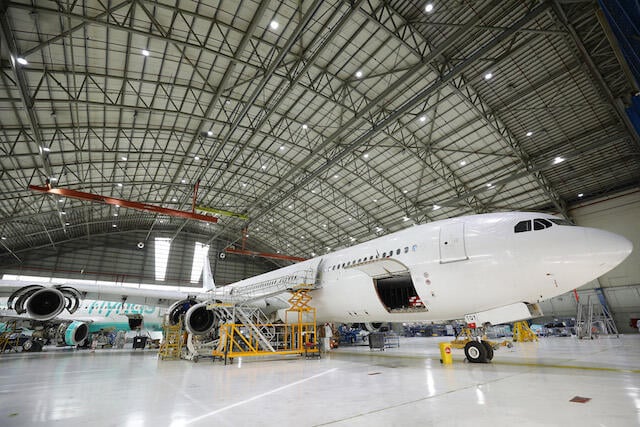
Joramco hangar

Safe harbour: Joramco’s base at Queen Alia International airport is outside the main areas of risk. 

Credit: Joramco

Observers say competitive advantage within the region had shifted toward providers that could guarantee certainty, access, and geopolitical resilience.

They cited Joramco (Amman), Turkish Technic (Istanbul), EgyptAir Maintenance and Engineering (Cairo), and AMAC (Istanbul and Bodrum) among potential beneficiaries in the short term and extending into the medium term as operators based in higher-risk geographies were forced to diversify.

In the longer term, deferred maintenance and risk-adjusted maintenance placement were expected to drive a significant bow-wave of demand for as long as operators and airlines were uncertain about the safety of their assets in other more directly affected parts of the region.

Less than a month after the start of hostilities, MRO providers outside the Gulf were reporting a return of operator confidence, which they attributed to the trust built up with their partners and their lower geographical risk exposure.

As reported by Aviation Week, an analysis published in mid-March by RBC Capital Markets concluded that while some short-term disruption to parts inventory and short-cycle MRO activity was to be expected, more widespread effects – increased retirements, for example – would require a protracted stand-off.

Moves by Gulf carriers to park some aircraft out of harm’s way – in Australia and Spain, for example – transferred some essential airworthiness maintenance away from regional MRO providers.

The general focus at MRO Middle East in early February, before the start of hostilities, was on managing the aftermarket’s capacity to keep fleets flying while operators waited for delivery of new aircraft. The abrupt change to that business-as-usual (BAU) scenario introduced a new risk, that a slowdown in demand for travel, if it persisted, could warrant taking out traffic capacity, resulting in lower MRO spend with deferred maintenance and more retirements.

Daniel Williams, Director of Fleet Data Services for AW Network, concurred. Line maintenance was immediately impacted with the cancellation of flights, as were “the cost and complexity” of spares logistics. Short-term, he says, checks on aircraft from third parties could be affected with operator reluctance to sending their aircraft into the region.

Williams suggested the “real worry” in the longer term was the impact of delays on the industry as a whole.

These thoughts were far from the minds of the senior executives taking part in the popular leaders’ panel discussion on the first day of the show. There, talk was about building capacity, adding new capabilities, key differentiators, and the seemingly unstoppable growth of the Middle East aerospace industry.

Ziad Al-Hazmi, Chief Executive of Lufthansa Technik Middle East (LHTME), says the region was seeing the growth of a complete aerospace ecosystem not unlike Toulouse, Seattle or Hamburg. “Most of the major players are now in the region,” he says. “The question used to be ‘Does it make sense to be in the Middle East?’ Now it’s ‘Why are you not here,’ because there are opportunities.”

Aviation Week’s 2026 Fleet & MRO Forecast placed the Middle East as the second fastest-growing MRO region globally, with demand projected to increase from $7.8bn in 2022 to $12.9bn by 2031.

Differentiation in such a market was key. Fraser Currie, Chief Strategy and Commercial Officer at DAE Engineering, the parent of Joramco, says it boiled down to planning and “delivering what you say you will, and being consistent. It’s quite boring.

“MROs are factories – sorry to bust the myth,” he says. “We have production lines and we produce aircraft. When we get something cutting in, like a component or spare part delay, it really mucks it up.

“We put a lot of focus not just on our readiness as an MRO, but on the customer’s readiness. Rarely you’ll find an MRO taking a customer with two-weeks’ notice; the last-minute shopper. I want long-term relationships, multiyear, multiline, and I want to get to know that customer and just be boringly consistent.”

Tej Mehta, Head of Strategy for Sanad, says the Abu Dhabi-based engine specialist is working to vertically integrate the MRO value chain by working with OEMs to do more repairs and develop its capabilities for line-replaceable units (LRUs). The vision, he says, “is to become a fully vertically integrated engine MRO which can do everything to do with an engine, and to cover pretty much every engine that flies.”

Mahesh Kumar, Chief Executive of Malaysia-based ADE Aero, which is planning to open a new station in Bahrain, says his company created its own marketplace for spares. What started as a way of disposing of excess inventory drew attention from airlines and MROs in Asia. “They asked to put their excess inventory in our marketplace,” he says. “The hidden benefit is a wider pool of spaces, which helped us a lot in terms of turnaround time.”

Panellists agreed that new technology, particularly artificial intelligence (AI) analysis tools, will have a big impact.

Al Hazmi says the region is something of a leader in the adoption of technology. Conversations at the show indicated that “people are coming from the outside to see what we’re doing with the tools” in what is essentially a fast-growing greenfield environment where players “can start adopting the latest technologies”.

“In this environment you can start taking new things and trying to implement them instead of trying to redo things that are already in place. I think that’s really exciting,” Al Hazmi says.

Elsewhere on the show floor, the French MRO and aircraft interiors industry returned with a national pavilion under the French Fab brand. “France’s global reputation in aerospace, paired with strong local integration, makes our companies ideal partners for the Middle East’s future-focused MRO landscape,” says Axel Baroux, Managing Director, Business France Middle East. “From maintenance and interiors to digitalization and logistics, this French delegation spans the full aircraft lifecycle.”

Show-stoppers

Boeing 747 freighter maintenance will be added to the growing list of capabilities at Dubai World Central (DWC) after Aerotranscargo FZE, GMF Aero Asia, and Air One Technics signed an MOU establishing a framework for collaboration between the three parties. It combines the global capabilities of GMF – one of Indonesia’s largest and most-integrated aircraft MRO providers – with Aerotranscargo’s widebody freighter fleet worldwide operations, and Air One Technics’ technical expertise based at the Mohammed Bin Rashid aerospace hub.

• Prior to the show, Vilnius-based MRO provider FL Technics opened a new engine, airframe, and materials services (EAMS) warehouse near DWC to move critical inventory closer to the fast-growing Middle East market. The new warehouse focuses on high-value rotable components.

• Sky Technique MRO FZE plans to expand its operations at DWC with a new state-of-the-art hangar designed for both heavy and light maintenance for Boeing 737 Classic and NG series aircraft, as well as the Airbus A320 family.

The hangar will have the capacity to accommodate four aircraft simultaneously, supported by apron parking for three more. It is scheduled for completion within 18 months.

Sky has also signed an MOU with component specialist Aerospace Technical Services (ATS) to establish a dedicated component repair shop in its new hangar. The companies say it will be one of the first of its kind in the region, when completed in 18 months, offering comprehensive component repair under one roof.

• Joramco used MRO Middle East to present certificates to the first graduates of its ground-breaking structured on-the-job training (SOJT) program. The graduates, members of the Joramco team, completed EASA type rating for the Airbus A320 at Joramco’s facilities, in partnership with FSTC Europe and under the Hellenic Civil Aviation Authority (HCAA).

Adam Voss, chief executive of Joramco, says it was the culmination of several years of effort and reinforced the Amman-based operation’s commitment to developing highly-skilled aviation professionals.

The program’s first international candidates are expected to be enrolled in the course this year following a “high expression of interest”, he says. More than 400 applicants responded to one advertisement for the course.

In addition to the Airbus A320, Joramco’s SOJT program supports training for Boeing B737 and B777 types.

Chuck Grieve

Chuck Grieve is an award-winning writer and editor with more than 40-years experience in consumer, corporate, trade and technical journalism on a global scale.