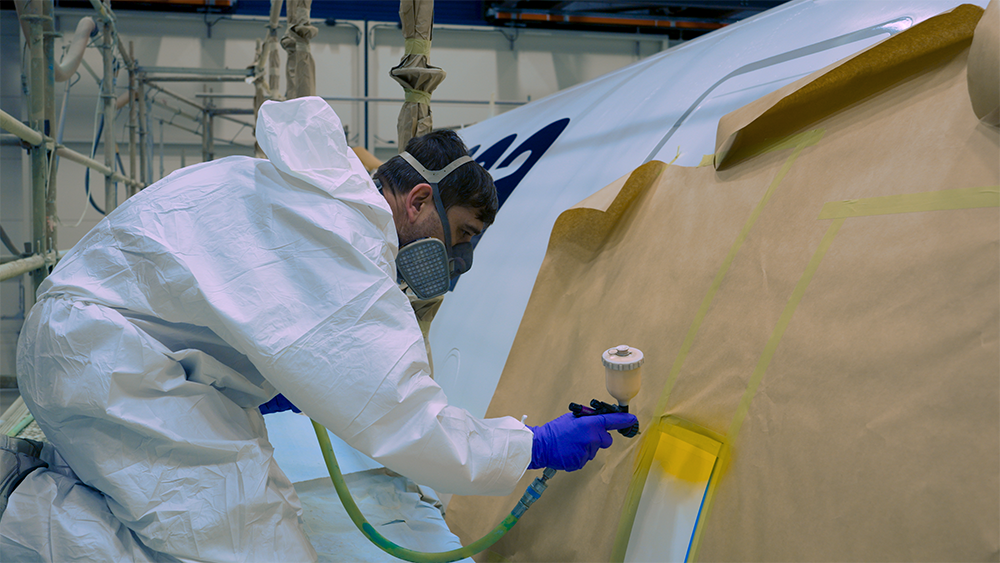
Aircraft painting specialist Airbourne Colours began 2026 with a major capacity uplift at East Midlands Airport. The company is in the midst of a 10-aircraft Airbus A320 repainting program for Austrian Airlines, which was announced in January.
While the contract strengthens the company’s European customer portfolio, it also highlights the wider economic role major paint programs now play across the UK’s regional airport network.
For East Midlands, where Airbourne Colours has operated since 2014, repeat international airline work is becoming a critical stabilizer for the local labor market.
“As an established employer for the East Midlands region, securing repeat international airline work is critical to maintaining a consistent workload,” says Simon Cracknell, sales and marketing director at Airbourne Colours. “This stability supports long‑term employment, skills retention and predictable workforce planning within the catchment area.”
The company’s workforce model reflects the realities of the aircraft painting cycle. Demand remains seasonal, with peak activity from October to May, and that continues to shape staffing patterns. “Shop floor roles continue to rely heavily on contractors,” Cracknell notes. “Many of these contractors are long-standing personnel and nearly all office‑based roles remain permanent.”
A two‑shift pattern supports throughput in the hangars, says Cracknell, while rising business jet activity is helping to smooth the summer trough.
The Austrian Airlines program arrives as Airbourne Colours expands its national footprint. Two new paint facilities at Teesside International Airport have opened within the past 19 months, adding capacity for narrowbody A321-sized aircraft.
Airbourne Colours also operates a dedicated business and regional jet facility at Exeter Airport. This multi‑site structure is increasingly important as operators look for flexible MRO slots and shorter downtimes.
The economic impact extends beyond direct employment, according to Cracknell. While specialist aircraft paint is supplied by three major global manufacturers with UK operations, most consumables and equipment are sourced from UK‑based suppliers, he says.
“Higher throughput across our facilities, not only at East Midlands, but our other locations at Teesside and Exeter Airport, directly increases demand for these regional supply chains,” Cracknell says.
Looking ahead, Airbourne Colours sees continued momentum for regional airports positioning themselves as MRO hubs. “Supported by our Part 145 maintenance partners, we expect regional airports such as East Midlands and Teesside to remain attractive to international MRO customers,” Cracknell says, pointing to the company’s recent investments as evidence of sustained demand.
International airline paint programs are emerging as a key driver of skilled aviation employment at UK regional airports, as carriers continue to place high-value MRO work outside Europe’s major hubs.

Related Content