This article is published in Aviation Week & Space Technology and is free to read until Jan 10, 2026. If you want to read more articles from this publication, please click the link to subscribe.
Landing Gear OEMs Lean Into More Sustainable Systems
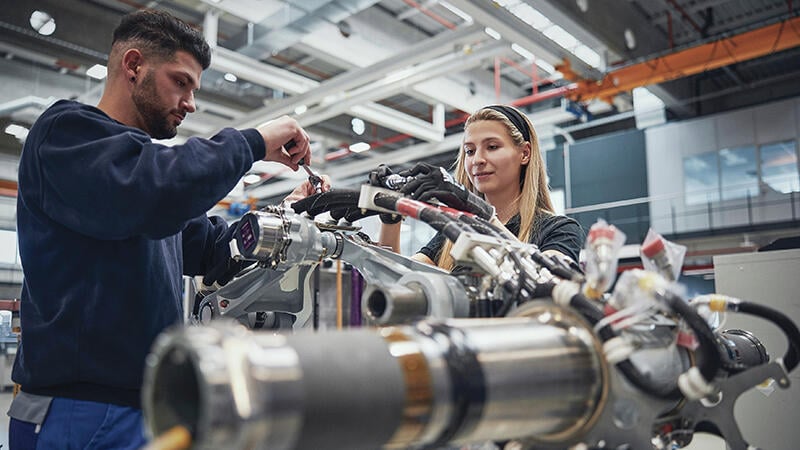
Liebherr Aerospace continuously monitors composite technology for potential applications to landing gear structural parts.
Landing gear OEMs are leaning greener. With sustainability at the forefront, suppliers are adopting lighter-weight metallic alloys, making greater use of composites and using more environmentally benign, corrosion-resistant coatings.
Laurent Raoul, executive vice president of engineering, research and technology at Safran Landing Systems, points out that the latest generation of long-range aircraft landing gear utilizes high-strength titanium to produce structures that are both robust and lightweight.
“High-strength titanium alloys, such as Ti 10-2-3 and Ti 5-5-5-3, are being used more extensively for primary structural components,” Raoul says. “Titanium 6-4 is favored for its producibility, high strength-to-weight ratio and corrosion resistance.”
Tim Lammering, director of landing gear systems at Liebherr Aerospace Lindenberg, notes that there is potential for high-strength, corrosion-resistant steel alloys in landing gear—but with a caveat.
“Such alloys may not be lighter than current high-strength steels, such as 300M. However, they bring the added value of inherent corrosion resistance while almost providing the same strength characteristics,” Lammering explains. “While they may not save weight, they allow simplification of the required surface protections and reduce the complexity of the production process.” He adds that for the application of those high-strength, corrosion-resistant steel alloys, Liebherr Aerospace has achieved a technology and manufacturing readiness level of 6, which is defined as being capable of producing a prototype or subsystem in a production-relevant environment.
COMPOSITES
Lammering reports that Liebherr Aerospace is continuously monitoring composite technology for potential applications to landing gear structural parts. However, he stresses that current analysis does not show a reasonable benefit over modern metallic parts.
“From our point of view, future application of composites seems more likely [for] struts and braces, which are also better shielded by the aircraft structure—such as landing gear bays and doors—against potential impact of foreign objects when compared to other landing gear parts,” he says.
Matthew Maurer, vice president of landing systems at Collins Aerospace, says that while thermoplastics and other composites are currently being applied primarily to nonstructural components such as brackets, research and development efforts continue into extending their use to larger, more highly loaded components, such as struts, potentially to replace high-cost and processes with long manufacturing lead times, such as for large metallic forgings.
“For larger commercial aircraft, the potential weight savings achieved by incorporating composites can be significant, amounting to hundreds of pounds, as compared to steel alloys,” Maurer says. “This reduction in weight enhances fuel efficiency and contributes to the overall performance of the aircraft.” In addition, he notes that thermoplastic composites are “inherently more resistant to moisture and foreign object damage impact, without the need for increased processing and coatings.”
In fact, Safran Landing Systems sees thermoplastics and composite materials expanding considerably in landing gear design. Raoul cites the OEM’s development of several components using those materials, including structural internal shock absorber components, such as the upper diaphragm tube.
“Also known as an orifice support tube, it can now be manufactured using [polyether ether ketone] reinforced with 30% short carbon fibers. It is a thermoplastic that offers excellent compression strength and a 25% weight reduction compared to aluminum, along with production efficiencies,” Raoul says. “Additionally, side and drag struts made from 3D woven organic matrix composites have been successfully implemented, notably on the [Boeing] 787-8, where they have demonstrated excellent in-service performance since 2013.”
Raoul says Safran Landing Systems is actively developing its second generation of 3D woven carbon fiber composites, targeting components such as brake rods, drag and side struts. “These composite technologies, which offer drop-in replacement capability for titanium parts, offer up to 30% weight savings, compared to titanium—while maintaining equivalent interfaces to the metallic part, along with exceptional impact resistance,” he says. “This technology is expected to play a key role in future aircraft programs aiming for lighter and more efficient landing gear systems.”
PROTECTIVE COATINGS
In addition to alloys and composites, recent advances have been made in the development of protective coatings. According to Maurer, traditional landing gear protection often involves multiple layers of different materials, which can add complexity, cost and potential vulnerabilities at transition zones.
To address that, he says Collins is creating streamlined, high-performance coatings without these drawbacks. “Several are at the prototype stage and currently undergoing testing and validation,” he says. “These coatings are designed to resist the harshest environments while maintaining the critical interface with wheel and brake components.
At the same time, Maurer reports that Collins is actively focused on testing and validating advanced robust surface coatings that are REACH (Registration, Evaluation, Authorization and Restriction of Chemicals)-compliant as well as wear- and corrosion-protective. These coatings include tungsten carbide cobalt chromium-based thermal spray, nonchromated primers, electroless nickel and zinc-nickel.
“We’re also developing specific design features to better safeguard the surfaces of high-strength alloys—including titanium, 300M and corrosion-resistant steel—to enhance the performance and longevity of landing gear components,” Maurer says. “These technologies are matured through a rigorous technology and manufacturing readiness level process, and their operational effectiveness is validated through collaboration with aircraft OEMs.”
Lammering at Liebherr Aerospace notes that for corrosion protection, low-hydrogen embrittlement zinc-nickel plating offers a viable alternative to conventional cadmium coatings for high-strength steels such as 300M. “On functional surfaces, high-velocity oxygen fuel [HVOF] spraying can be used as a substitute for traditional hard chrome plating,” he says.
Rui Furtado, vice president of engineering for product development and research and technology at Heroux-Devtek, reports that the Montreal-based landing gear OEM has for decades used green coating technologies, including HVOF coating and alkaline zinc-nickel plating, with proven service records across multiple commercial and military platforms.
“Heroux-Devtek is actively working to remove hexavalent chromium from the processes used to apply corrosion protections on parts, in line with REACH regulations and broader environmental objectives,” Furtado says. “Alternative processes and products are being developed and qualified to deliver the required corrosion protection and durability without relying on substances of concern.”
Furtado adds that the OEM is evaluating high-velocity air fuel (HVAF) for use as a next-generation alternative coating. “Though not yet as established as HVOF, HVAF offers the potential for coatings [with] greater corrosion protections than what can be achieved with traditional platings,” he says. “Heroux-Devtek is actively assessing its applicability for future landing gear systems, particularly where sustainability and life-cycle efficiency are critical.”
ADVANCED MANUFACTURING
Additive manufacturing and 3D printing are being used increasingly in landing gear fabrication. For example, Raoul says Safran Landing Systems has developed several titanium components using 3D printing. They include the single integrated manifold block, a centralized hydraulic manifold for the extension-retraction system that offers simplified architecture and up to 50% less weight compared with traditional machined parts. Another, he points out, is the brake selector valve, a hydraulic pressure control unit for the braking system, which delivers improved integration and up to 30% weight savings.
“These components replace heavier forged or assembled parts, contributing to overall weight reduction, enhanced system performance and greater design flexibility,” Raoul says.
“The titanium alloys used in these applications are inherently highly resistant to corrosion, making them ideal for use in harsh operational environments. Moreover, the use of additive manufacturing allows for the creation of single-piece components, which reduces the number of joints and potential leakage points.”
Lammering predicts that 3D printing will increasingly “be a standard manufacturing alternative process to machining.” However, he cautions that it is currently not foreseeable for major landing gear structural parts.
“The primary reason lies in the material used for landing gear structural components. These parts are typically made from high-strength steel alloys, such as 300M, chosen for their superior mechanical properties,” he says. “However, these steels are extremely difficult to weld and cannot be additively manufactured as can titanium or aluminum alloys.”
Maurer notes that Collins Aerospace “has evaluated additive manufacturing across multiple processes,” including wire-direct energy deposition, wire-arc additive manufacturing and laser powder bed fusion with respect to alloys, and landing gear part types over the past decade.
“These processes have been explored for landing gear components because of the potential value proposition for cost savings, supply chain security and production efficiency—particularly for the large forgings that make up the major landing gear components,” Maurer explains. “By combining standard raw materials such as bar stock with additively manufactured features, manufacturers can eliminate the need for large forgings altogether. Also, additive manufacturing could provide an advantage for future maintenance and overhauls by selectively repairing or rebuilding select features on an existing part using additive manufacturing, enhancing maintainability and further reducing life-cycle costs.”