This article is published in Aviation Week MRO part of Aviation Week Intelligence Network (AWIN), and is complimentary through Apr 22, 2026. For information on becoming an AWIN Member to access more content like this, click here.

How Diamond Dust Could Improve Trust In The Aerospace Supply Chain
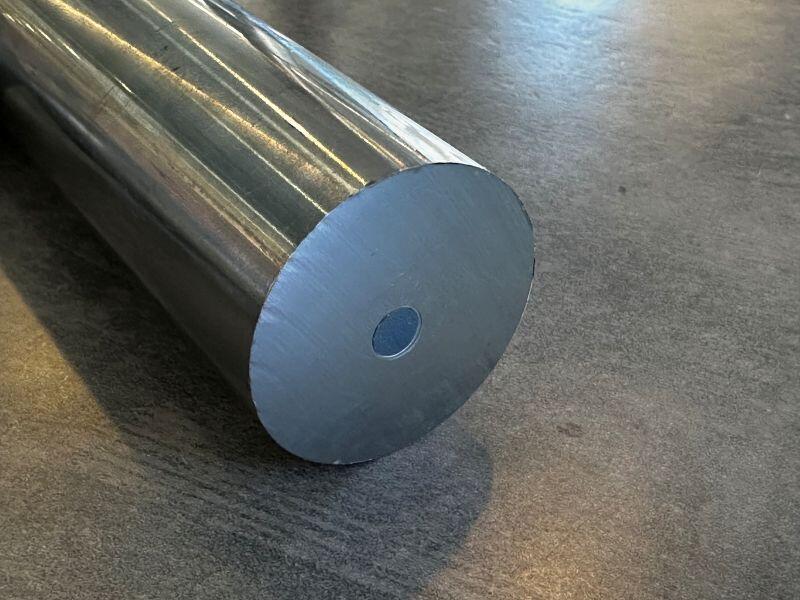
DUST Identity’s diamond dust “fingerprint” applied to a bar of raw metal.

DUST Identity’s diamond dust “fingerprint” applied to a bar of raw metal.

Credit: DUST Identity

Back-to-birth parts tracing might be worth its weight in gold for the aerospace industry, but an Airbus and Lockheed Martin-backed startup is turning to a much harder substance—diamonds—to enable parts authentication.

DUST Identity’s new aerospace material and parts authentication platform, Theseus, pairs artificial intelligence (AI) assisted analysis with a unique physical “fingerprint” created from engineered diamond dust to connect a part or raw materials’ physical identity with documentation.

“The diamond dust allows us to create a unique identity on the physical object that remains permanent to that physical object and it’s very easy to apply,” DUST Identity Co-Founder and CEO Ophir Gaathon told Aviation Week. “Don’t think of it as necessarily a replacement for the serialization that is sometimes required by the regulators . . . but think of it as something that allows us to be able to very quickly create an identity and then attach the data to that identity in a unique way.”

As raw materials move through the supply chain and are converted into parts, manufacturers can reapply dust to ensure continuity and attach information about the part via the Theseus software platform. The software ties documentation to the physical parts it describes, which DUST Identity says makes it impossible to present legitimate paperwork alongside a substituted component.

When a part is then installed on an aircraft or shipped to an MRO, “you have a way to just touch the part, scan it, and within three seconds, you can get all the lifetime data that you as a user within the ecosystem are allowed to see,” such as airworthiness review certificates or back-to-birth documentation, Gaathon said.

He notes that the diamond dust can survive most operating conditions, but DUST Identity “gives the opportunity for the user to be able to reapply” in certain cases, such as welding or repainting.

“Our job is not necessarily to ensure that the markings survive the operations, because most of the time it’s necessary to secure up to the installation and make sure that [at the time of] the installation there is a good handshake,” he added.

When asked about the advantages Theseus offers compared with other parts integrity technologies being developed for aerospace, such as blockchain or optical AI, Gaathon said DUST Identity’s approach is more robust and secure.

“We’re not using AI in order to authenticate the object. We’re using a predictable, algorithmic way to make sure that we’re authenticating in the same way that you would authenticate somebody as evidence for committing a crime or any kind of biometrics security,” he says. “What we’ve seen in the market is that people or certain companies tend to make claims about being able to use optical characteristics that are native to the object in order to uniquely identify them. Unfortunately, that’s not something that is very robust and definitely not secure.”

Gaathon argues that optical AI is easy for a bad actor to manipulate and it can have poor performance as parts age, whereas diamond dust has “a very consistent fingerprint that lasts the full lifetime of the object.”

Where DUST Identity does use AI is to analyze documentation—such as certificates of conformity, FAA 8130-3 forms and European Union Aviation Safety Agency Form 1s—to detect anomalies, provide a trust score and predict if there is any risk associated.

He stressed that the company is taking a cautious approach to incorporating AI, but added that “supervised AI” will be critical for detecting fraud in today’s tech-forward environment to ensure “the good actors have, at the very least, some basic tools that will allow them to rely on more advanced technology, because the bad actors are using this already.”

For instance, Gaathon noted that paper documentation could previously be faked. “Today, in order for me to fake back-to-birth documentation, maybe 100 pages, I just need a prompt, and I can create something that is incredibly difficult, and it’s going to be very challenging for humans to be able to catch those mistakes because they are so rare,” he says.

DUST Identity says Theseus is now on the market and can integrate with companies’ existing enterprise and supply chain systems.


Lindsay Bjerregaard

Lindsay Bjerregaard is managing editor for Aviation Week’s MRO portfolio. Her coverage focuses on MRO technology, workforce, and product and service news for MRO Digest, Inside MRO and Aviation Week Marketplace.