This article is published in Aerospace Daily & Defense Report part of Aviation Week Intelligence Network (AWIN), and is complimentary through Oct 31, 2026. For information on becoming an AWIN Member to access more content like this, click here.
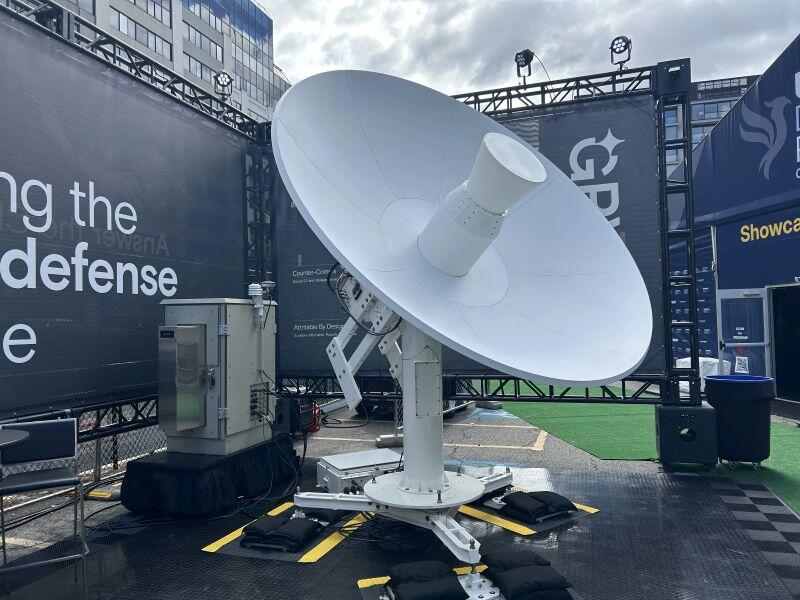
GRVTY’s remote modular terminal on display at the Association of the U.S. Army’s annual convention, Oct. 13-15 in Washington.
The first full-scale production units of the U.S. Space Force’s remote modular terminals (RMTs) are rolling off the line over the next four weeks, industry officials said Oct. 13.
The new ground-based satellite jammers were developed via a prototype contract with the Space Rapid Capabilities Office (RCO) by Northstrat with support from CACI, with the initial contract awarded in 2022 for about $22 million. The 24 jammers in the initial order were delivered within two years and quickly sent out into the field, with the first arriving within 18 months.
Now, the first units developed under the RMT production contract will be ready in the next four weeks, Roger Stapleton, general manager of GRVTY’s Spectrum Operations Business Unit, told Aviation Week Oct. 13 at the Association of the U.S. Army’s annual convention in Washington. GRVTY, a defense technology company backed by Arlington Capital Partners, acquired Northstrat in May 2026.
The RMT’s primary mission is counter-satellite communications targeting systems in multiple orbits. An April 2026 report by the Secure World Foundation described Block 0 as utilizing Ku band antennae, while Block 1 is expected to cover multiple bands. Former Space RCO Director Kelly Hammett has previously said the office intended to procure at least 160 systems.
The Space Force has already operationalized the initial platforms. Combat Forces Command Commander Lt. Gen. Gregory Gagnon told The Wall Street Journal that the RMTs’ locations are not disclosed to protect the systems from adversary targeting, however, “They are used in combat and are emplaced, actually, globally,” he said in a video interview published Oct. 14.
The system is being designed to support additional signal processing capabilities, Stapleton said, hinting at a future model that could target multiple satellite signals at once. GRVTY and the Pentagon are currently discussing next-generation requirements for the RMT, he said, while declining to share details of those conversations.
“Through our existing work in space electromagnetic warfare systems, we are able to anticipate next-generation requirements and are investing in bringing those capabilities to the warfighter,” a GRVTY spokesperson said in an email.
GRVTY has brought additional vendors onboard the program to ensure it can produce at capacity, in particular for antennas and power amplifiers, Stapleton said. But the company has faced similar challenges to many in the industry in sourcing long-lead items on rapid timelines.

Related Content