
The Pentagon's Silo Problem Has a Fix, and the Army Just Tested It in Tampa
U.S. forces have a surprisingly mundane problem. Its most advanced systems often cannot talk to one another. Radars built by one contractor, launchers built by another, and command and control software built by a third have long been stitched together, if at all, through expensive, bespoke integration work that can take years and lock the government into a single vendor's vertically integrated systems. Every new sensor or software patch becomes a negotiation, a contract amendment, a delay.
This summer, in a nondescript exercise space in Tampa, the Army tried something different. It asked contractors to prove, in real time, that open architectures could replace proprietary lock-in, and that the fix could be delivered not in years, but in weeks.
The exercise, called Operation Jailbreak Falcon Fury, ran from July 25 to August 28 and was hosted jointly by the Army's Chief Technology Officer and the Assistant Secretary of the Army for Acquisition, Logistics, and Technology. It was the second phase of an initiative that began in May at Fort Carson, where a first cohort of contractors had just 5 weeks to prove their systems could integrate on open terms. The premise was simple but consequential. Require companies to publish platform-agnostic interfaces, exchange data securely with government-selected command and control systems in standard data formats, and post verified documentation to the Army's API Marketplace, where any qualified vendor, not just the original supplier, could build on it.
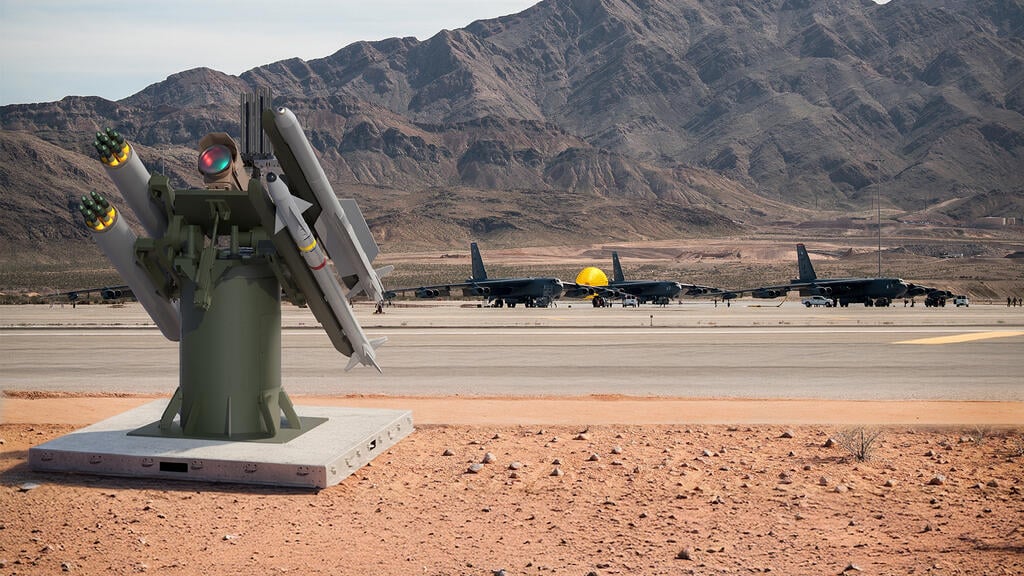
SNC used the exercise to expand the open-architecture credentials of its Mobile Anti-Air Weapons Launcher – Reconfigurable, or MAAWLR, a modular air-defense platform built to be ready to plug into a broader multi-echelon defense network rather than function as a closed system. Using what the company calls a C2 Gateway as a common software boundary, MAAWLR proved it could pull in data from electro-optical and infrared sensors, tactical radars, passive radio-frequency detectors, precision navigation feeds, and other sensors as well as receive commands from and post replies to autonomy and tasking engines. The Army's Operational Evaluation Command later issued a formal memorandum confirming MAAWLR met all interoperability criteria for the exercise, and SNC's proven open application programming interfaces (APIs) are now published in the Army’s API marketplace for the Army or the rest of the industrial base to leverage.
Why does this matter beyond one contractor's technical scorecard? Because the economics of proprietary defense systems have long worked against both speed and affordability. When only the original vendor can modify a system, the government pays a premium for every upgrade and waits in line for every fix, costs that compound over a platform's decades-long service life. An open, standards-based approach inverts that arrangement. Any qualified company can compete to add a sensor, patch a vulnerability, or field a new effector, driving down long-term sustainment costs while shrinking the time between a battlefield need and a fielded solution.
That case for speed and savings is precisely what the Army is testing as it shapes requirements for its next-generation short-range air defense program, known as M-SHORAD Increment 4, where officials have signaled that non-proprietary modularity and rapid counter-drone integration will be central requirements.
Operation Jailbreak 2.0 proved that open, vendor-agnostic architectures are no longer theoretical concepts, they are operational realities that can be integrated and deployed today, eliminating costly contractor locks, slashing integration timelines and delivering decisive overmatch directly to the warfighter. For a Pentagon under pressure to modernize faster and spend smarter, that combination of speed now and savings later may be the most durable weapons upgrade of all.