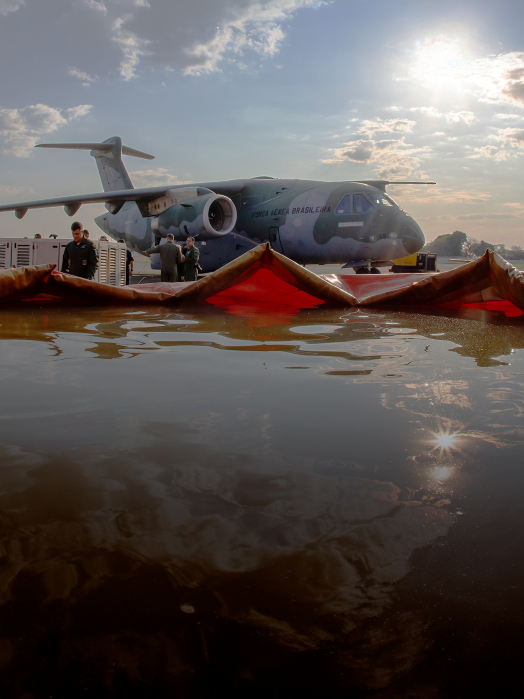
From Airlifter To Aerial Firefighter In Hours
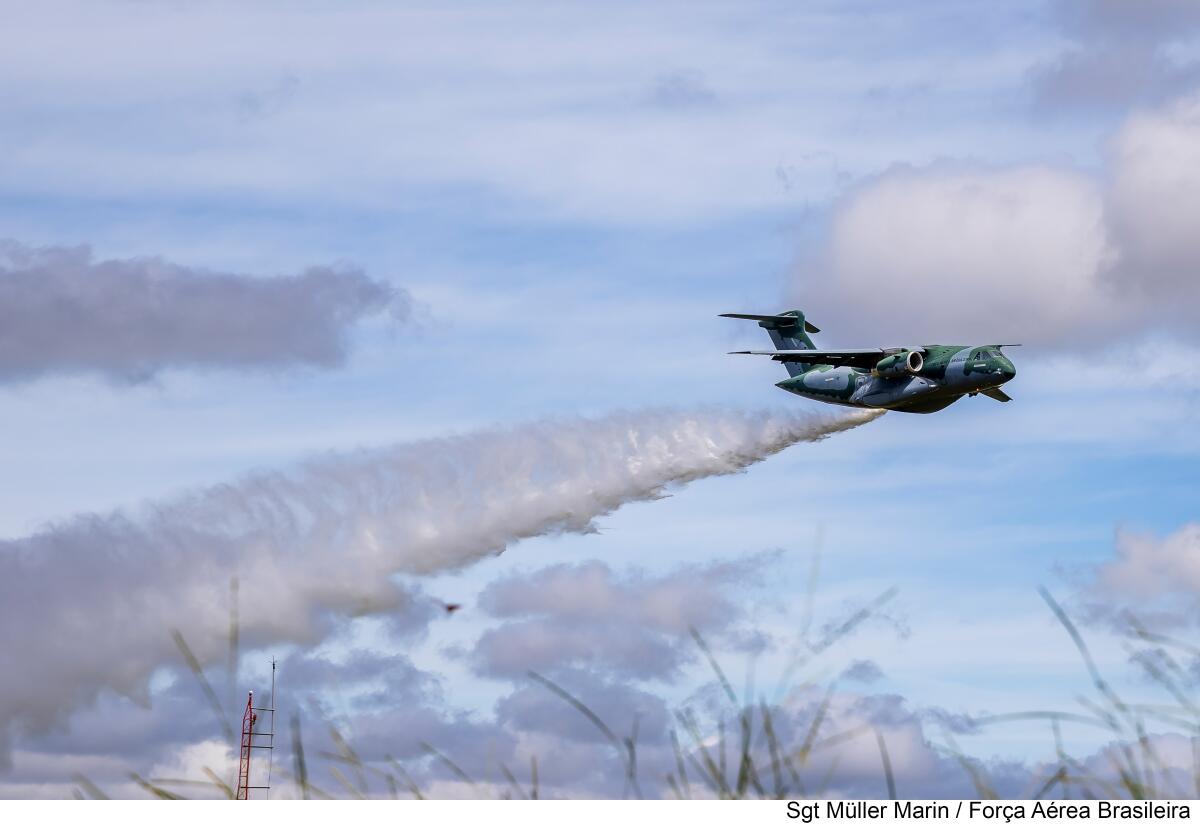
A roll-on/roll-off firefighting package allows a tactical transport fleet to answer seasonal emergencies without sacrificing its military mission set. Brazil’s 2024 operations showed what that proposition means in practice: rapid conversion, austere deployment and high-volume delivery at maximum effort operational tempo.
A Multi-Mission Answer to an Episodic Threat
Wildfires are becoming a strategic air-mobility problem as much as a global environmental emergency. The requirement is not simply to own an aircraft capable of aerial firefighting, but to be able to generate useful capacity quickly, move it to the threatened region and sustain repeated sorties with limited infrastructure. In that context, the KC-390 Millennium’s central advantage is not a single firefighting metric. It is the aircraft’s modular architecture and its ability to change roles without creating a separate, lightly used fleet.
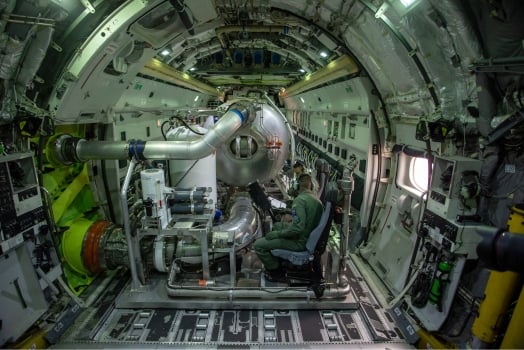
The Modular Airborne Fire Fighting System II, or MAFFS II, is installed in the cargo compartment as a roll-on/roll-off mission kit. The KC-390 can transition from cargo transport to aerial firefighting in less than four hours, without any permanent structural conversion required. When the seasonal peak recedes, the kit can be removed and the aircraft returned to airlift, aerial delivery, air-to-air refueling, aeromedical evacuation, search and rescue or humanitarian missions.
This is an important fleet-planning distinction. Dedicated aerial firefighting aircraft are one thing, but wildfire demand is geographically expansive and highly seasonal. A modular system converts an existing military asset into emergency-response capacity while preserving the investment’s year-round utility. For defense ministries, the relevant measure is therefore not simply liters of retardant delivered per drop, but the capability each aircraft generates across the annual mission cycle.
MAFFS II: Pressurized Delivery, Controlled Effect
MAFFS II is a self-contained, pressurized retardant-delivery system. In the KC-390 configuration, its nominal usable load is 3,000 US gallons (11,000 liters). The full load can be released in seven seconds, producing the concentration needed to support crews on the ground, arrest a fire front or reinforce a containment line.
The system is more sophisticated than a tank and nozzle. The KC-390 installation uses the aircraft’s electrical supply and includes onboard compression, enabling pressurization without tying the aircraft to a large, fixed compressor at every staging point. The S-shaped delivery duct is routed through a pressure plug at the paratroop door, allowing the cargo ramp to remain closed and the cabin pressurized. This arrangement helps preserve aircraft performance and crew comfort and places the retardant stream into a low-turbulence zone which limits fluid contact with the fuselage.
Release, quantity and coverage can be tailored to the fire plan. The KC-390/MAFFS II combination provides three selectable delivery options, one-third, one-half or a full load, and supports ground pattern coverage levels from 1 to 8 gallons per 100 square feet. The release point, dispersion and timing are supported by mission calculations, while the aircraft’s fly-by-wire controls and high-lift system contribute to precise low-speed, low-altitude handling. Publicly presented reference conditions include 140 knots and 150 feet above the target area, always subject to the authorized operational profile, terrain, visibility and fire behavior.
Forward-Based Operations and Fast Turnaround
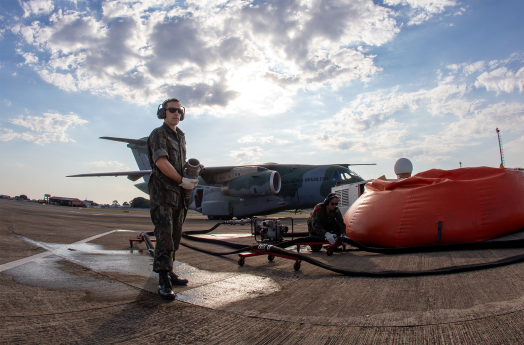
The operating concept is inherently expeditionary, and a firefighting aircraft is only as productive as its cycle time. The KC-390 can deploy with the MAFFS II kit and associated support equipment, use alternative water sources and operate away from its main base with a limited footprint. This has proven to be particularly valuable in a country the size of Brazil, where fire fronts can be hundreds of kilometers from a fully equipped air base. It is also relevant to Europe, where cross-border reinforcement must often arrive quickly and integrate with local incident command, airspace coordination and ground crews.
Austere operation does not eliminate the need for disciplined preparation. Low-level flights in smoke, turbulence, high terrain and congested temporary airspace are demanding. Safe employment depends on trained crews, lead or coordination aircraft when required, accurate target marking, separation from helicopters and civilian aerial firefighters, and a reliable refill plan. The platform reduces workload and infrastructure dependence, enabling the crew to focus on the integrated firefighting system.
Importantly, during Brazil's early fire-season campaign, the Brazilian Air Force (FAB) reported that the KC-390 could return, refill and take off again in approximately 40 minutes. The KC-390 can also operate at low level at night, using NVGs and enhanced-vision systems for navigation. Combined with the Litening® 5 EO/IR sensor and precision airdrop capability, this enables accurate delivery day and night, providing unique 24/7 coverage.
Brazil 2024: Operational Proof at National Scale
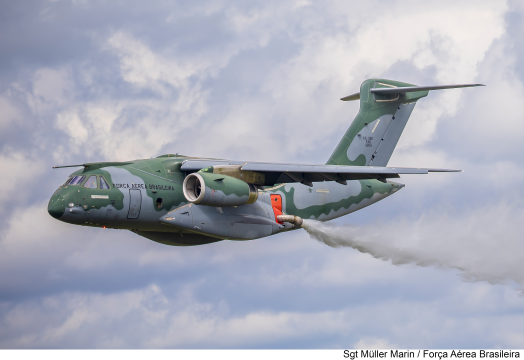
Fire season operations in 2024 provided the first sustained real test of the MAFFS II delivery system onboard the KC-390. After the aircraft began real-world operations, in one week it had already exceeded 200,000 liters of water in 22 flights and logged 27 flight hours. Less than one month later, the total had already exceeded 520,000 liters. By the end of the fire season in 2024, the KC-390 had delivered more than one million liters in more than 100 flights, suppressing major wildfires in different regions of the country.
The campaign also demonstrated responsiveness between regions. When severe fires developed in other regions of Brazil, the MAFFS-equipped aircraft was able to rapidly redeploy to suppress them and an additional 60,000 liters were delivered, nationwide.
The significance lies in the compression of effect. A transport aircraft that ordinarily carries troops, vehicles and relief cargo was reconfigured for a specialized civil-support mission, moved to the point of need and then generated repeated precision drops. That is the practical meaning of multi-mission flexibility: not a catalogue of theoretical roles, but the ability to shift scarce fleet capacity as national priorities change.
From Proven Demand to Fleet Expansion
This delivery of operational effect resulted in a contract for a second MAFFS II unit for FAB by the end of 2024. The service said its decision reflected the system’s efficiency in more than 100 flights and the need for additional emergency-response capacity. This doubles the number of KC-390s that can be configured simultaneously for firefighting, without converting either aircraft into a permanently dedicated aerial firefighting.
The need for aerial firefighting extends beyond Brazil. The Czech Republic and the United Arab Emirates have ordered the MAFFS II capability for their KC-390s, reflecting two distinct needs: European civil-protection reinforcement and Middle Eastern contingency capacity. This also suggests a new dimension for tactical transport fleets. Firefighting kits can become deployable sovereign assets, available for domestic emergencies, bilateral assistance or multinational civil-protection mechanisms.
Future Outlook: A European Surge-Capacity Gap
The 2026 fire season in Spain and France reinforced the scale of the challenge. UN reporting in July described major evacuations in both countries and cited World Health Organization data showing that 2.2 million hectares burned across the European Region in 2025, up from 1.4 million hectares in 2022. The operational lesson is clear: national firefighting fleets can be saturated, and reinforcement must be available and maintained at a suitable level for readiness across the region.
For KC-390 operators and prospective customers, modular firefighting creates several opportunities: shared pools of mission kits, common training standards, pre-planned cross-border deployment packages and forward-based support sets. Challenges remain, particularly interoperability and availability of trained ground teams. Yet these are manageable integration issues, not arguments for keeping valuable airlift capacity single purpose.
For decision-makers, the proposition is not to replace legacy aerial firefighters with another dedicated platform. The KC-390 and MAFFS II deliver the ability to add rapidly deployable aerial firefighting capacity without surrendering the missions for which a military transport fleet exists. As wildfire seasons intensify in severity and duration across the planet and emergency resources are stretched across regions and beyond national borders, fleet modularity, mobility and multi-mission readiness have become critical requirements for nations determining their next generation of military airlift aircraft. The KC-390 Millennium is mission ready today.