
Moving Beyond Traditional Outsourcing Models In The UK Defense Sector

The United Kingdom's defense industry is a national security and technological innovation cornerstone. In recent years, defense spending across land, air, and sea domains has increased, placing extraordinary pressure on industry to accelerate program delivery while adhering to stringent security and sovereignty requirements. These challenging environments necessitate fresh thinking about the wise utilization of engineering service delivery and partnering models that can aid in meeting these complex demands.
The defense industry operates fundamentally differently from commercial aerospace. Defense programs typically span decades, involve multiple government stakeholders and industrial partners, and operate within complex procurement frameworks. While commercial aerospace has embraced strategic engineering partnerships with outsourcing levels approaching 30%, the defense sector maintains remarkably lower levels, typically under 5% for true strategic partnerships in engineering outsourcing. This disparity stems from the unique nature of defense programs. Unlike their commercial counterparts, UK defense contractors receive funding throughout product development and must wait until product delivery for revenue realization. This payment structure provides program stability but often reduces incentives for operational efficiency improvements. Additionally, the UK's defense procurement landscape prioritizes transparency through increasingly complex processes, sometimes sacrificing agility for compliance.
Limitations of Traditional Engineering Service Models
Current engineering service approaches in UK defense manifest primarily in two forms, neither adequately serving modern defense programs' evolving needs.
The first approach involves direct contingent labor engagement through numerous agencies, essentially "body shopping" with minimal strategic value. This model provides temporary capacity but fails to deliver a strategic advantage or drive innovation across programs. It creates administrative overhead and limits knowledge retention within core programs.
The second approach attempts to identify and package complete work segments for specialist providers, similar to how prime contractors engage with major subsystem suppliers. However, this model often proves impractical given the integrated nature of defense systems, changing requirements, and the need to maintain sovereign capabilities. The complexity of defense systems also makes clean work package separation difficult, creating integration challenges and potential responsibility gaps.
Further complicating matters, security requirements mandate that work remains within UK borders, eliminating traditional cost arbitrage opportunities available in commercial sectors. These restrictions create a unique landscape for engineering services that demand tailored partnership models rather than off-the-shelf solutions.

The Need for Strategic Partnership Approaches
Recent developments in UK defense programs illustrate the growing necessity for innovative engineering partnership models. Major current initiatives like the Future Combat Air System (FCAS) and SSN-A submarine programs pose immensely challenging technology and delivery schedules that require advanced levels of engineering capability on an unprecedented scale. These programs' delivery timeline and operating landscape demand innovation and a completely different approach to design, development, and Through Life Support than their predecessors. This, in turn, requires new engineering methods and processes and a fresh approach to accessing and deploying engineering talent while maintaining program control and protecting intellectual property.
The traditional approach of engaging engineering suppliers through contingent labor or full work package outsourcing proves insufficient for these complex programs. Leading organizations now recognize the need for Strategic Engineering Partners capable and willing to proactively invest and share operational risks.
Quest Global’s sole purpose in engaging with the UK Defense sector is to create value for its customers through a strategic Partnership Approach that will enable efficient program delivery with reduced operational risks. This is achieved through an Extended Engineering Team model that operates as a trusted layer around the core customer engineering team, working seamlessly across several delivery models.
Quest Global's Partnership Model for UK Defense
Quest Global has developed a partnership model tailored to the UK defense sector. Our approach recognizes both the constraints and opportunities unique to defense programs. Rather than attempting to force commercial aerospace models into defense applications, our approach builds from the ground up to address defense-specific requirements. The model enables various engagement types depending on program needs and security requirements:
To develop the partnership model, we invest significant time with customers upfront to understand their engineering landscape and help build a joint roadmap to deliver strategic objectives. The fundamental approach is based on developing the Engineering Partnering strategy through assessing work in four Categories (refer to figure below):
- Do: Business Critical and Competitive Critical (In-House) – Core technological capabilities that directly impact competitive advantage must remain internal
- Buy: Non-Critical (Full offload through work packages) – Commodity or non-core services that can be fully outsourced as a package
- Protect: Competitive Critical, but not Business Critical (Joint Teams) – Adjacent activities involving skills that must be retained internally and require close collaboration, delivered through joint team delivery models
- Control: Business Critical, but not Competitive Critical (Managed Offload) – Process-driven activities that remain business-critical but benefit from standardization and can be managed through controlled partnerships
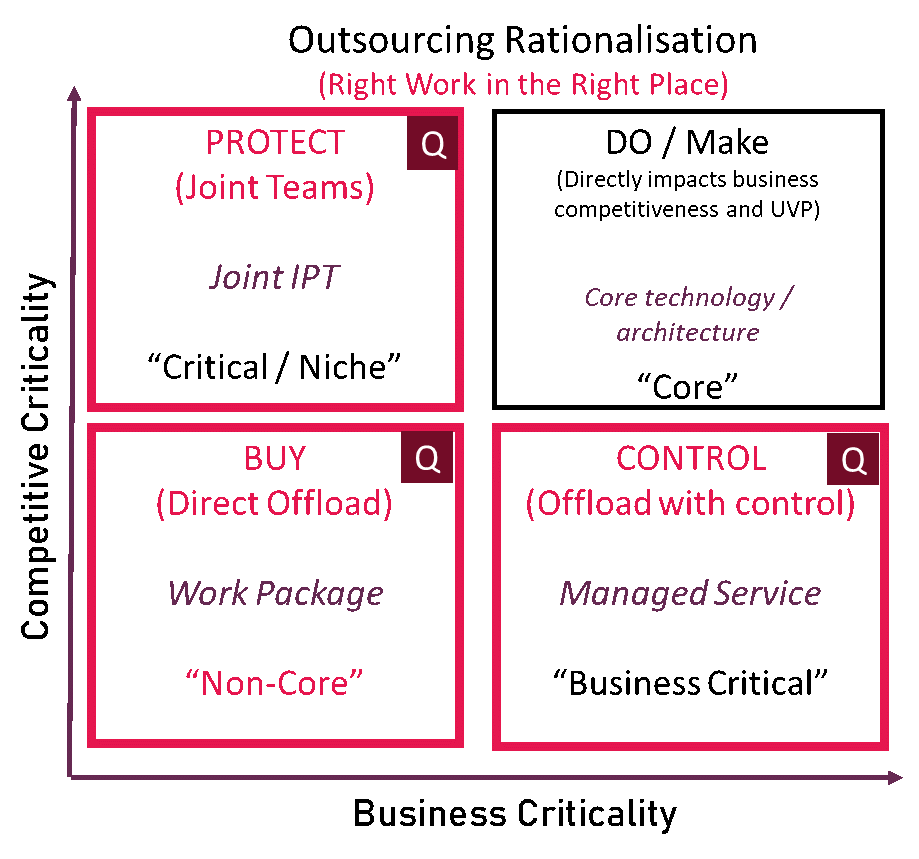
Whilst traditional engineering outsourcing models are governed by a Do / Buy matrix (internal vs. offload), they often ignore the types of work that fall under the Protect and Control category and a mechanism to deliver this work in a strategic partnering approach. In a Defense environment, Strategic Partnering comprises work that falls under the Buy, Protect, and Control categories, with the latter two often contributing to over 80% of the work scope.
The delivery of the work in a partnering model is often managed through the models below:
Joint Integrated Project Teams (Typically for work in the Protect category)
This engagement model brings together customer and partner teams for critical developments, ensuring knowledge transfer while maintaining program control. This approach works particularly well for complex / cross-functional system development where requirements evolve over time and a close collaboration along with a risk-sharing mindset is required. These are not fully scoped-out packages of work but rather a series of tasks/sprints undertaken throughout the project to deliver the overall program.
Work Package Delivery (Typically for work in the Buy category)
This model provides frameworks for handling well-defined work scopes while ensuring integration with core programs. It establishes clear deliverables and interfaces, maintaining program integrity while optimizing resource utilization.
Managed Services (Typically for work in the Control category)
This approach enables efficient delivery of process-driven activities that benefit from standardization and scale. It applies particularly well to ongoing activities that require consistent quality, with the partner company having process ownership through delegated customer approval and the overall process being controlled by the end customer.
Each engagement model includes appropriate governance frameworks, security protocols, and performance metrics tailored to defense requirements. This flexibility allows defense organizations to apply the right partnership model to each program element rather than forcing a one-size-fits-all approach.

Quest Global's Strategic Role in UK Defense
Quest Global brings decades of engineering expertise to the UK defense sector, serving as a strategic partner to significant defense organizations across air, land, and sea domains. Our dedicated UK defense practice has established a strong track record of delivering complex engineering programs while maintaining the highest standards of security and sovereignty. We maintain specialized teams with appropriate security clearances and domain expertise across critical areas, including:
- Product development and testing
- Embedded Systems and Software development
- Systems engineering and integration
- Digital thread creation across the product lifecycle
- Advanced manufacturing support and supply chain optimization
- Platform modernization and technology insertion
- Through-life support and sustainability engineering
- Critical infrastructure management and facilities engineering
- PLM implementation and configuration
- Product Non-Conformance and Modification Management
These capabilities have proven valuable in programs requiring rapid modernization and technology integration. Our engineering services encompass the full spectrum of defense program needs, from early-stage design and development to Through Life Support.
Quest Global has established Centres of Competencies (CoC) focused on specific defense engineering disciplines, enabling knowledge sharing and best practice development while maintaining strict security protocols. This approach has enabled us to help UK defense organizations reduce program delivery timelines while optimizing engineering resources. Our commitment to the UK defense sector is demonstrated through continuous investment in local capabilities and talent development. Quest Global also maintains strong relationships with UK technical institutions and actively participates in developing the next generation of defense engineering talent.
Advantages of Strategic Engineering Partnerships
Organizations that successfully implement strategic partnership models position themselves to handle increasing program complexity while maintaining focus on core technological capabilities. Measurable benefits include:
· Strategic capability and capacity at scale
Strategic partnerships enable defense organizations to maintain appropriate staffing levels across program lifecycles, avoiding the peaks and troughs that challenge purely internal delivery models. This approach reduces recruitment and training costs while maintaining program continuity.
· Accelerated Program Delivery
Capabilities at scale, operating as an extended team, and sharing operational risks drive accelerated program delivery. When implemented effectively, this acceleration has proven to reduce program timelines by 15-20%, particularly in development phases.
· Enhanced Focus on Core Capabilities
As partners handle adjacent and support activities, internal teams can focus on core technological development that maintains competitive advantage and sovereignty. This focus increases innovation potential in critical program areas.
· Proactive Investments and Operational Risk Sharing
The partnership approach ensures operational risk sharing, with the partnering company proactively investing in strategic infrastructure and capability development, while sharing the operational risks in project delivery.
· Knowledge Transfer
Well-structured partnerships facilitate knowledge exchange between defense organizations and their partners, bringing fresh perspectives and innovative approaches to traditional defense challenges.
These benefits materialize when partnerships are structured with clear objectives, appropriate governance, and mutual commitment to program success. To overcome traditional barriers, the transformation requires cultural alignment and executive sponsorship from both sides.
The Future of UK Defense Engineering Partnerships
The future of defense engineering services in the UK lies not in binary choices between internal delivery and outsourcing, but in nuanced partnership models that create value while maintaining program integrity. These partnerships must carefully balance competing priorities: maintaining security and sovereignty requirements, optimizing resource utilization, and driving innovation through cross-industry knowledge transfer.
As defense programs grow increasingly complex and technology-intensive, strategic engineering partnerships will become essential to program success. Organizations that develop effective partnership models now will position themselves advantageously for future defense programs that demand unprecedented engineering scale and capability.
Quest Global stands ready to support this transformation, bringing both defense-specific expertise and cross-industry experience to create value for UK defense programs. Our commitment to the UK defense sector remains unwavering as we continue developing partnership models that meet the evolving needs of defense organizations and their critical national security missions.