
A U.S. Drone Dominance Roadblock: The Economics of Asymmetric Warfare
The conflicts in Iran and Ukraine are exposing a fundamental flaw in how the United States fields unmanned aircraft systems (UAS). The U.S. has lost roughly 25 percent of its MQ-9 Reaper fleet in Iran, each with a $30-$60 million price tag. These are not marginal assets—they are among the most capable in the world and represent a loss of over $1.3 billion worth of traditional large unmanned systems.
The problem is not a lack of capability. It is a mismatch between how UAS are designed and utilized in modern conflicts. For two decades, the U.S. optimized its drone fleet for permissive environments—long-endurance missions launched from fixed runways, supported by large crews, and protected by uncontested airspace.
This traditional model no longer holds.
Today’s battlespace is defined by advanced electronic warfare, fully contested airspace, and the widespread availability of inexpensive drones and counter-drone technology. Although some large systems like the RQ170 Sentinel are optimized for stealth in such environments, they are the exception, not the rule. Large, runway-dependent platforms are easier to detect and target, harder to launch and transport, and far more costly to lose.
When a $30 million aircraft is shot down by a system costing a fraction of that amount, the economics of the engagement are misaligned.
Fortunately, a quiet but significant shift has emerged in underlying technologies that enable unmanned aviation. For years, smaller UAS were constrained by limited range, short endurance, and unreliable communications.
That is no longer the case.
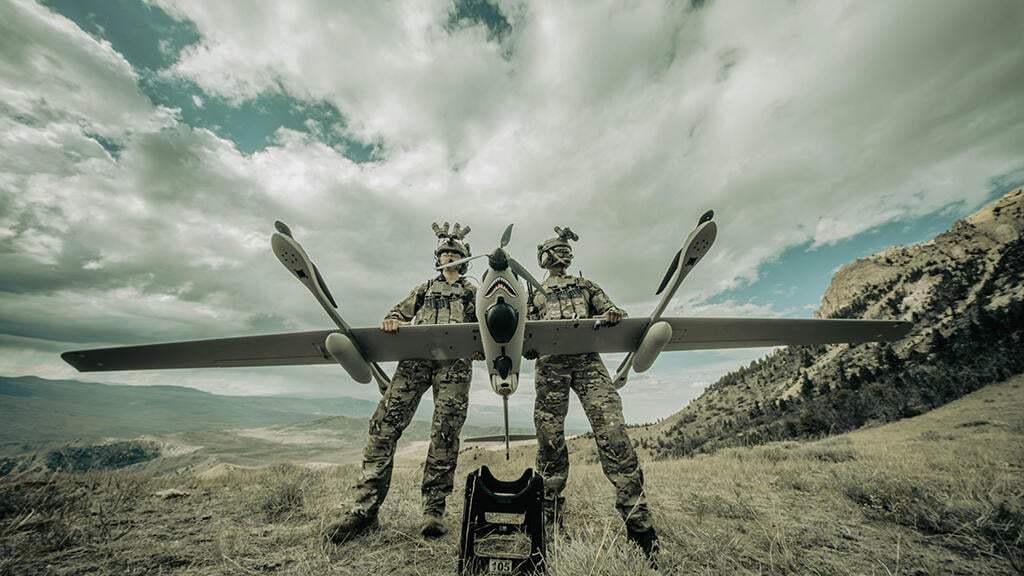
Today, long range, long endurance UAS in the smaller Group 2 class are providing a hybrid solution that bridges capability gaps between large UAS and very small drones.
The most important breakthrough is not solely in autonomy, but energy. After decades of development, solid oxide fuel cell technology is enabling UAS to achieve endurance levels previously reserved for larger platforms, often in austere conditions and extreme environments. In some cases, these systems can remain airborne up to four times longer than battery-powered aircraft, fundamentally changing what smaller platforms can do.
Lower acoustic, visual, and electromagnetic signatures make these smaller systems more difficult to target. In contested environments, such stealth advantages can make the difference between mission success or failure.
At the same time, global communications have been transformed. The emergence of low-Earth orbit satellite networks, driven by advancements like Starlink, dramatically expand the ability to maintain secure, high-bandwidth connectivity with distributed assets in contested environments at a more effective size, weight, and power ratio. This communication resilience reduces reliance on vulnerable ground infrastructure and enables operations far beyond traditional line-of-sight constraints.
Equally important, the rapid miniaturization of sensors and onboard processing has compressed the capability gap. Compare the war theater to a modern-day office worker: you have your laptop… but you also have your smartphone, which is more mobile and more important. In today’s wars, small UAS are the smartphone.
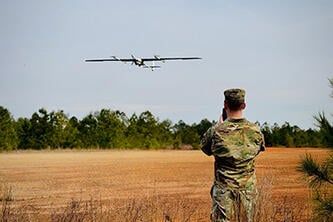
Dramatically reducing the logistical burden required to sustain operations, smaller UAS require less fuel, fewer personnel, and minimal launch infrastructure. Many can be deployed from a truck, by one or two operators in under 10 minutes, and instantly exfiltrate the area to avoid targeting by the adversary.
These capabilities translate into higher operational tempo and greater persistence. Instead of relying on a handful of aircraft operating from centralized bases generally unavailable for operational and tactical missions, commanders at the local level can distribute capability across a wide area, maintaining coverage even in the face of disruption.
Runway independence is no longer a convenience but a decisive advantage. Expendability also changes the calculus of risk. When individual platforms are affordable, commanders can push assets deeper into contested areas, accept losses when necessary, and maintain mission continuity without jeopardizing strategic capability. In the case of small, specialized teams, these easily deployable UAS can be launched by surrogate forces familiar with the local area.
Most importantly, distributed systems create resilience through redundancy. A single platform can be lost. A network can adapt.
A group of smaller UAS can maintain coverage, even under active disruption, and provide continuous intelligence in dynamic conditions. This is not simply a technological shift but a shift in how capability is delivered.
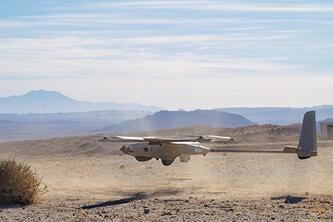
None of this suggests larger unmanned systems should be abandoned. The RQ170 Sentinel offers stealth for sensitive operations. Platforms like the MQ-9 Reaper still provide valuable capabilities in environments where survivability is less constrained and payload requirements are higher.
But the current balance is misaligned.
Modern warfare demands systems that can be produced, deployed, and replaced at speed by U.S. manufacturers not dependent on foreign supply chains. It demands architectures that prioritize distribution, redundancy, and adaptability over singular performance. And it demands a willingness to rethink long-standing assumptions about how capability is delivered.
The technologies that will enable this shift already exist. Let’s move them to the frontlines.
Authored by Joshua Stinson
Joshua Stinson is the Co-President and Chief Growth Officer of Redwire Defense Tech, as well as a former member US Army Special Forces Operator and a CIA-trained Intelligence Officer in the Defense Intelligence Agency with nearly 25 years of national security experience.