Moog Space And Defense Is Advancing Innovation To Meet Growing Demand

Inside the company's shift from reacting to threats to getting ahead of them
By Mike McClary
The old model of defense innovation — wait for a specification, then spend years engineering to it — no longer fits the pace of today’s threats. That’s why Moog Space and Defense is getting ahead of that curve instead of chasing it.

“Innovation is no longer about waiting for the specification to come from the government and then taking our time to create a design that meets it,” said Omar Vikin, vice president of Moog’s Power and Data Division. “That used to be defined in terms of years. That’s been turned on its head over the last four to five years.”
Getting Ahead of Requirements
“We’re evolving our approach to align with the demands coming out of the Department of War, specifically around affordable mass, developing solutions on our own instead of waiting for requirements to come out of the government,” said Mike Gruver, senior vice president of Moog’s Defense Division. “We’re getting far out in front of that.”
That effort runs deeper than any one division. Dedicated strategy, growth and innovation teams now work outside the core business to anticipate what customers will need before requirements ever flow down, said Joe Alfieri, president of Moog Space and Defense.
“We’ve been able to take lessons learned, technologies and skills from other parts of our business and bring those forward to affordable mass solutions,” Alfieri said. “We have a real capability in the affordable mass space, and our customers see that.”
That capability now runs alongside Moog’s long-standing precision work, giving customers a choice of cost and performance without a multiyear development cycle.
Scaling for the Next Wave
Demand is not slowing. Certain segments, munitions among them, are in what Alfieri called a hyper-growth cycle, and Moog is investing to stay ahead of it, reinvesting at nearly twice the rate of its peers to fund new facilities and hire talent ahead of need.
“We want to support the needs of today, but also the volume ramps of tomorrow,” Alfieri said. “We try to be ahead of the game, because we work hard to be more ready than our competition.”
Gruver said an experienced workforce is what makes that speed possible without sacrificing quality.
“Having the experience base gives us the ability to apply additional resources to the future,” Gruver said. “If we had to apply resources into just doing more of the same, we wouldn’t be able to afford to focus on the future.”
Technology That Moves with the Mission
New technology follows new threats, and Vikin pointed to Moog’s 2025 acquisition of COTSWORKS as a direct response to demand for faster, more secure data across weapons platforms.
“We see fiber optics as a way to reduce weight and increase the physical security of the signal,” Vikin said. “That acquisition is now the third leg of the power and data solution. We have the slip ring, motion control and now rugged optical solutions, so Moog is uniquely positioned to provide a customer with a system solution.”
Moog is also applying artificial intelligence to counter-unmanned aircraft systems, one of the fastest-growing mission areas since the start of the war in Ukraine.
“It’s no longer enough for a human in front of a screen to prosecute and evaluate all the threats in front of them,” Vikin said. “Coupling that with artificial intelligence gives a soldier or an airman the opportunity to select the right effector and the right target.”
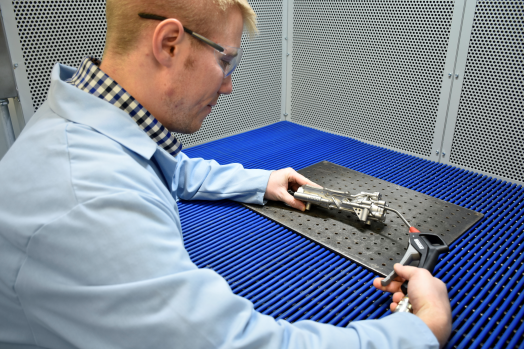
Additive manufacturing for valve design is one piece of that broader automation push, Vikin said.
Mark Covelli, senior vice president of Moog’s Space Division, said engine and valve designs that once took months to machine can now be printed, tested and revised in an afternoon, combining multiple parts into one and improving weight and thermal performance in the process.

“Today almost anybody can print a part,” Covelli said. “Our differentiation is our ability to properly design the parts for additive manufacturing. That’s a very different approach, refined over decades.”
Gruver said the throughline across every investment is the same: helping customers move faster without giving up performance.
“We want our customers to see Moog not just as a supplier,” Gruver said, “but as a company that can help them think through what’s next, how capabilities will evolve and how to create a lasting strategic advantage in a rapidly changing environment.”
Learn more about Moog at https://www.moog.com/smd
Moog videos
Facility Expansion for the Golden Dome Initiative
Moog's Multi-Domain Solutions for America's Golden Dome
Moog Infographics
Moog Defense Infographic
Moog Space Infographic