This article is published in Aerospace Daily & Defense Report part of Aviation Week Intelligence Network (AWIN), and is complimentary through Sep 13, 2026. For information on becoming an AWIN Member to access more content like this, click here.
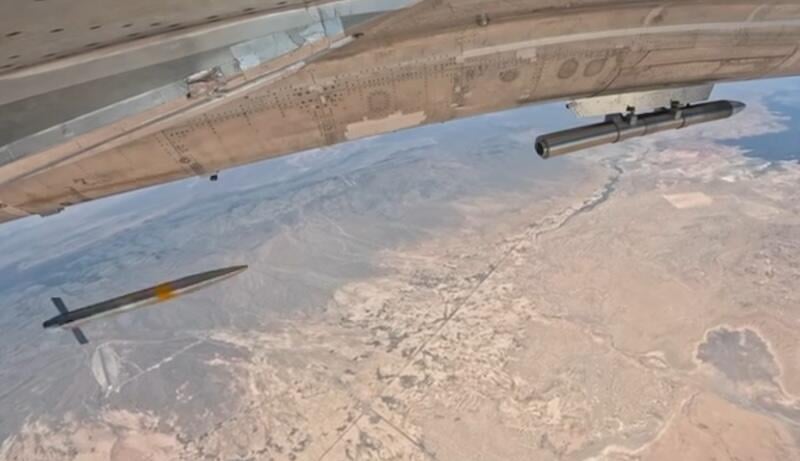
High-speed aircraft developer Hermeus has successfully deployed an inert weapon from its Quarterhorse Mk. 2.1 unpiloted vehicle over New Mexico.
The store separation test was conducted under the U.S. Defense Innovation Unit’s (DIU) Hypersonic and High-Cadence Airborne Testing Capabilities (HyCAT) program, for which Hermeus recently secured a $159 million contract modification.
Hermeus is one of several aerospace companies involved in HyCAT, which is designed to prove that uncrewed aircraft can reliably reach high-Mach speeds and release payloads in flight, establishing the technical foundation for future military use cases.
A video of the store release revealed by the DIU shows a missile-like payload with deployable tail fins ejecting aft from a tube launcher mounted under the centerline of the Quarterhorse. It is unclear from the video whether the deployment occurs at subsonic or supersonic speeds.
The DIU test occurred on only the aircraft’s fifth sortie since making its first flight from Spaceport America in February and comes just over a week after the Pratt & Whitney F100-229-powered vehicle achieved a top speed of Mach 1.6.
While this is beyond the upper end of its previously announced design speed range of approximately Mach 1.25-1.50, Hermeus plans to go faster with the follow-on Mk. 2.2 vehicle, which recently arrived at Spaceport America from the company’s production site in Atlanta. Configured with variable geometry spike inlet, the Mk. 2.2 is expected to reach Mach 2-plus and demonstrate the Hermeus-developed pre-cooler.
Flight tests of the variable inlet and pre-cooler will provide Hermeus with a steppingstone towards the follow-on Mk. 3 version. This latter vehicle will be equipped with a complete turbine-based combined-cycle propulsion system incorporating the precooler, variable geometry inlet, F100 and a ramjet. The Mk. 3 is planned to demonstrate mode transition from turbine to ramjet power over speeds between Mach 2.5 and Mach 3.