This article is published in Aerospace Daily & Defense Report part of Aviation Week Intelligence Network (AWIN), and is complimentary through Sep 13, 2026. For information on becoming an AWIN Member to access more content like this, click here.

Golden Dome Faces Budget Uncertainty Amid Growth

SMD-GoldenDome 0811

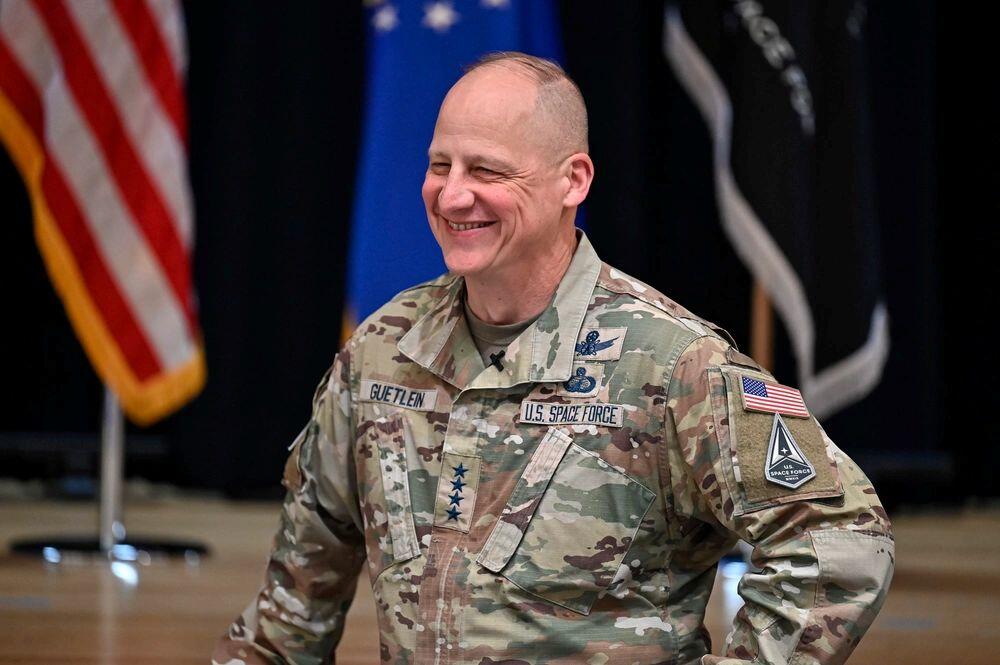
Gen. Micheal Guetlein

Credit: U.S. Air Force

HUNTSVILLE, Alabama—With a new reconciliation package seeming increasingly unlikely amid budget turmoil on Capitol Hill, the head of the new Golden Dome air and missile defense shield warns that if the additional funding is not approved, the effort would likely end.

The Golden Dome for America project started by President Donald Trump last year relies entirely on the reconciliation process for its funding, with $25 billion approved in the One Big Beautiful Bill Act. For fiscal 2027, the administration wants $17.5 billion in the mandatory funding package separate from the regular defense topline. Lawmakers have raised uncertainty about the partisan process moving forward with a continuing resolution in place to keep the government funded.

“We’ve got to figure out, as a nation, a different way of funding Golden Dome at least for ’27,” Gen. Michael Guetlein, the direct reporting program manager for Golden Dome, said Aug. 11. “Right now, that’s under reconciliation. Both sides of the aisle, as well as the House and the Senate, are working through the math about how to do this in ’27. I will tell you that if they don’t figure it out, there is no Golden Dome.”

That means the project would stop with what has been funded and delivered, far short of the goal of a meaningful operational capability by the end of Trump’s term. So far, 90% of $22.5 billion dollars in funding has been obligated and 95% committed. This includes contracts for radars, launchers, space-based interceptors (SBIs), hypersonic tracking systems, the Space Data Network and military construction, Guetlein said in a major update on the overall project at the Space and Missile Defense Symposium here.

There have been discussions within the Pentagon on how to proceed if reconciliation does not pass. Many of the program’s capabilities have been requested by combatant commands and military services are also funding some of the components. For example, the Space Force can increase its spending on certain programs without Golden Dome’s own funding.

“There are some alternatives that we can pursue,” Guetlein says. “We have not made any decisions on any pathway.”

SBIs have seen some uncertainty as part of the overall Golden Dome architecture, with Guetlein himself raising concerns about whether they are affordable. In testimony in the spring, he told lawmakers that if boost-phase intercept is too costly, it will not go to production and instead there are other options to address the challenge.

Space Systems Command (SSC) has started a four-stage “prize-based” competition for SBIs leading to demonstrations. The stages, or gates, are: 1. Initial design and component level testing. 2. Building a capability that can go into space. 3. Proving the capability can work in outer space. 4. Proving that it can work as part of the broader Golden Dome architecture.

That first gate recently wrapped, and Guetlein says he has been told by SSC that “all providers look positive and will continue into gate two.”

Once all four stages are completed, “then we will make a decision: is it affordable and scalable,” he says. Until then, there has not been an operational request for production capabilities.

Guetlein in his discussion also previewed the increasing role that artificial intelligence will play in Golden Dome. AI systems will take in broad sensing data—from the military, the intelligence community, commercial providers and others—and rapidly help determine what system would be best to go after the threat. Operators will be able to select how much automation for the process, from none to fully automated responses.

“Because as the fight starts to become exceptionally dynamic, we’re going to want to go further and further toward automation because it’s going to be progressing at machine speed, faster than human speed,” he says.

As the architecture comes together, Guetlein says that three weeks ago Trump signed a new National Security Presidential Directive that gives him access to any and all government data that he deems necessary.

“How novel is that? I don’t have to say, ‘Mother, may I?’ I just say I need that data and they have to give it to me, per the President of the United States,” he says. “That will allow us to go a lot faster.”

The Pentagon announced Aug. 11 that it created a new website designed for commercial providers, venture capitalists and academic research to securely submit their own ideas for contributing to Golden Dome: hub.goldendome.mil. Guetlein says he personally has met with 500 companies since the program was stood up to gather interest and ideas.

While there is uncertainty going forward, Guetlein argues the one-year-old project has shown progress and proven that there is a need for a system to protect the homeland.

“The threat has been persistent for decades. The threat is not going away. So the need for Golden Dome is not going to go away,” he says. “So no matter what happens going forward, we still need this capability, whether it’s called Golden Dome or something else and ... as a nation, we owe it to our citizens to protect and defend them. We’ll continue to pursue something to get after the threat.”

Brian Everstine

Brian Everstine is the Pentagon Editor for Aviation Week, based in Washington, D.C.