
Golden Dome Is Fast-Tracking Advanced Homeland Defense Capabilities.
Milliseconds Matter
Upholding America’s national security is more critical, and challenging, than ever before. A wide range of adversaries have and continue to develop threat capabilities that threaten the American homeland.
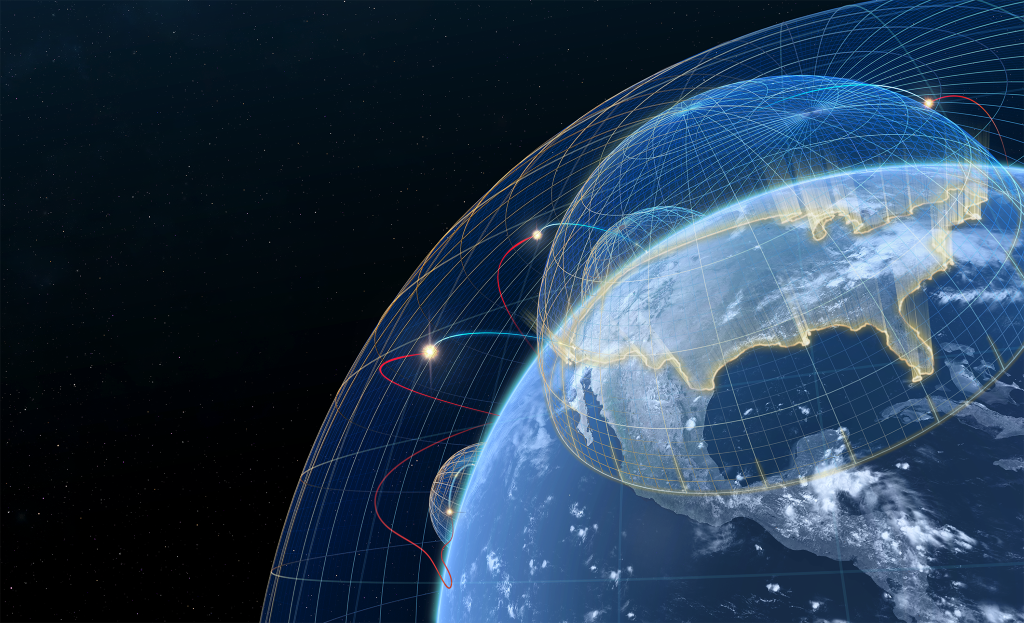
Addressing this unprecedented threat landscape requires the nation to lean into our missile defense legacy while thinking beyond what was done in the past. Weaving together experience and innovation, the U.S. government is partnering with industry to rapidly field a Golden Dome for America — an end-to-end, integrated homeland defense ‘system of systems’ to protect the American people.
“As threats evolve and emerge, this once-in-a-generation initiative is urgently needed,” said Vice President Raymond Sharp, who leads Northrop Grumman’s Golden Dome efforts. “Northrop Grumman is bringing our missile defeat thought leadership to get after this problem. We have ready-now technologies and products that are essential to a strong Golden Dome capability.”

Countering the Threat
Imagine a missile event as freeze-frames of a film. In the first frame, a missile launches; the following frames form its trajectory towards its target, which looks different depending on whether the missile is a traditional long-range ballistic missile, a high-speed hypersonic missile or a shorter-range cruise missile. If the missile continues unmitigated, the final frame will show the weapon reaching its target.
There’s always something happening off-camera. Even before a weapon is launched, America’s integrated sensing systems in space, in the air and at sea provide indications and warnings of impending attacks. Through Golden Dome, the U.S. will expand capabilities that prevent and disrupt missiles from launching at all.
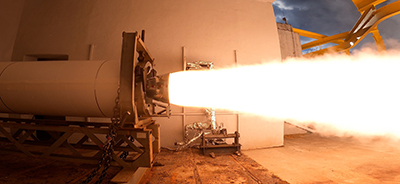
If an adversary does execute a missile attack, it will likely be multiple missiles at once requiring a robust missile defense architecture. Today, the U.S. fields a range of surface-launched kinetic interceptors, which are powered by solid rocket motors and neutralize incoming ballistic, hypersonic and advanced cruise missiles in and above the atmosphere. Through Golden Dome, an integrated network of space-based interceptors would be fielded — an innovative concept requiring cutting-edge technologies and deep-rooted space and missile defense expertise.
“Interceptors are a powerful tool in our nation’s arsenal for countering a range of threats, and Northrop Grumman has delivered this capability for decades,” said Wendy Williams, Vice President and General Manager, Northrop Grumman Launch and Missile Defense Systems Division.
The Eyes and Brains of the Mission
Once a threat is launched, the nation’s warning systems detect the launch, identify the type of threat and track its trajectory, all in a matter of seconds. For decades, Northrop Grumman has been a key provider of the systems, payloads and algorithms that enable this critical capability.
“Missile warning and tracking systems are our nation’s eyes in the sky, delivering a decisive advantage,” said Chris Adams, Vice President and General Manager, Northrop Grumman Strategic Space Systems Division.
The information from these systems is delivered via ground-based technologies to sites that employ sophisticated software to process and fuse the data, conveying a 3D-fidelity view of the situation to decisionmakers and warfighters.
Currently, multiple regional and branch-specific command and control (C2) systems direct U.S. responses to foreign missile threats in specific theaters of operations. Through Golden Dome, these C2 systems would be integrated to provide a real-time picture of the global battlespace of missile threats. This would enable existing regional C2 systems, like the Integrated Battle Command System, to take data collected by sensors like the AN/TPS-80 Ground/Air Task-Oriented Radar — which detects, identifies, and facilitates engagement of airborne threats — and more effectively share that information.
“Northrop Grumman has been at the forefront of homeland defense for decades and is delivering advanced capabilities now,” said Raymond. “We’re ready to accelerate and innovate to address this national challenge.”