This article is published in Aviation Week & Space Technology and is free to read until Apr 22, 2026. If you want to read more articles from this publication, please click the link to subscribe.

Pentagon Set To Unveil ‘Generational’ $1.5 Trillion Spending Plan

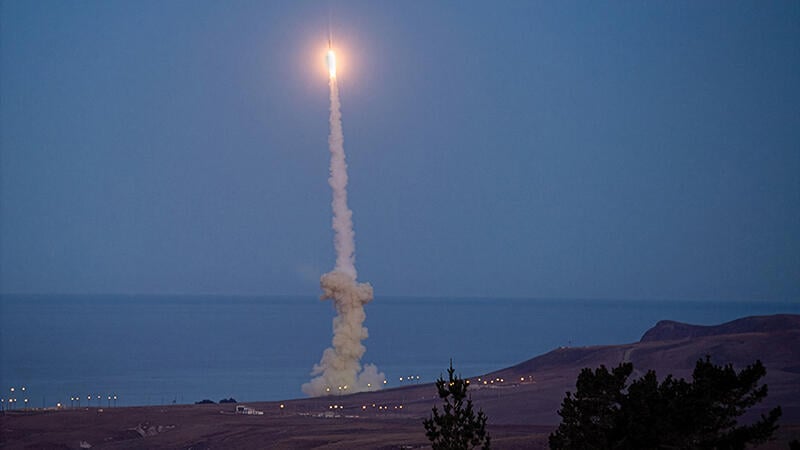
ground-based interceptor

The Golden Dome plan includes existing systems as well as new technologies at an increasing cost.

Credit: U.S. Missile Defense Agency

The Pentagon is set to take the covers off its “generational investment” in procurement and research and development as part of a $1.5 trillion budget, and despite the major uptick in spending, there are still hard decisions to be made.

President Donald Trump first raised the $1.5 trillion figure in a January social media post, prompting the Pentagon to review its plans and look for the best way forward.

“At first, I was worried that we would have trouble generating [$1.5 trillion], and then the department pleasantly surprised me,” said Jay Hurst, the Pentagon’s chief financial officer, who is performing the duties of the undersecretary of defense (comptroller). “We had to cut down significantly to get to [$1.5 trillion]. We had more ideas and more concepts for how to spend the money than we knew what to do with, so we took a long time to trim that down.”

  • Golden Dome costs are growing
  • Procurement and R&D are the top priorities

The Pentagon is expected to roll out its fiscal 2027 budget request by the end of April or possibly in early May, says Rep. Rob Wittman (R- Va.), who serves on the House Armed Services Committee. Hurst did not specify timing for the rollout, but he added that full justification books and a five-year defense plan should come in April.

“I think we’re very close—I’d say the department is mostly pencils down at this point,” Hurst said March 17 at the McAleese and Associates Defense Programs conference outside Washington.

While the Pentagon cannot specify what is in the massive request, Hurst said the investment will buy “many more aircraft, more ships, tens of thousands of critical munitions.”

He likened the Pentagon’s plan to the defense spending high under President Ronald Reagan—with a similar ratio of increased spending on procurement and research and development—compared with more recent budgets, particularly during the Global War on Terror, when the focus was on operations.

However, the Pentagon is weighing what to do with high operational costs linked to the ongoing war in Iran. In the first six days, the Pentagon spent about $11.3 billion on operations, Hurst said. Lawmakers have raised the idea of rolling a supplemental request into the overall $1.5 trillion budget top line. Although Hurst would not confirm this approach, he said it is one of multiple options Trump and Pentagon leaders could take. Defense Secretary Pete Hegseth confirmed on March 19 that a potential $200 billion supplemental request is being considered, but he said the final amount could change.

One of the top priorities for the Pentagon has been Trump’s push to create the Golden Dome for America air and missile defense shield. The effort initially had a price of $175 billion, but that has increased by $10 billion, reports Gen. Michael Guetlein, who is the direct reporting program manager overseeing the effort. The increase comes from an order to accelerate Space Force air-moving-target indication and space data network efforts, along with the Missile Defense Agency’s Hypersonic and Ballistic Tracking Space Sensor.

While Golden Dome costs have grown, Guetlein took issue with independent assessments that they could balloon into the hundreds of billions to multiple trillions. “The difference between what they are estimating and what we are building is [that] they’re not estimating what we’re building,” he said at the event.

The Golden Dome is intended to include such existing interceptor systems as Raytheon’s Patriot and Lockheed Martin’s Terminal High-Altitude Area Defense System. Some estimates drew on current cost figures for these, but Guetlein said there is a key difference: Golden Dome would be used only for homeland defense.

“That kit is very expensive; that kit is self-contained; that kit is very manpower intensive; it’s meant to operate independently on the battlefield for a different type of fight than what we have in the homeland,” Guetlein said. “We are changing that equation under Golden Dome—simplifying it, disaggregating it, if you will, to bring down that cost equation.”

The money is needed to address a threat that is growing more complex, he said. A new threat assessment released March 18 by the Director of National Intelligence bolsters that position, saying that threats to the homeland will rise to 16,000 missiles by 2035, up from the current roughly 3,000. At the same time, some adversaries are closely watching what the U.S. is doing.

“Chinese officials probably fear that the Golden Dome for America will reduce Washington’s threshold for initiating military action against Beijing in a crisis, which is likely driving China to focus on using international arms control discussions, particularly on its space-based elements,” the assessment states.

Brian Everstine

Brian Everstine is the Pentagon Editor for Aviation Week, based in Washington, D.C.