This article is published in Aviation Week & Space Technology and is free to read until Feb 25, 2026. If you want to read more articles from this publication, please click the link to subscribe.

Opinion: How The U.S. Space Force Aims To Win The Future Fight
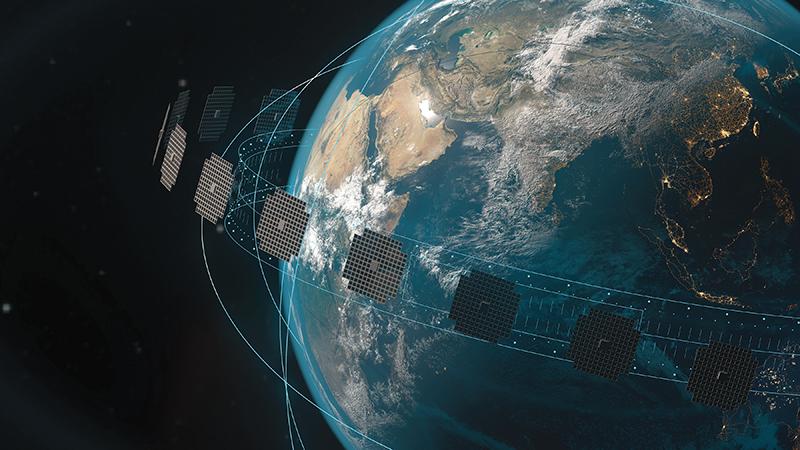
Satellite over Earth
Credit: Just_Super/iStock/Getty Images Plus

In modern warfare, defending the homeland depends on the ability to track thousands of ships, tanks, fighting vehicles, command-and-control aircraft, drones or mobile missile launchers and engage these targets with sophisticated precision munitions. The U.S. and its allies must maintain an unprecedented level of battlespace awareness as well as the ability to track targets with speed, accuracy and persistence deep into enemy kill zones. This type of global vigilance and reconnaissance could be provided by moving battlespace awareness systems up to the space layer.

To this end, the U.S. Space Force is delivering on an ambitious plan to field hundreds of satellites that can track enemy targets with a capability called moving target indicator, a mission partially fulfilled by the Joint Surveillance Target Attack Radar System. A family of satellites emitting this type of radar energy in a high-paced, collaborative cadence enables the tracking of moving targets for battlespace management purposes. Moving target indicator constellations will provide U.S. forces an unblinking eye on previously denied airspace through the forward edge of the battle area or across the expanse of open ocean. By proliferating payloads into low Earth orbit, satellites can revisit any point on the planet in minutes and provide target tracks to improve battlespace awareness at command centers around the globe. Furthermore, proliferating these types of payloads builds resilience by creating a targeting problem for any adversary that aspires to “blind” the Pentagon’s global awareness.

In addition to tracking thousands of moving targets, these satellites also produce high-capacity tactical understanding of threatening adversary activity. With more available satellite data and a higher global revisit rate, priority targets like hypersonic glide vehicle airfield hangars, aircraft carriers or nuclear missile silos can be monitored dozens of times per day. If homeland defense is a national security imperative, then Space Force moving target indicator constellations will serve as the front line of the Golden Dome. Now, with persistent monitoring, discrete tactical indications and warnings can cue U.S. military preparation earlier to defend against inbound threats to the homeland.

The accelerated development of this next-generation capability is possible due to the partnership between the Space Force and the National Reconnaissance Office. Together, they used a government-owned, contractor-operated framework for satellite development, acquisition and launch that capitalized on the speed, agility and innovation advantages of the commercial sector while remaining laser-focused on delivering timely and accurate targeting data from the space domain.

Employment of this moving target indicator constellation is enhanced through a first-of-its-kind collaboration among the Space Force and national intelligence agencies. Led by Guardians from Space Delta 7, this combined team will advance the art of tactical targeting and reconnaissance from space, orchestrate global allocation of moving target indicator resources to combatant commands and develop automated processes to curate the overwhelming amount of data produced by these satellite systems. As a result, the rest of the joint force ultimately will be armed with actionable targeting data that will contribute to increased military strike effectiveness and help save lives from unintended collateral damage.

The complexity and congestion of the future operational environment requires assured tasking and timely delivery of tactical targeting data at the speed, scope and scale of a technologically sophisticated, networked, high-end fight. The Space Force is breaking new ground with commercial partners and intelligence agencies, using agile procurement practices to deliver the warfighting target-tracking data necessary to fight and win tomorrow’s wars.

Col. Phoenix Hauser is the commander of the U.S. Space Force’s Space Delta 7, where she leads a global enterprise focused on executing intelligence, surveillance and reconnaissance operations to enable the detection, characterization and targeting of adversary space capabilities composed of on-orbit assets and their terrestrially based infrastructure.