This article is published in Aerospace Daily & Defense Report part of Aviation Week Intelligence Network (AWIN), and is complimentary through Jul 12, 2026. For information on becoming an AWIN Member to access more content like this, click here.
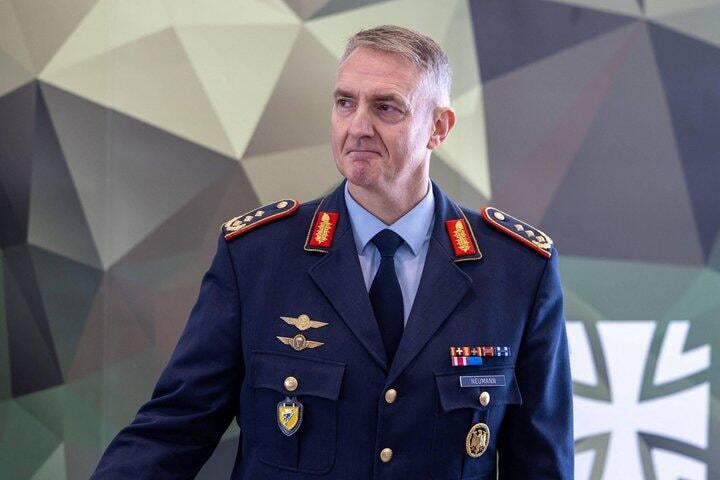
Lt. Gen. Holger Neumann is the head of the German Air Force.
BERLIN—The German Air Force is undergoing an intense period of modernization through the end of the decade that will do more than just revitalize its core air dominance role, the service’s chief of staff says.
Security developments in recent years have altered the thinking around air and space forces, Luftwaffe Inspector Lt. Gen. Holger Neumann said ahead of ILA Berlin 2026. For the Luftwaffe, which is celebrating the 70th year of its existence in the modern era, that means, for instance, adding the mission to safeguard space to its role of being able to attain and maintain air superiority, he said in written comments to Aviation Week.
Before the end of the decade, the Luftwaffe will start fielding Lockheed Martin F-35s, the first time it will fly a stealth aircraft, and introduce upgraded Eurofighter Typhoons as well as new Boeing CH-47F Chinook heavy-lift helicopters. Germany is also defining its plans for the next evolution of its fighter fleet and related elements of air combat.
“The sixth generation will encompass far more than a new combat aircraft. It will integrate a broad spectrum of unmanned platforms within a common data network, with interfaces to additional systems and other operational domains,” Neumann said.
Additionally, the Luftwaffe is introducing a range of new air and missile defense capabilities. “Strengthening ground-based air defenses is a top priority,” Neumann said.
The first Israel Aerospace Industries Arrow 3 capabilities have now arrived in Germany, giving the country its first ability to counter longer-range ballistic missiles. Germany plans to boost the number of Arrow interceptors it is buying in coordination with Israel and U.S. It also plans to add to its inventory of Diehl IRIS-T SLS short-range air defenses and field the longer-range SLM version.
A big step in the Luftwaffe’s modernization is due in the fall, when the service expects to take delivery of its first F-35, which also is supposed to serve as a central node for the service’s coming fleet of collaborative combat aircraft.
The service’s first eight F-35As will operate from the U.S. at Ebbing ANGB in Arkansas, with the first Tornado and Eurofighter pilots selected to operate the new jets. Germany opted to select pilots from both heritage fleets to reflect the multirole use of the F-35. Germany also is betting that the use of F-35s in neighboring country will foster agile combat employment operational techniques.
A year after receiving the first F-35, Germany expects to introduce the CH-47F Block II at its base in Schoenewalde. The CH-47F (DE) will replace the aging CH-53s, while enhancing special operations support, medical evacuation and civil support functions.
Five years after Germany set up a space command, the capabilities to operate in the domain are being clearly expanded, Neumann said. That encompasses more staff, various satellite constellations deployed into different orbits, including inspection satellites and those to guard its assets, Neumann added.