This article is published in Aerospace Daily & Defense Report part of Aviation Week Intelligence Network (AWIN), and is complimentary through Oct 07, 2026. For information on becoming an AWIN Member to access more content like this, click here.
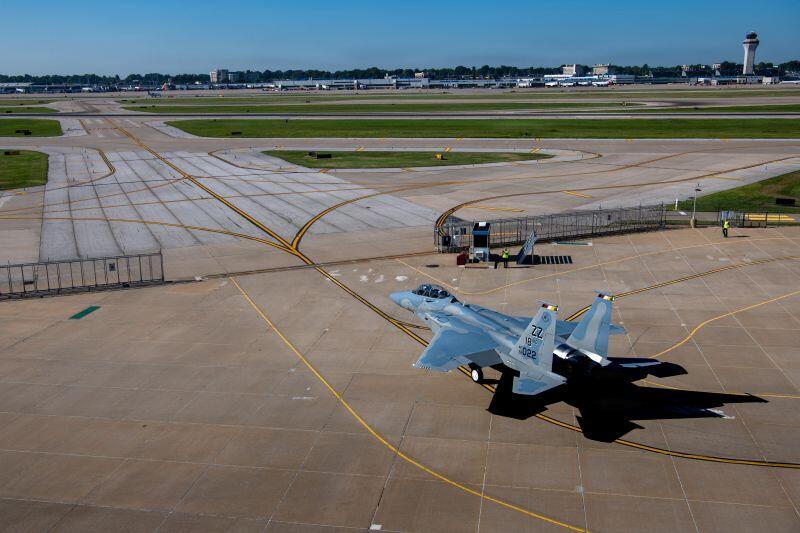
With a decision made to greatly increase the U.S. Air Force’s F-15EX program of record, the service is thinking long term about potential improvements to the aircraft as it has reshaped how it installs the major electronic warfare upgrade of its current F-15E fleet.
The service this year decided to more than double the planned procurement of the F-15EX from 130 to 268, pressing Boeing to increase production to a rate of 24 per year and potentially even more. Brig. Gen. Timothy Helfrich, the program acquisition executive for fighters and advanced aircraft, says the production ramp-up is a chance to explore the improvements.
“As we’re going to go build a whole bunch more, we need to start ... thinking about the radar, thinking about the mission computer on the F-15,” he said during a Sept. 28 Mitchell Institute for Aerospace Studies event.
The F-15 program has in many ways taken advantage of international investment by partner nations that in turn has been adopted by the U.S. Air Force. For example, the baseline Eagle Passive Active Warning Survivability System (Epawss) is based on the F-15 Saudi Digital Electronic Warfare System.
“Many of our FMS partners are already going down the path of investing in improvements in mission computer and radar capability. There are potential opportunities for the U.S. Air Force to leverage that investment by our partners to be able to get increased capability and also make sure that we can continue to produce through all of the production lots of F-15EX,” Helfrich says.
Epawss is a major focus of the F-15EX’s defensive capability, and is also being installed on the F-15E Strike Eagle. The latter program has faced significant headwinds, a recently released selected acquisition report (SAR) said.
The report says that Boeing is more than a year behind in producing kits, causing a slow integration of the system at its facility in San Antonio. In June, the Air Force stood up a new “speed line” to install Epawss on Strike Eagles at the depot at Robins AFB, Georgia.
Six F-15Es at Boeing in San Antonio were going to finish installation, with the rest of the program shifting to Warner Robins, according to the SAR, which was produced in April. Standing up the new line enables the service to “push through more quickly more modifications while keeping jets fully mission capable, so we’ve made that transition,” Helfrich says.

Related Content