This article is published in Aerospace Daily & Defense Report part of Aviation Week Intelligence Network (AWIN), and is complimentary through Sep 10, 2026. For information on becoming an AWIN Member to access more content like this, click here.
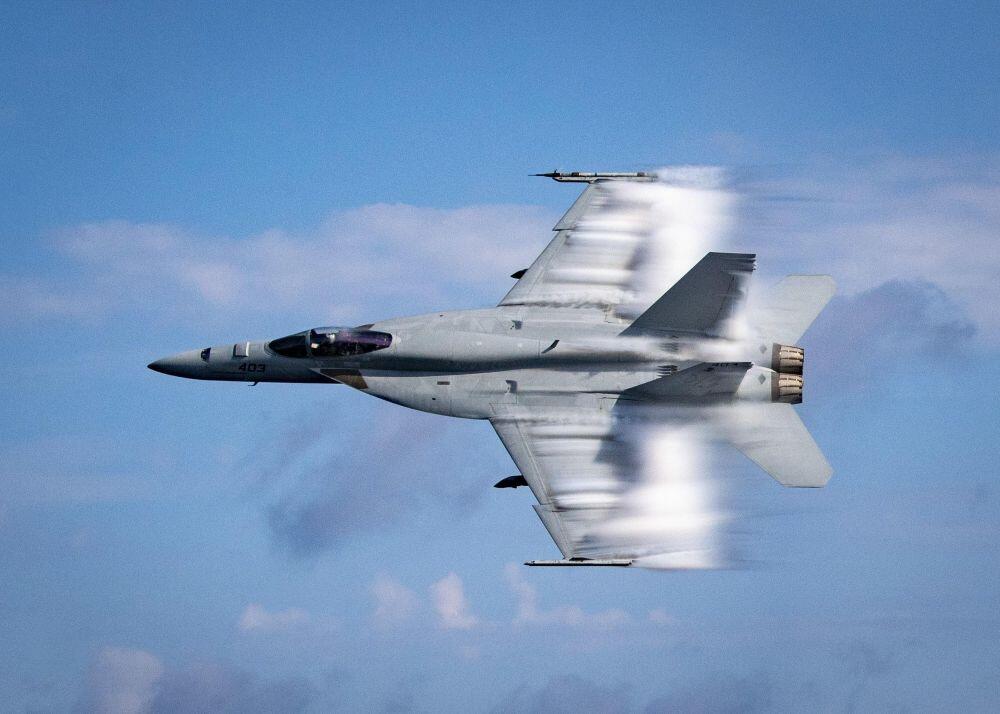
A U.S. Navy F/A-18E Super Hornet banks during flight testing.
The U.S. Navy will start fielding automatic ground collision avoidance systems on its F/A-18 Super Hornet fleet next year, with installations beginning the following year for the EA-18G Growler fleet.
The move comes after installation of the similar Automatic Terrain Awareness and Warning System (ATAWS) started on legacy F/A-18C/D Hornets this year, according to Naval Air Systems Command.
In a Sept. 2 statement, the command says the schedule is set for the Navy’s fleet over the next two years. There has long been a push for Auto GCAS to be installed on the aircraft, including multiple prompts from Congress to start. For example, the fiscal 2026 defense policy bill included a provision calling on the Navy to outline how and when it will develop Auto GCAS for the aircraft.
“In summary, Auto GCAS provides a crucial automated safety feature that complements aircrew skills and training, safeguarding against human error, aircrew incapacitation, and the inherent risks of tactical fighter operations,” a report on the House’s version of the measure stated.
The Navy budgeted $18 million in 2026 for the effort, stating it is a “significant safety improvement that could have prevented multiple fatal F/A-18 mishaps over the past two decades.”
Auto GCAS has been installed on several other combat aircraft, including F-16s, F-22s and F-35s. Boeing and the Air Force started developing a system for F-15s, and that service has outlined a goal to have the system installed on T-7A Red Hawk trainers.
The Navy in November 2025 released a solicitation for a software update to redesign the F/A-18E/F and EA-18G digital map computer and flight control computer on the Tactical Aircraft Moving Map Capability (TAMMAC) for Auto GCAS.
The aircraft have an existing Terrain Awareness Warning system that can provide alerts of potential controlled-flight-into-terrain incidents.