This article is published in Aerospace Daily & Defense Report part of Aviation Week Intelligence Network (AWIN), and is complimentary through Dec 17, 2025. For information on becoming an AWIN Member to access more content like this, click here.

Saab To Fly Software-Defined Fuselage In 2026

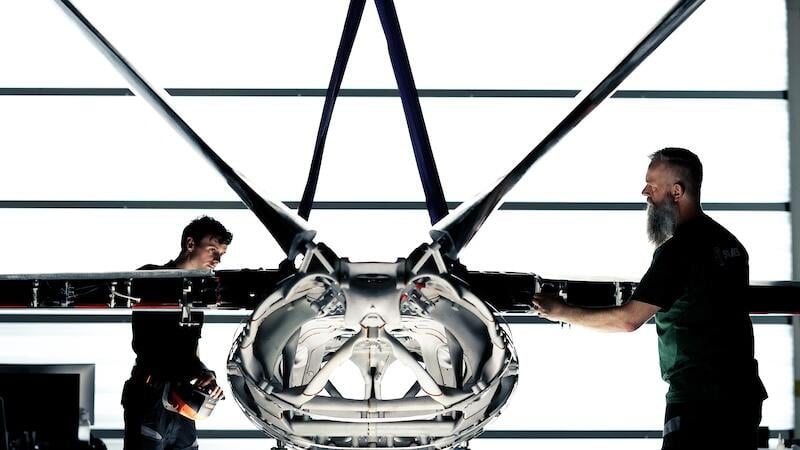
saab and divergent workers collaborating
Credit: Saab

Saab next year plans to fly an uncrewed aircraft using a software-defined fuselage as part of a company initiative to optimize processes to get equipment into the field faster.

The aim, eventually, would be to “CAD in the morning, fly in the afternoon,” says the head of Saab’s The Rainforest advanced concept organization, Axel Bååthe, in reference to taking a computer-aided design (CAD) to reality.

The fuselage is part of Ruby, a 6-7-m-wingspan, jet-powered air vehicle demonstrator to prove new production methods and cost-effective avionics using technology based on cellphone hardware. Ruby is due to be powered by a General Electric J85 from the Saab 105 jet trainer and fly from the Vidsel test range in Northern Sweden.

The initial effort involving a part that measures 5 X 1 X 0.6 m delivered reduced part count more than 99% and cut wasted material by over 90%, he said in a briefing to reporters. The part will have a payload capacity of 200 kg (441 lb.).

The fuselage that is due to fly has already completed structural proof loading, Saab said.

Saab teamed with Torrance, California-based Divergent 3D, which specializes in providing the digital design and additive layer manufacturing tools to turn the concept into a component.

Bååthe said the design evolution, in the case of the uncrewed air system set to fly next year, essentially begins by defining the basic concept of the platform in terms of required performance, service life and other high-level aspects. The software then takes over the process of thousands of engineering hours to turn that concept into a detailed digital design. The software uses a topology-optimized approach to minimize parts count and material usage.

Once designed in the software-defined manufacturing system, Divergent tools produce the part in component bricks using its printers. The software can determine how to take the entire section and split it into smaller parts that can be printed for assembly. The bricks are then assembled without the need for fixtures using a proprietary approach, said Divergent chief of programs, Cooper Keller.

Saab said the process not only generates efficiencies in terms of material and time, but also lends itself to rapidly scaling up production and adapting to requirements changes.

Using the new approach also provides more design freedom, Bååthe said. Rather than being constrained by designing shapes tooling can support, the software can optimize around physics because the parts are printed.

Marcus Wandt, Saab’s head of strategy and technology, said the effort fits with other activities the company has undertaken to speed development, such as its use of artificial intelligence to control a Gripen fighter. The company teamed with Helsing on that initiative.

Divergent currently has one factory, is breaking ground on a second and plans to add more in the U.S. over the next two years. Keller said the company is looking to set up in Europe in 2028 as part of its expansion plan.

Robert Wall

Robert Wall is Executive Editor for Defense and Space. Based in London, he directs a team of military and space journalists across the U.S., Europe and Asia-Pacific.