Reimagining Airlift As A Critical Node In Networked Warfare

For decades, U.S. military airlift and tankers have been the quiet backbone of American power, enabling the rapid movement of forces to respond to crises and project power. From combat deployments to humanitarian relief, airlift and tankers have been a reliable constant. That assumption is now being pressure tested as the U.S. prepares for conflicts in which contested skies and targeted logistics systems are the norm.
The airlift and tanker fleets underpinning U.S. global reach were largely designed for an era of air superiority. Aircraft such as the C-17 and KC-135 that have long sustained combat operations, were built to operate from secure bases along predictable routes with pre-determined re-fueling points. Adversaries have adapted, investing heavily in long-range missiles, advanced air defenses and electronic warfare (EW) capabilities to hold these large, non-stealthy aircraft at risk well beyond the front lines. In a high-end conflict, mobility and high-value airborne asset (HVAA) aircraft may be forced to operate farther from the fight, slowing the movement of forces and supplies precisely when speed is most critical.
Despite its reputation for flexibility, air mobility remains deeply dependent on fixed infrastructure. Long runways, fuel farms, maintenance facilities and secure hubs are essential to sustained operations, yet they are few in number and well known to adversaries. These nodes are attractive targets, and even limited degradation can ripple across a combat theater.
These realities have driven a reassessment from operational planners: airlift and tankers can no longer be treated as an enabler operating with impunity. They are increasingly viewed as contested capabilities requiring resilience and integration into the fight. One emerging approach is to expand what airlift and tanker aircraft contribute and receive once airborne, turning them into active participants in the DAF (Department of Air Force) Battle Network.
SNC’s Mobility and HVAA Connectivity and Survivability Solutions embody that shift. Built entirely on open architecture principles, SNC provides a modular, plug-and-play mission backbone for airlift and aerial refueling platforms. Rather than requiring costly, aircraft-specific modifications, the system allows new sensors, communications and mission applications to be integrated rapidly, extending the relevance of existing fleets while expanding their roles and increasing survivability.
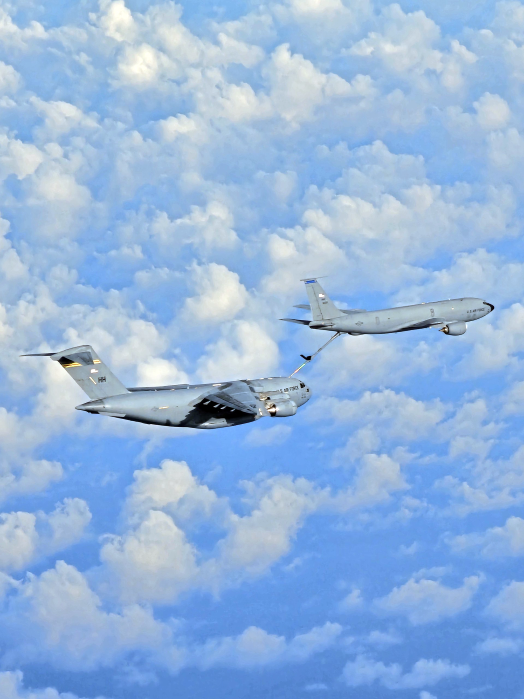
Operationally, SNC’s connectivity and survivability solution enables airlift and tanker aircraft to become multi-role platforms. A cargo aircraft might deliver humanitarian aid one day and reconfigure for intelligence, surveillance and reconnaissance missions the next. A tanker could serve not only as a refueling platform but also as a data relay, passing information between fighters, unmanned systems and command centers. In this way, aircraft that are already airborne become network nodes, enhancing situational awareness for planning, increased survivability, and command and control, rather than solely moving fuel or cargo. SNC’s Mobility and HVAA Connectivity and Survivability Solutions have flown in several exercises and in support of real-world operations.
Modular mission systems also help extract more value from legacy fleets that are expensive to replace and slow to modernize. Rather than retiring aircraft due to outdated mission systems, the military can upgrade them incrementally in line with operational needs. This approach avoids major structural overhauls while extending the usefulness of existing platforms.
None of this eliminates the fundamental challenges of airlift and aerial refueling. Aircraft will still require access, infrastructure and protection. But by turning mobility platforms into flexible, connected assets, SNC is proving that it is possible to mitigate risk and expand the mission set for these planes.
In future conflicts, the success of U.S. air mobility may depend less on its ability to operate invisibly and more on how effectively it adapts under pressure.
Related Content