This article is published in Aerospace Daily & Defense Report part of Aviation Week Intelligence Network (AWIN), and is complimentary through Mar 11, 2026. For information on becoming an AWIN Member to access more content like this, click here.

Radia Responds To U.S. Trans Comm RFI On WindRunner

WindRunner

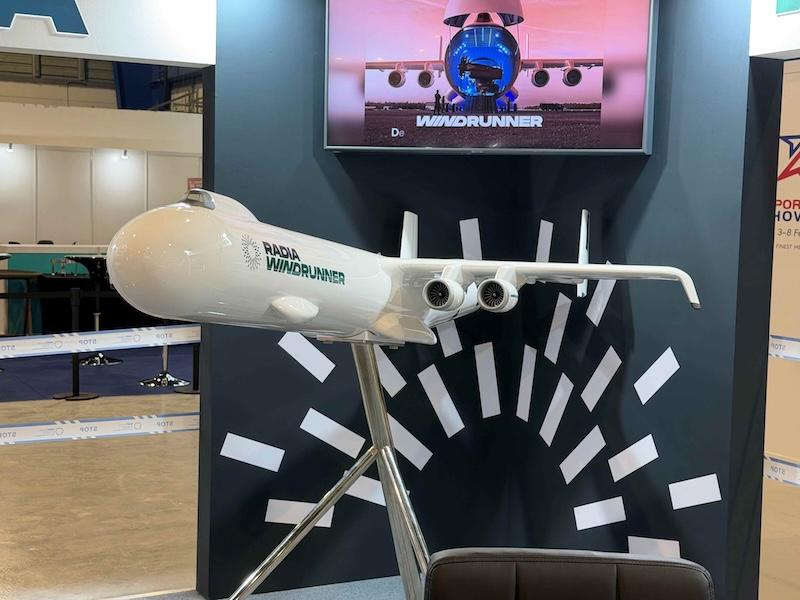
Radia is displaying a model of WindRunner at the Singapore Airshow.

Credit: Guy Norris/Aviation Week

SINGAPORE—Radia, which is developing the WindRunner outsize cargo aircraft, has responded to a U.S. Transportation Command request for information (RFI) for aircraft capable of transporting oversized Defense Department cargo, including space launch vehicles up to 300 ft. in length.

Targeted at supporting a congressional report on future large and oversized air cargo transportation capabilities, the RFI was authorized by the Fiscal Year 2026 National Defense Authorization Act and issued in mid-January. The RFI seeks an aircraft capable of entering service by the end of 2035.

“Just this last week we answered the RFI,” says Thad Bibb, Radia’s recently appointed vice president of business development for defense and a retired U.S. Air Force major general, speaking here at the Singapore Airshow. Bibb recently served as the commander of the 18th Air Force—the primary numbered air force for Air Mobility Command—from 2020 to 2022.

“We're also very excited for the CRADA we have with U.S. Transportation Command that they're interested in looking into this,” Bibb says, referring to the Cooperative Research and Development Agreement with the U.S. Defense Department to evaluate the WindRunner for military logistics and specialized transport.

The CRADA partnership, announced in May 2025, focuses on assessing the plane’s capacity for moving oversized defense cargo, such as aircraft, space components and humanitarian aid. U.S. Transport Command says it is interested in acquiring between 2,000 to 7,500 flight hours on an oversize aircraft for 2 to 5 years after it becomes operational.

With a length of 356 ft. and wingspan of 261 ft., the four-engined WindRunner is designed to transport the largest wind-turbine blades directly to onshore wind farms. But in its military guise, Radia says it could carry mission-ready loads of up to six CH-47s or four V-22s without the need for reassembly. Other potential loads include four F-35Cs or 12 AH-64s.

Despite becoming potentially the world’s largest aircraft, with 12 times the cargo volume of a Boeing 747, the airlifter is also being designed with the ability to operate from short and unprepared runways as small as 6,000 ft. The aircraft’s 10,000-ft.² area wing and Fowler flaps also are intended to enable approach speeds as slow as 100 kt. with a full payload.

Radia’s announcement comes as the U.S. Air Force works on defining the air mobility fleet that it expects to replace the C-17 and C-5M in the 2040s. Radia wants the WindRunner to be considered as a bridge to the Next-Generation Airlift family of systems—or even a full time part of a future fleet—particularly as its intended entry-into-service target of around 2030 would be well ahead of any other known new-build airlifter program.

Radia says it is at “the very tail end of conceptual design and moving on to start preliminary design,” adding this will be a phased process taking place over the next few years.

The company also sees potential for the WindRunner in Asia-Pacific region. Bibb says: “We're getting started in the Asia-Pacific where we see a real need for this capability. There's two game changers for our aircraft. One is to have an aircraft designed by volume instead of by mass. The other thing is the acquisition process. As a ‘neo’ prime, like an Anduril or a Palantir, you’ve got private investment and some national investment, and then you build and deliver it. We're not waiting for the official requirement to be written.”

“We see the need,” Bibb continues, and “we're listening to militaries throughout the world, and they've said that this is a capability they need. But we're moving out before the formal requirements are written for an outsized cargo airplane of this size.”

Guy Norris

Guy is a Senior Editor for Aviation Week, covering technology and propulsion. He is based in Colorado Springs.