Northrop Grumman Autonomy Capabilities Aid Range of Uncrewed Systems

Modern military aircraft are becoming increasingly automated. But automation and fully autonomous are not the same.
True autonomy represents a fundamental technological leap, enabling the ability for an aircraft to perceive its environment, make decisions and act within the context of its mission objectives without continuous human input. Instead of remotely controlling every movement, warfighters can set mission goals and constraints while autonomous systems manage tactical execution and adapt in real time.
That distinction becomes especially important in contested environments, where aircraft may operate beyond visual line of sight or where continuous human control is impractical. Autonomy can enable warfighters to shift from managing individual aircraft to making higher-level decisions, coordinating multiple platforms and focusing attention where it matters most.
Autonomy Beyond the Cockpit
The technology can apply to systems ranging from small uncrewed aircraft to platforms as large as a 737. Northrop Grumman has spent seven decades advancing autonomy and has accumulated more than 500,000 hours of autonomous flight experience across programs including Triton and Global Hawk. That experience provides a foundation for developing autonomous systems informed by real-world flight data, operational integration and complex mission environments.
The next step is bringing those capabilities to collaborative combat aircraft.
A Portfolio Built for Rapid Innovation
Northrop Grumman’s approach includes the Project Talon portfolio, which brings together Talon IQ, Talon Blue and Prism mission autonomy software. Together, they create an integrated path for developing, testing and demonstrating mission autonomy while reducing the risk and time associated with moving new capabilities from concept to operational platforms.
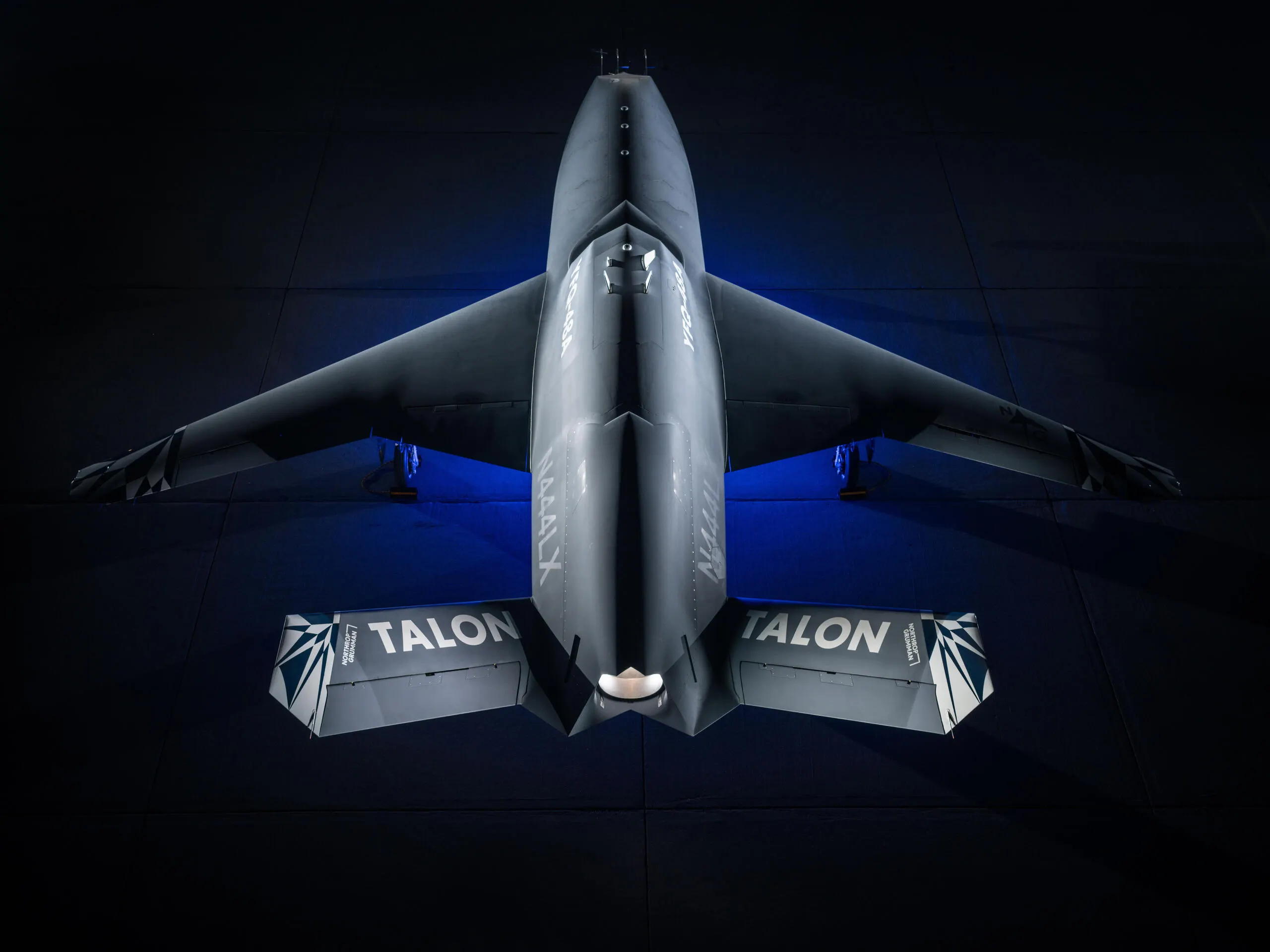
Talon IQ is an optionally autonomous testbed built around the Scaled Composites Model 437 aircraft. Its open-architecture design allows multiple autonomy software and hardware solutions to be integrated and evaluated concurrently. Developers can rapidly experiment, refine algorithms and demonstrate interoperability across different mission systems and scenarios.
Putting Autonomy to the Flight Test
Northrop Grumman’s Prism mission autonomy software has already commanded the Model 437 airframe, establishing Talon IQ as a flight-proven environment for advancing mission autonomy. Recent demonstrations have included AI-enabled autonomy software executing mission-critical behaviors on the aircraft, as well as in-flight transitions between Prism and partner autonomy solutions.
Why Open Architecture Matters
Open architecture is particularly important as the United States Air Force and broader defense community pursue autonomy solutions that can operate across different collaborative combat aircraft platforms. By enabling software components to be integrated, updated and reused across platforms, open architectures can accelerate technology insertion, support a growing ecosystem of partners and reduce development timelines.
For mission autonomy, that flexibility can help ensure new capabilities are not locked into a single aircraft, software stack or hardware configuration.
Building Autonomy from the Start
Talon Blue builds on that foundation as a self-funded, collaborative combat aircraft (CCA)-class demonstrator designed from the outset around full autonomy rather than a remotely piloted paradigm. Its purpose is to push the boundaries of intrinsic aircraft autonomy and demonstrate capabilities such as independent mission execution, advanced sense-and-avoid and human-autonomy teaming in realistic operational environments.
Starting with autonomy at the foundation allows the aircraft to be designed around the demands of autonomous operations rather than adapting an existing remotely piloted approach.
One Portfolio, Three Capabilities
The portfolio’s three elements serve distinct but connected roles. Talon IQ provides the open-architecture environment for testing and evolving autonomy, Prism provides mission-level autonomy capabilities and Talon Blue provides a flight demonstration platform for proving how those capabilities can work together.
This integrated approach allows technologies to move through experimentation, flight testing and demonstration while continuously incorporating lessons learned and new capabilities.
Turning Autonomy into an Operational Advantage
Achieving trusted autonomy still requires solving significant challenges, including AI predictability and verification, resilient communications, cybersecurity, safe separation between crewed and uncrewed aircraft and standardized interfaces and data models. Just as important is building warfighter trust through predictable autonomy behaviors and seamless human-machine collaboration.
The goal is to give warfighters intelligent, adaptable and trustworthy aircraft that can operate collaboratively in complex environments, extending reach, increasing flexibility and allowing people to focus on the decision that matters most.
By combining decades of autonomous flight experience with an open testbed ecosystem, flight-proven mission autonomy software and a purpose-built CCA demonstrator, Northrop Grumman is accelerating the future of autonomy from the test range to the operational battlefield.

Related Content