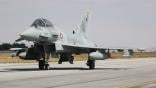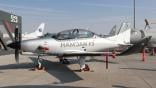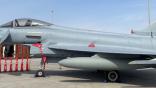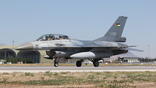
The PAC-Chengdu JF-17C Block III has been a regular exhibit at Middle East aerospace shows, in Dubai, Saudi and Bahrain.
There is intense speculation that the Iraqi Air Force (IQAF) is set to order up to 18 PAC-Chengdu JF-17C Thunder aircraft. The Pakistan Air Force (PAF) Commander, Air Chief Marshal Zaheer Ahmed Babaer Sidhu, visited Lt. Gen. Pilot Mohanad Ghalib Mohammed Radi Al-Asadi at his Iraqi Air Force HQ in Baghdad on January 10.
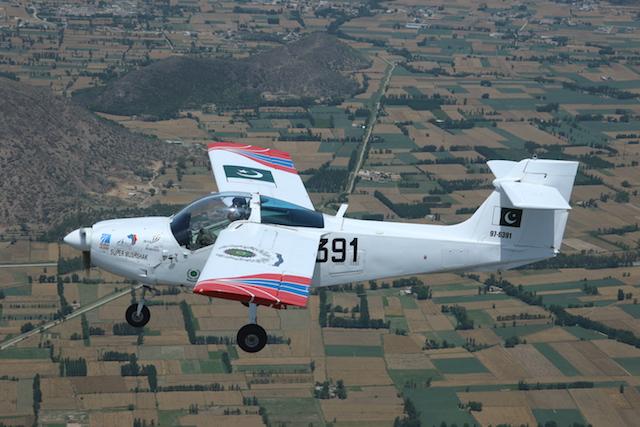
Pakistan’s official Inter-Services Public Relations (ISPR) reported that the IQAF “expressed a keen interest in JF-17 Thunder fighter jets and the MFI-17 Super Mushshak trainer aircraft”.
PAC Kamra’s Aircraft Manufacturing Factory (AMF), which builds the Super Mushshak, is also the home to the JF-17 final assembly. The sale of 12 Super Mushshaks primary trainer aircraft to the IQAF in 2023, was initially to Balad Air Base, before being transferred to the new Iraqi Air Force Academy at Al Suwehr, has cemented relations between the two sides.
The JF-17C Block III is a significantly-enhanced version of the earlier Block I and II jets, housing a Chinese Nanjing KLJ-7A active electronically scanned array (AESA) radar, that elevates the aircraft into a new sphere.
It also has an air-to-air refueling capability and the new avionics suite includes a wide-angle head-up display (HUD) in the cockpit and a new Chinese helmet-mounted display sight. For self-protection there is also an embedded Chinese electronic countermeasures (ECM) system. A new integrated Klimov RD-93MA powerplant provides an extra 5,000 lbs of thrust.
The JF-17C prowess has seen its weapons load considerably enhanced, with four weapons stations under each wing, with one housing a twin-rack, that can be fitted with two missiles. There is an additional station under the central fuselage, and a chin-mounted hard point that houses the Turkish Aselsan Aselpod targeting pod.
New Chinese air defense missiles, like the beyond visual range PL-15E and within visual range PL-10E, were on the aircraft when they went into combat with India during May 2025, providing the JF-17 with a deadly capability. The JF-17Cs flew a dangerous suppression/destruction of enemy air defenses (SEAD/DEAD) mission that destroyed the radars of India’s very capable Russian S-400 air defense system, using a high-speed Chinese CM-400AKG missile. The new Pakistani-developed GIDS Taimoor air-launched cruise missile test fired by a JF-17C on January 4 will soon become another option for the Thunder.
Saudi Arabia is also interested in the JF-17C Thunder, as part of a landmark defense pact with Pakistan, said to be worth up to $4 billion dollars. Pakistan’s Prime Minister Shehbaz Sharif flew to Riyadh to sign a ‘strategic mutual defense agreement’ with Saudi Crown Prince Mohammed bin Salman on September 17.
It came just a week after an Israeli strike on Doha, the capital of Qatar that borders a small part of Saudi Arabia east, targeted Hamas leaders attending a peace summit in the city. As a result, the Saudi government like many other Arab nations have lost confidence in the US government to protect it. A Pakistani minister said on September 17 that the Pak-Saudi strategic mutual defense agreement (SMDA) states that any aggression against either country shall be considered an aggression on both.
It’s unclear if the agreement will see the purchase of JF-17Cs or whether the Pakistan Air Force will deploy the fighter to several air bases, to provide air defense support. If this is the case, the PAF will need to acquire more Block IIIs.

Related Content