This article is published in Aerospace Daily & Defense Report part of Aviation Week Intelligence Network (AWIN), and is complimentary through Aug 14, 2026. For information on becoming an AWIN Member to access more content like this, click here.

Hensoldt Sees Pegasus Export Talks In Europe

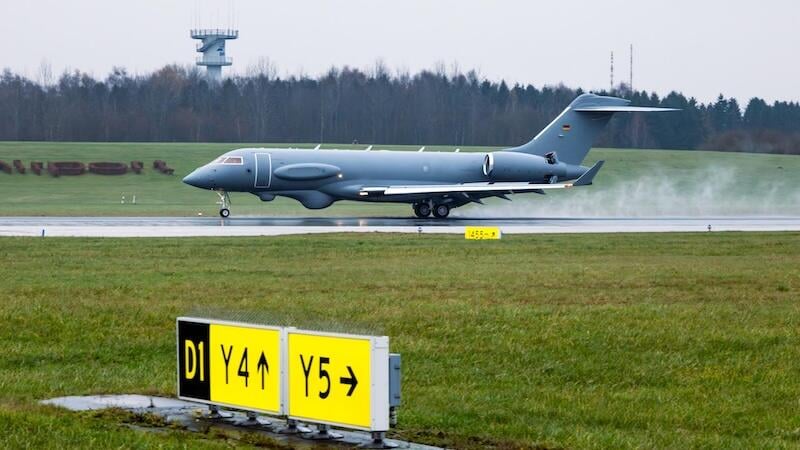
pegasus taking off
Credit: Lufthansa Technik

Hensoldt is starting to see serious export interest in Europe for its Pegasus signals intelligence aircraft as it also gears up for the competition in Germany to provide the luWES airborne electronic attack system, CEO Oliver Dörre said.

The company has “started our export campaigns with three global customers, partially also with the support of the German Air Force,” Dörre said on the company’s second-quarter earnings call.

The company initially looked globally, but the active talks now are all in Europe. In two cases those are underpinned by a strong government-to-government agenda, he added.

“I definitely see that the export campaigns are maturing,” Dörre said.

International interest is aided by how the program is unfolding, he said. “We are absolutely confident that we will hand over the first capability to the customer mid-2027, which is a bit earlier than initially anticipated.”

Hensoldt also is looking to secure a top-up order from Germany for additional Pegasus aircraft beyond the three now on contract. The company would submit the bid to the government in the coming days to then enter contract negotiations, CFO Christian Ladurner said. The company was hoping to ink the deal before year-end, though Ladurner noted that will be a race.

Hensoldt also is looking to leverage its performance on Pegasus to help secure its spot on the luWES program. The tender is likely to be released in August, Dörre said, with an opportunity ranging from several hundred million euros to multiple billions, depending on the role the company will secure. In the early days of the program, Hensoldt was unsure if it would be just a sensor provider or take a larger, program-responsibility role. Dörre said, “As we are advancing in the campaign, definitely our ambition is to go for taking a broad responsibility.”

Hensoldt, on the combat aircraft electronics side, also is dealing with somewhat of a state of uncertainty as Germany decides its path forward after the demise of the fighter cooperation with France and Spain. The decision is for the government, Dörre said. One issue on the table for Germany and Spain is, “how would we strengthen our value proposition for any program that we might join.”

Dörre stressed, though, that the company is not dependent on the fighter program to underpin its position in electronic systems for combat air assets, noting its work in collaborative combat aircraft with the likes of Helsing on the CA-1 Europa and Boeing with the MQ-28 Ghost Bat.

Hensoldt also is looking to have a key role on the future European-Ukrainian Freya ballistic missile defense interceptor project to field a Patriot-like capability, Dörre said. Ukraine is already the largest operator of the company’s TRML-4D radar. Hensoldt in June also struck an agreement with Ukraine’s FirePoint to work together on Freya, though the companies have not shared details.

Robert Wall

Robert Wall is Executive Editor for Defense and Space. Based in London, he directs a team of military and space journalists across the U.S., Europe and Asia-Pacific.