
Inside The World's First Space-Based Commercial Laser-Relay Service
The European Data Relay System (EDRS) is a new space-based commercial data-relay service that will use laser-beam transmissions between low-Earth-orbiting (LEO) spacecraft and communications satellites in geostationary orbit to reduce the time it takes to get large quantities of imagery and data to the ground. Orbiting at nearly 800 km altitude, Earth observation spacecraft transmit data routinely, but only when passing over ground stations in a handful of regions around the globe. Geostationary satellites, however, hover 36,000 km above Earth, with ground stations in permanent view, which means they can relay data from LEO to Earth at anytime.

Co-financed by the European Space Agency (ESA), Airbus Defense and Space and the European Commission, EDRS is a public-private partnership valued at more than €600 million ($638 million).
A precursor to EDRS is the experimental laser communications terminal (LCT) carried onboard Inmarsat's Alphasat commercial communications satellite (above), which launched to geostationary orbit in 2013. Built by Tesat Spacecom, a subsidiary of Airbus Defense and Space, the Alphasat LCT has been conducting laser-link tests with the European Sentinel-1A, an Earth observation satellite in LEO that carries an identical Tesat LCT.
This laser technology demonstration aboard Alphasat combines laser beam transmissions delivered from Sentinel-1A with Alphasat's high-speed downlink. The SAR satellite sends optical data to Alphasat at 1.8 Gbps, and the geostationary satellite downlinks that data in Ka-band at 600 Mbps. This is just one-third the capacity of the Tesat laser terminal. However, once EDRS becomes operational with the launch of an LCT aboard the Eutelsat 9B spacecraft later this year, that will change: “With EDRS, there is explicitly one mode that will use the full optical capacity,” says Bjoern Guetlich, a member of the laser communications team at German Aerospace Center DLR. “As soon as a user pops up and says 'I want 1.8 Gbps,' the capacity is there to downlink that via Ka-band.”
Tesat's laser terminal weighs 53 kg. Guetlich says the driver for LCT mass is the telescope aperture size, which also determines the link capability of the terminal. “If you have a large antenna, this is better for the link budget and the potential data rate. On the contrary, it could also reduce the power in the link, and that drives the mass.” Guetlich notes that while the LCT apertures on Sentinel-1A and Alphasat measure 135 mm in diameter, first-generation terminals flying aboard the U.S. Missile Defense Agency's Near Field Infrared Experiment (Nfire) spacecraft and Germany's TerraSAR-X satellite weigh around 35 kg and have an aperture of just 125 mm diameter. “It's just a few centimeters which have the consequence of significant additional mass,” he says.
Guetlich says that in tests conducted over the past few months, the link budget between the Alphasat and Sentinel LCTs (pictured with the LCT in the center of the launch adapter) has been validated as expected, and that tracking performance is excellent. “Pointing for the acquisition has always been a big concern, in terms of how well and reliably you can close the link. But both terminals performed significantly better than expected.”
Sentinel-1A during radio frequency tests (above). Orbiting from pole to pole at almost 800 km altitude, Sentinel-1A transmits data to Earth routinely via two X-band channels of 260 Mbps each—but only when it passes over ground stations in Europe. Guetlich says to transmit Sentinel-1A data to the ground via laser would be far more complex than relaying it through satellites in GEO. "We see inter-satellite links as the obvious market, because for satellite-to-ground, there is the cloud challenge; you can't transmit through the cloud with optical,” Guetlich says. "LEO operations are much more difficult because 1 min., 30 sec. before a link occurs, a cloud may move in and you have to switch to another ground station. Plus you need to establish 8-10 ground stations and fiber glass terrestrial to serve them. That's a huge cost.”
The first laser link between Alphasat and Sentinel-1A occurred on Nov. 28, 2014, at ESA's Space Operations Center in Darmstadt, Germany. Teams of operators watched as the two spacecraft linked up using laser signals stretching almost 36,000 km across space. So far, the link time between Alphasat and Sentinel-1A has run up to 20 min. and a total of 4 terabytes of data has been transmitted in each direction.
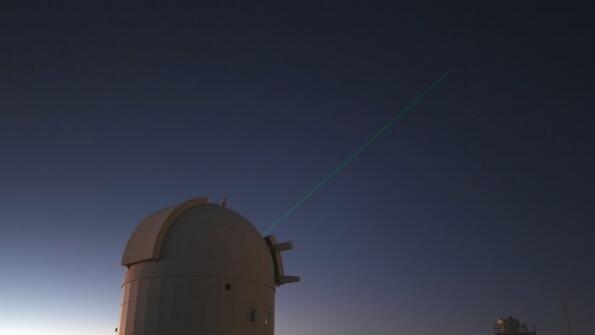
In addition to inter-satellite links, Alphasat has successfully tested GEO-to-Earth laser connectivity using a Transportable Optical Ground station with adaptive optics (Taogs) that compensates for atmospheric disturbances in space-to-ground communications. The Taogs is installed at ESA’s Optical Ground Station in Tenerife, where winter weather has lately complicated the testing regime. However, trials will pick up again in April. “We see this as experimental work, but we think Tesat's 1,064-nanometer BPSK technology may be suited to GEO-to-ground links,” Guetlich says.
During the Nov. 28 link up, the Sentinel-1A relayed an image of the semi-arid border region between Uzbekistan (top) and Turkmenistan (bottom). The northern part of Sarygamysh Lake, which straddles the border, can be seen in the lower center of the image. The image was directly transmitted almost 36,000 km across space by laser to the Alphasat telecommunications satellite in geostationary orbit, which then downlinked the data to Earth in Ka-band. All of this happened in a matter of moments and formed part of a live demonstration at ESA’s space operations center in Germany.
Tesat is now producing additional LCTs for the remaining Sentinel spacecraft under the European Commission's Copernicus program. “All together, we will have flown eight LEO LCTs on Sentinel spacecraft, two LCTs on EDRS satellites, one on Alphasat, plus the two LEO LCTs on Nfire and TerraSAR-X,” says Matthias Motzigemba, head of laser products at Tesat. “It means we see validation of the long-distance link, and there is now more security in the community to think about laser comm no longer being a technology demonstration. It's real.”
Eutelsat 9B, a communications satellite built by Airbus Defense and Space for fleet operator Eutelsat, will host the first commercial LCT under the EDRS program when it launches later this year. Known as EDRS-A, the laser terminal will allow Airbus to offer high-speed downlink over Europe to the commercial market, while maintaining the European Commission's Copernicus Earth-observation program and its series of Sentinel spacecraft as an anchor customer. Eutelsat 9B/EDRS-A will be followed next year by the launch of an identical laser terminal, EDRS-C, on Avanti Communications' Hylas-3 satellite. However, EDRS will not offer global service until a third LCT, EDRS-B, is launched to orbit. For now, ESA has not committed to financing the third leg of the project.
Before EDRS, and even before Alphasat, the U.S. Missile Defense Agency and the German government have conducted operational tests of first-generation Tesat LCT aboard the U.S. Nfire and German TerraSAR-X spacecraft in LEO. The first link was established Feb. 21, 2008. Since then, more than 500 links have been established and several terabits of data transmitted at 5.6 Gbps.
Above is a schematic view of the changing optical link path pattern between the Nfire and TerraSAR-X spacecraft. The first LEO-LEO inter-satellite link was performed above the Pacific Ocean near Central America. Continuous free-space optical transmissions were maintained for as long as the two spacecraft were within line-of-sight—about 20 min. The measured bit error rate was < 10-9. Tests were also conducted with laser transmissions to ground stations in Germany and Spain. “For more than three years we've been performing satellite links to the ground for developing a ground station using this equipment,” Guetlich says.
An artist's view of laser communication demonstrations between TerraSAR-X and Nfire (above). Guetlich says the U.S.-German experiment is expected to end this year. “It's very likely our U.S. partners will stop operating Nfire due to lifetime issues,” he says. “Nfire has already been extended for some years. However, we are still considering using the TerraSAR-X spacecraft for satellite to ground links, so we'll see.”
In the meantime, cooperation between the U.S. and Germany continues in the private sector as Tesat collaborates with drone-maker General Atomics to demonstrate ground-to-GEO and aircraft-to-GEO laser links, potentially with an MQ-9 Reaper. The demonstrations, slated for 2016 and 2017, respectively, are fully funded by the two companies, with a small contribution from the German defense ministry.
Read our special report on space telecom developments in the March 16 Aviation Week & Space Technology: Big Gains On The Horizon For Laser Communications Suppliers; Eutelsat To Order Protoype Quantum Satellite By April; OneWeb Eyes Honeywell For Broadband Aero Terminal Hardware