https://aviationweek.com/themes/custom/particle/dist/app-drupal/assets/awn-logo.svg
Skip to main content
  • Market Sector
    • Aerospace
    • Air Transport
    • MRO
    • Defense
    • Space
    • Business Aviation
  • Markets
    • Aerospace
      • Aircraft & Propulsion
      • Connected Aerospace
      • Emerging Technologies
      • Manufacturing & Supply Chain
      • Advanced Air Mobility
      • Sustainability
    • Air Transport
      • Aircraft & Propulsion
      • Interiors & Connectivity
      • Airports & Networks
      • Airlines & Lessors
      • Safety, Ops & Regulation
      • Maintenance & Training
      • Sustainability
    • MRO
      • Aircraft & Propulsion
      • Interiors & Connectivity
      • Emerging Technologies
      • Supply Chain
      • Safety, Ops & Regulation
      • Workforce & Training
      • Sustainability
    • Defense
      • Aircraft & Propulsion
      • Sensors & Electronic Warfare
      • Missile Defense & Weapons
      • Supply Chain
      • Budget, Policy & Operations
      • Sustainability
    • Space
      • Launch Vehicles & Propulsion
      • Commercial Space
      • Space Exploration
      • Satellites
      • Budget, Policy & Regulation
      • Operations & Safety
    • Business Aviation
      • Aircraft & Propulsion
      • Interiors & Connectivity
      • Airports, FBOs & Suppliers
      • Flight Deck
      • Safety, Ops & Regulation
      • Maintenance & Training
      • Sustainability
    • In Focus
      • Middle East & Africa
  • Marketplace
  • Services
    • Services
      • Advertising
      • Marketing Services
      • Fleet, Data & APIs
      • Research & Consulting
      • Network and Route Planning
      • Marketplace
  • Store
    • Market Sector

      • Aerospace
      • Air Transport
      • MRO
      • Defense
      • Space
      • Business Aviation
    • Type View All Products
      • Intelligence Bundles
        • AWIN - Premium
        • AWIN - Aerospace and Defense
        • AWIN - Business Aviation
        • AWIN - Commercial Aviation
      • Market Briefings
        • Advanced Air Mobility Report
        • Aerospace Daily & Defense Report
        • Aviation Daily
        • SpeedNews
        • The Weekly of Business Aviation
      • Directories
        • Air Charter Guide
        • Aviation Week Marketplace
        • Route Exchange
        • The Engine Yearbook
      • Data Services
        • AC-U-KWIK
        • Aircraft Bluebook
        • Airportdata.com
        • ASM Global Route Development
        • CAPA – Centre for Aviation
        • Catchment Analyzer
        • Defense Market Analyzer
        • Fleet Discovery Civil
        • Fleet Discovery Military
        • Fleet & MRO Forecast
        • MRO Prospector
        • Tracked Aircraft Utilization
      • Publications
        • African Aerospace
        • Air Transport World
        • Arabian Aerospace
        • Aviation Week & Space Technology
        • Aviation Week & Space Technology - Inside MRO
        • Business & Commercial Aviation
        • CAPA - Airline Leader
        • Routes magazine
        • Show Business
  • Events
    • Recent webinars
    • Events View All Events
      • MRO
        • MRO Americas
        • MRO Asia
        • MRO Australasia
        • MRO Baltics & Eastern Europe Region
        • MRO Europe
        • MRO Greater China
        • MRO Latin America
        • MRO Middle East
        • MRO Southeast Asia
        • Military Aviation Logistics and Maintenance Symposium (MALMS)
      • Commercial Aviation/A&D
        • Aero-Engines Americas
        • Aero-Engines Europe
        • Aero-Engines Asia-Pacific
        • Engine Leasing Trading & Finance Europe
        • Engine Leasing, Trading & Finance Americas
      • Air Transport
        • Routes Americas
        • Routes Europe
        • Routes World
        • CAPA Airline Leader Summit - Airlines in Transition
        • CAPA Airline Leader Summit - Americas
        • CAPA Airline Leader Summit - Latin America & Caribbean
        • CAPA Airline Leader Summit - Australia Pacific
        • CAPA Airline Leader Summit - Asia & Sustainability Awards
        • CAPA Airline Leader Summit - World & Awards for Excellence
        • GAD Americas
        • GAD World
      • Aerospace and Defense
        • Defense Conference
      • Awards
        • Aviation Week 20 Twenties
        • Aviation Week Laureate Awards
        • ATW Airline Awards
        • Program Excellence Awards and Banquet
        • CAPA Asia Aviation Summit & Awards for Excellence
        • Space Tech Challenge Awards
  • About
    • About Aviation Week Network
      • Our Story
      • Content and Data Team
      • Aviation Week & Space Technology 100-Year
    • Contact Us
      • Subscriber Services
      • Advertising, Marketing Services & List Rentals
      • Content Sales
      • Events
      • PR & Communications
      • Content Licensing and Reprints
      • FAQ
  • Log In
  • Register
  • My Account
    • Profile
    • Sign Out
  • AWIN Access
  • My cart
    Back to
  1. Space

Share

Ingenious Ingenuity Paves Way For Follow-On Mars Rotorcraft

Guy Norris April 23, 2021
Ingenuity helicopter
Credit: NASA/JPL-Caltech

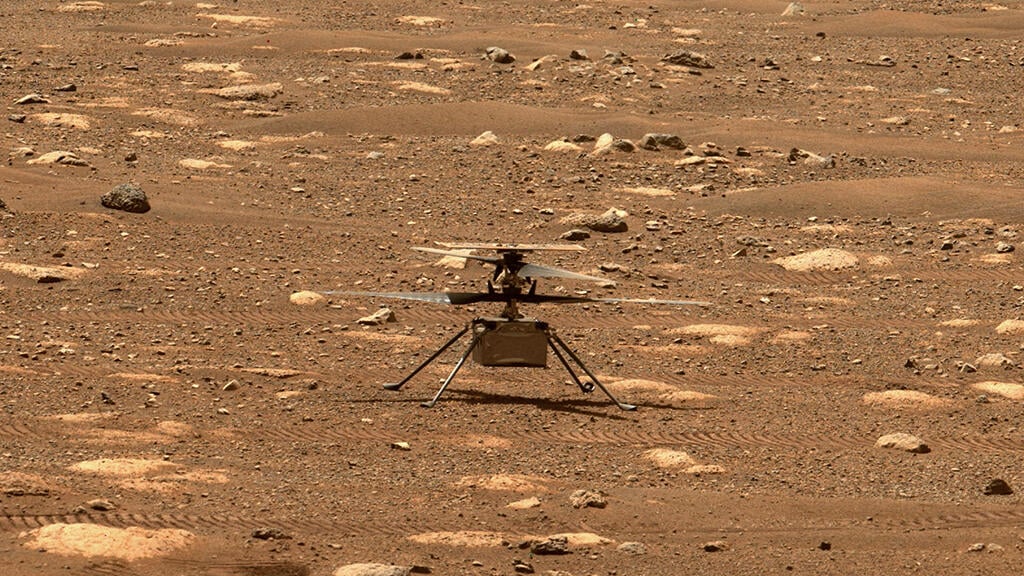
Carried to Mars beneath the Perseverance rover, the 4-lb. Ingenuity helicopter was deployed to the surface on April 4. The test site, in Jezero Crater, was named Wright Brothers Field in honor of the pioneering aviators Orville and Wilbur Wright, who made the first powered flight in 1903. The International Civil Aviation Organization also ceremonially designated the site JZRO—for Jezero Crater—and allocated the flight designator IGY-1 to the helicopter along with the call sign “Ingenuity.”

Ingenuity
Credit: NASA/JPL-Caltech

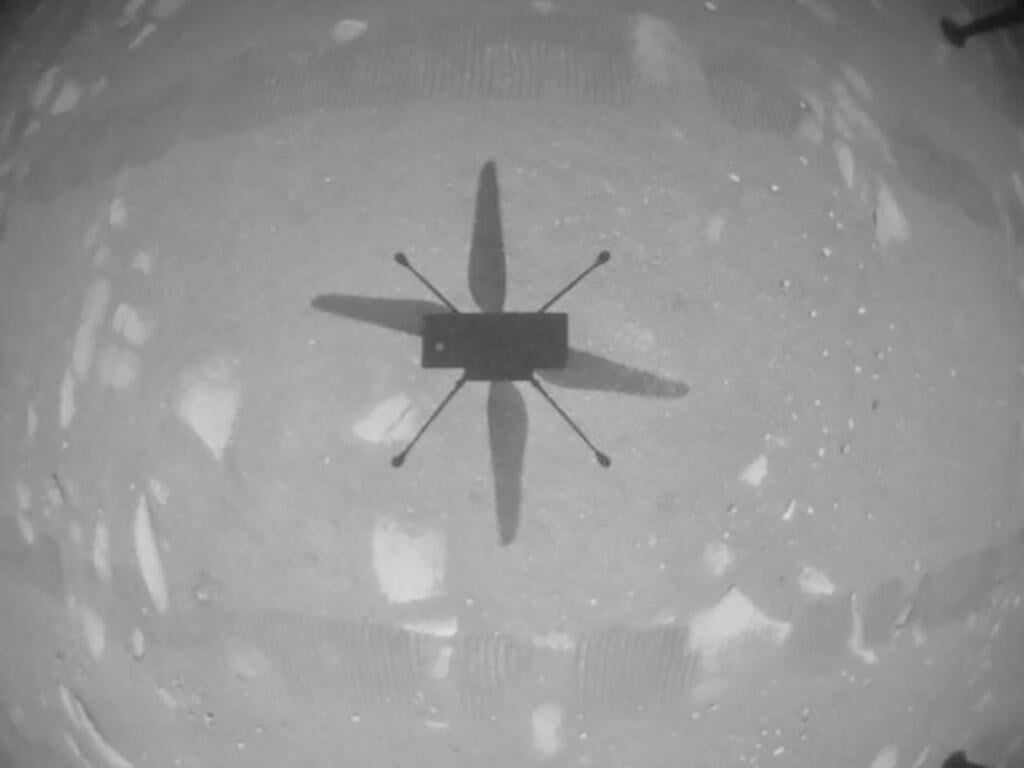
The first flight, which occurred at 12:33 Local Mean Solar Time (Mars time) on April 19, began with a vertical ascent into a hover at 10 ft. for 5 sec., followed by a 96-deg. clockwise turn to allow the helicopter’s onboard camera to point in the direction of the rover. Ingenuity maintained a stable hover in this position for a further 20 sec. before descending at 3.2 ft./sec. to land just inches away from its takeoff location. Images relayed from the helicopter’s downward-pointing navigation camera just prior to touchdown revealed one surprise: The rotors kicked up less dust than expected.

Ingenuity
Credit: NASA/JPL-Caltech

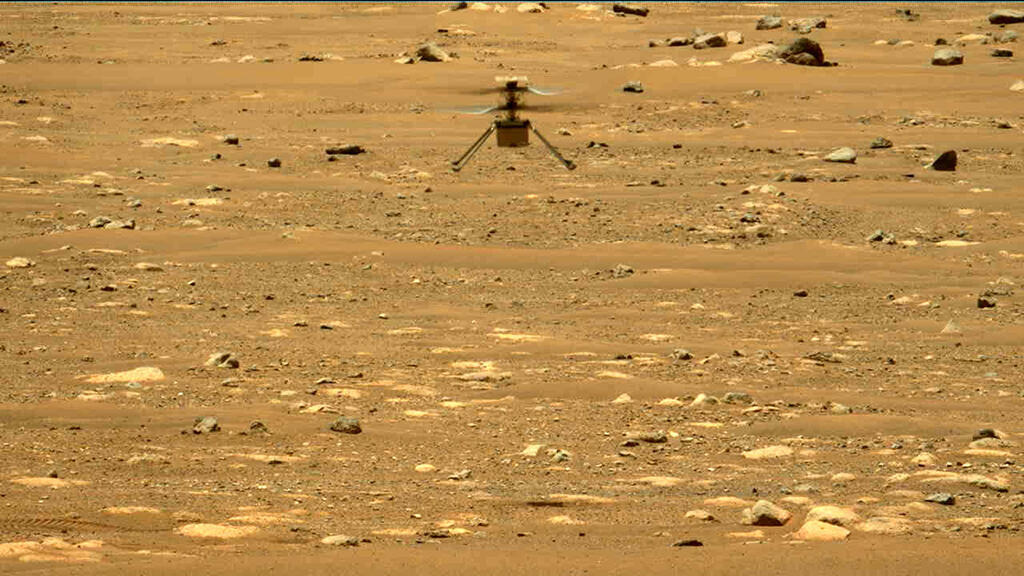
For its second flight test on April 22, Ingenuity climbed to 16 ft. and hovered briefly before executing a lateral maneuver. To perform this the flight control system commanded a 5-deg. tilt, allowing some of the thrust from the contrarotating rotors to accelerate the craft sideways for 7 ft. The 51.9-sec.-long flight forms part of a planned five-flight test program designed to push the edges of the rotorcraft’s performance envelope to its limits. The final flight, if executed as planned, could see Ingenuity fly to a site almost 2,000-ft. away from the rover before attempting to return.

Ingenuity diagram
Credit: NASA/JPL-Caltech

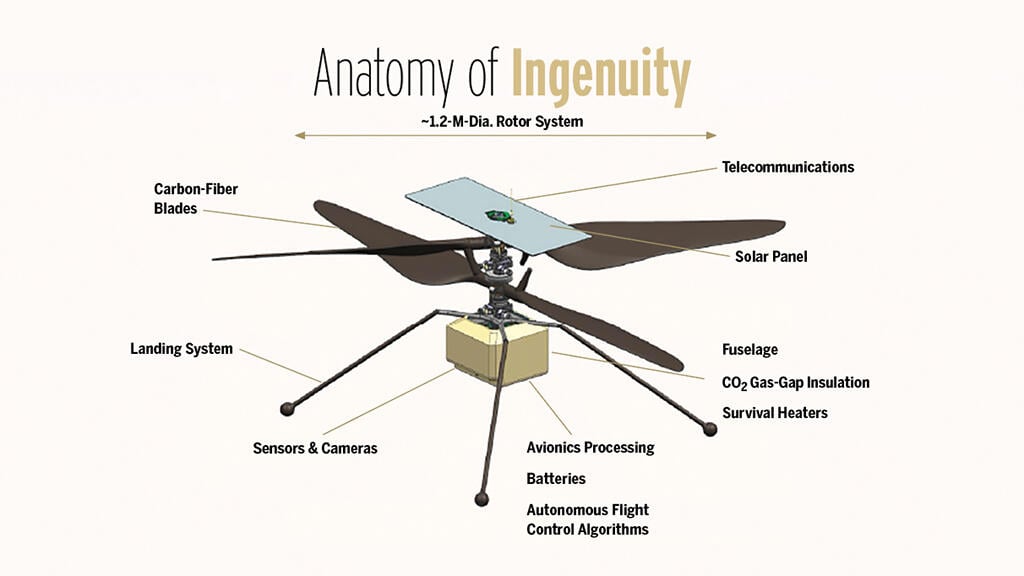
Designed purely for proving the concept of controlled flight in the thin Martian atmosphere, Ingenuity is a technology demonstrator and therefore carries no science payload. The coaxial 4-ft. rotor-diameter blades feature collective and cyclic control on both rotors and operate at a maximum speed of 2,800 rpm—compared to 400-500 rpm for small helicopters on Earth. Limited battery life means the helicopter is designed for just five flights—over 30 Mars days or sols—with a maximum endurance per flight of around 90 sec. Half the battery capacity, even when boosted by solar cells, is allocated to keeping Ingenuity warm during the frigid Martian nights.

Mars Science Helicopter chart
Credit: NASA

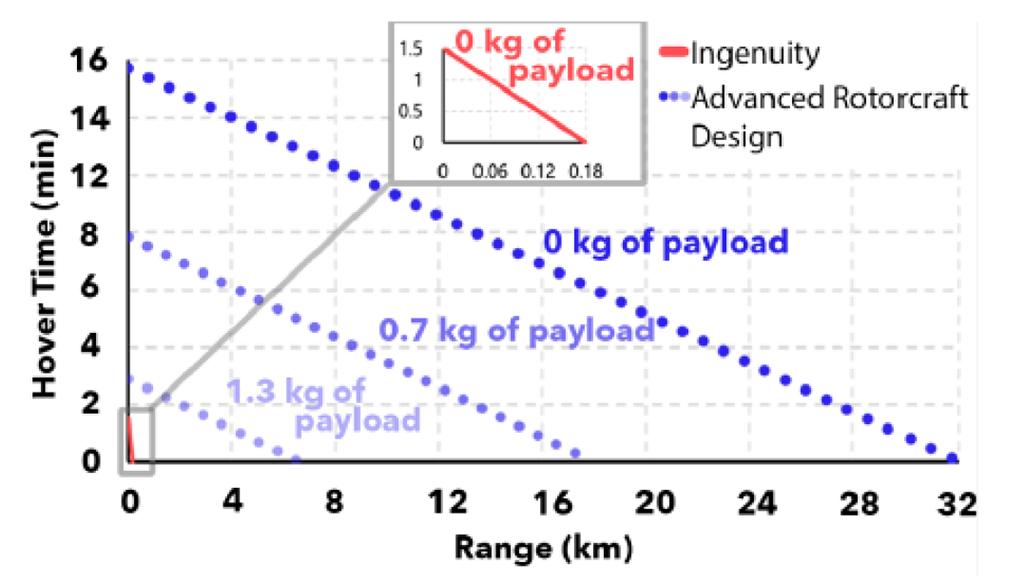
For a future mission NASA has studied various Mars Science Helicopter (MSH) concepts with optimized rotor designs that will enable a substantial increase in science payload capability, range and hover time. The huge increase in capability, seen in this payload-range chart, contrasts with the very limited performance of the first-generation Ingenuity rotorcraft (in red).

MSH vehicle concept design
Credit: NASA

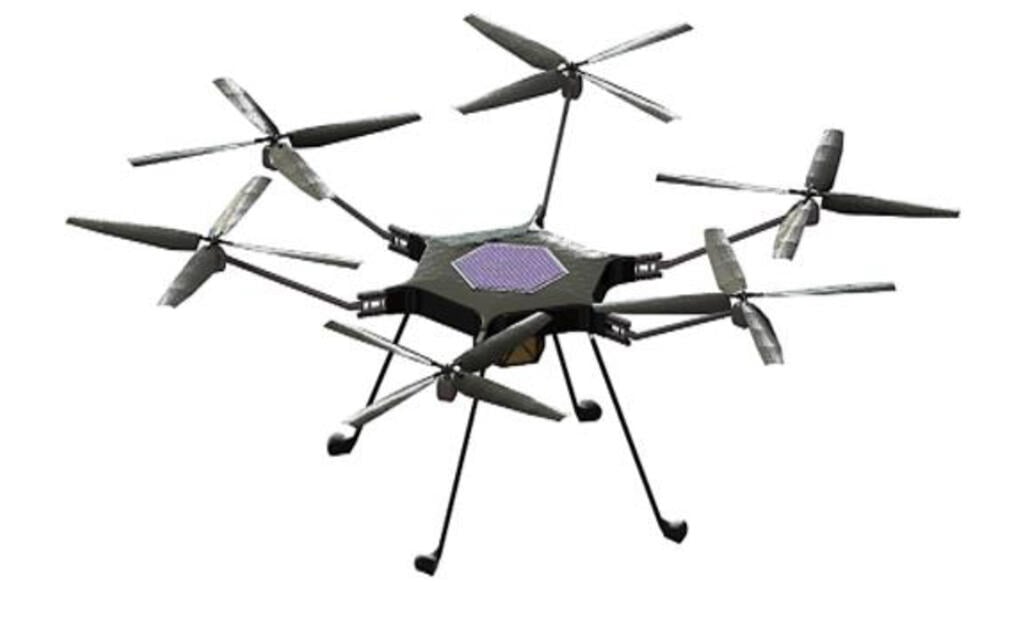
NASA’s MSH study with the Jet Propulsion Laboratory (JPL) and the agency’s Ames Research Center has developed three vehicle concept designs—one of which is a large hexacopter with a rotor diameter of 4.2 ft. and mass of around 44 lb. Multirotor designs with at least six rotors provide redundancy, enabling missions to be completed even if a rotor is damaged or a motor fails. Because of the thin Martian atmosphere designers have opted for controlling the rotorcraft using collective pitch rather than variable rpm—as used by small multirotors on Earth.

MSH compound tiltrotor design
Credit: NASA

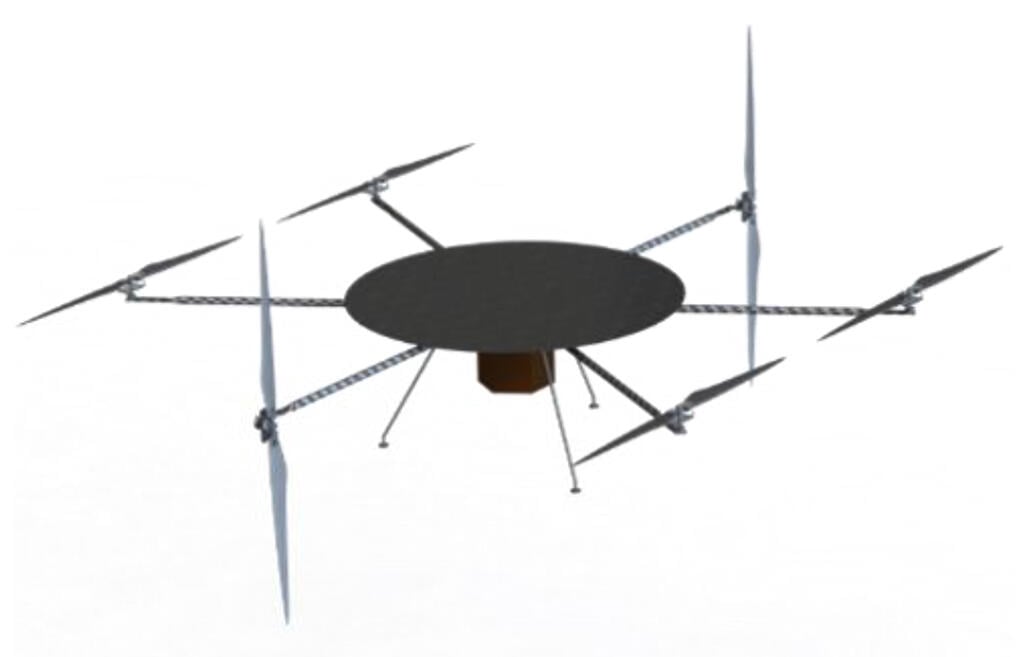
Although wings are not as useful on Mars as they are on Earth because of the low air density, a compound tiltrotor design including rotors, pushers, pullers and wings could still be a potentially viable candidate for longer-range science missions. The surface area of the wing could provide some lift as well as a bigger space for a larger solar panel. Thrust vectoring using the rotors could also allow use of simpler fixed-pitch rotors in place of the more complex collective mechanism of the multirotor.

MSH coaxial tiltrotor
Credit: NASA

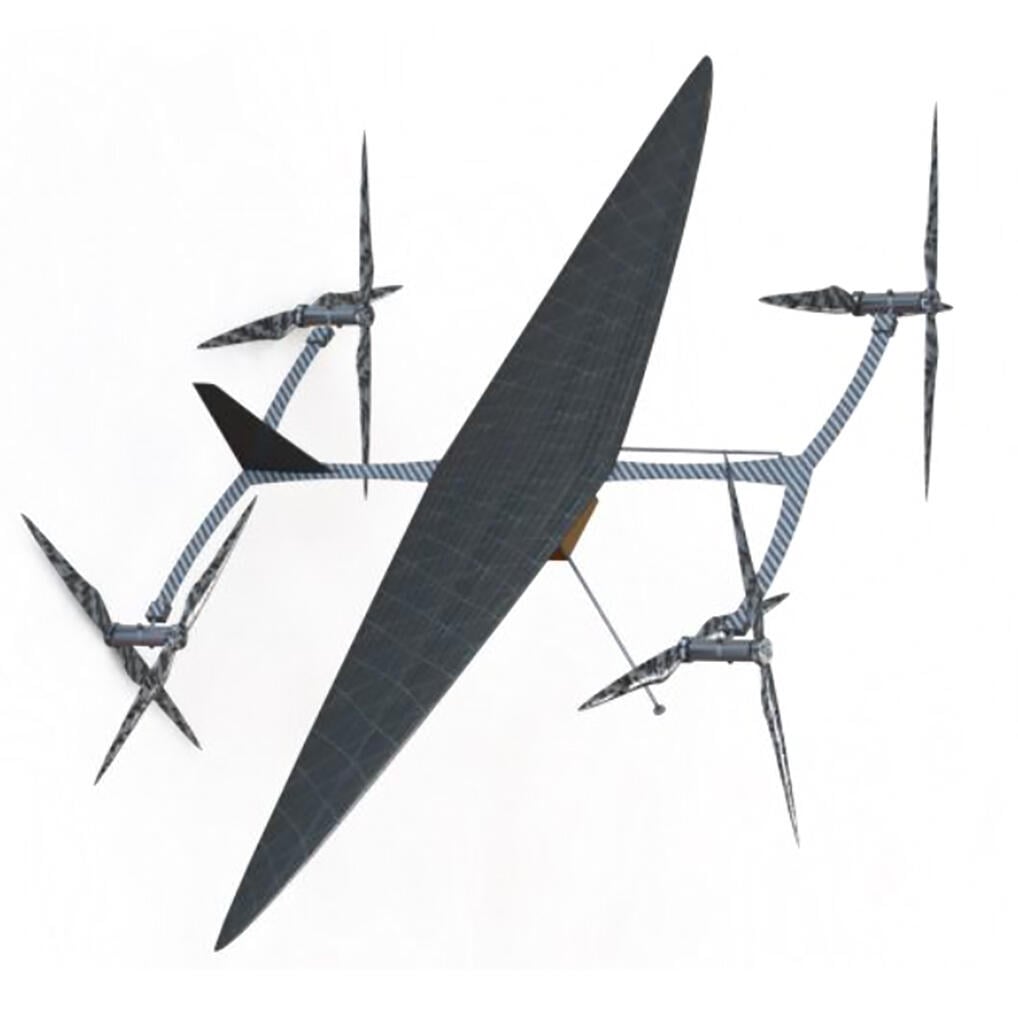
Another option under study for a future Mars vehicle is a coaxial tiltrotor that combines the idea of a winged craft and tilting rotors—capable of tilting at an angle between 0-90 deg.—with overlapping blades. The approach, which is similar to aspects of the Ingenuity coaxial configuration, offers added redundancy and antitorque benefits but poses a challenge for packaging in the delivery spacecraft as well as for mass.

MSH hexacopter storage design
Credit: NASA

Getting the vehicle to the surface of Mars will require ingenious packaging concepts such as this MSH hexacopter storage design. With arms and rotors folded origami-like into the aeroshell, the vehicle would be deployed by extending its elements either by linear­—or telescoping—motions, or by unfolding uses hinged sections.

Previous
Next

NASA’s Ingenuity Mars Helicopter achieved a breakthrough for space exploration on April 19 when it hovered successfully over a site close to the Perseverance rover, marking the first time a vehicle has performed a powered, controlled flight on another planet. The short flight test effort aims to prove rotorcraft and other aircraft types could play a key role in future planetary exploration, surveying and collecting samples from areas inaccessible by other means. Encouraged by Ingenuity’s success to date, NASA is already designing follow-on vehicles.
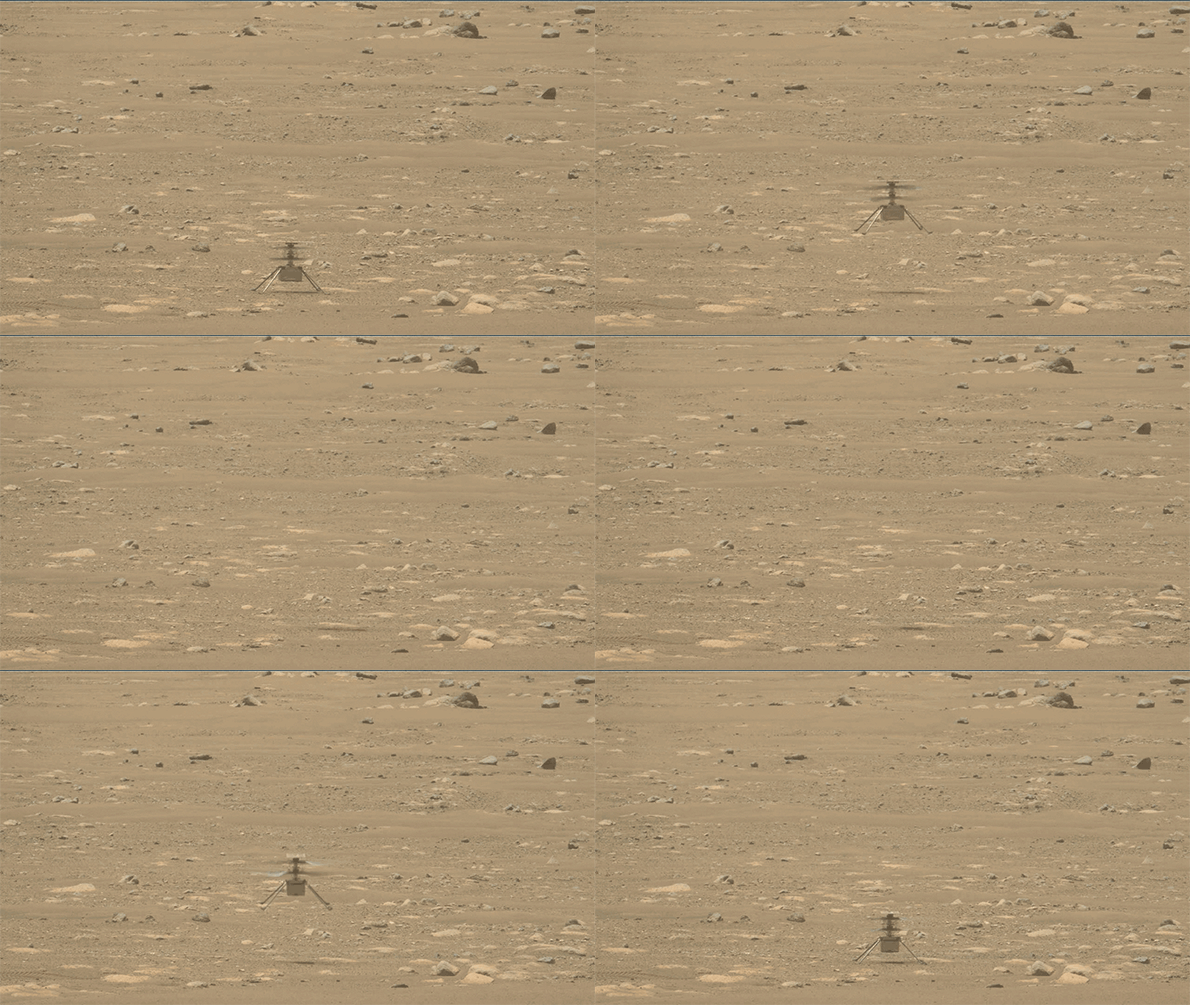
Ingenuity flies on Mars

Credit: NASA/JPL-Caltech

Guy Norris

Guy is a Senior Editor for Aviation Week, covering technology and propulsion. He is based in Colorado Springs.

Related Content

Six Decades Of Mars Exploration

Follow us on

Markets

  • Aerospace
  • Air Transport
  • MRO
  • Defense
  • Space
  • Business Aviation

Products

  • AWIN Intelligence Bundles
  • Market Briefings
  • Publications
  • Data Services
  • Directories
  • Resources

Contact Us

  • Subscriber Services
  • Advertising, Marketing Services & List Rentals
  • Content Sales
  • Events
  • PR & Communications
  • Content Licensing and Reprints
  • FAQ

Other Resources

  • Aviation Week Marketplace
  • Knowledge Center
  • Newsletters
  • ShowNews
  • Advertising - Media Kits
  • Japanese 日本語
  • Korean 한국인
Copyright © 2025. All rights reserved. Informa Markets, a trading division of Informa PLC.
  • Accessibility
  • Privacy Policy
  • Cookie Policy
  • Terms of Use