
ESA's Planck Mission Buys Time: Star Formation Began Later Than We Thought
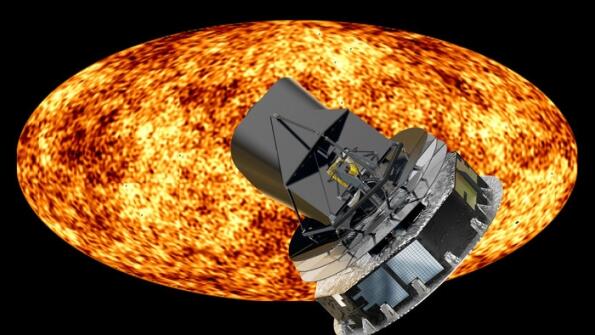
The first stars began to populate the universe later than previously believed, perhaps 100 million years or so later, according to new studies of the Cosmic Microwave Background by astronomers associated with the European Space Agency's Planck space observatory.
In round numbers, their assessment points to a start of star birth 550 million years after the Big Bang, rather than 450 million years.
The refinement was made possible by examining the polarization of the CMB from "all sky" surveys made with Planck between its launch in 2009 and the 2013 conclusion of its extended mission.
The change, small in the scheme of a 13.8 billion year old universe, nonetheless promises to make it easier to detect and characterize the first generation of galaxies at infrared wave lengths with the NASA-led James Webb Space Telescope and other future observatories of its class. The JWST, scheduled for launching in October 2018, is the designated successor to the near 25-year-old Hubble Space Telescope, which has also glanced back at the cosmic frontier in search of the earliest star systems.
Planck scientists presented their refinements of cosmic history on February 5, based on images of CMB polarization at new higher resolution.
"This provides a powerful tool to estimate in a new and independent way parameters such as the age of the universe, its rate of expansion and its essential composition of normal matter, dark matter and dark energy," noted François Bouchet of the Institut d'Astrophysique de Paris, France, in an ESA statement.
The CMB originated when the universe was hot and dense, about 380,000 years after the big bang, based on prevailing timescales. As the universe expanded, the CMB travelled along providing a modern day fossil record of the earlier era penetrated by Planck and other space telescopes like NASA's Cosmic Background Explorer and Wilkinson Microwave Anisotropy Probe.
During that hot early phase, electrons, protons, neutrinos and particles of light, or photons, were confined by constant collisions. As they gradually escaped with expansion of the universe, the elemental particles combined into neutral particles and the light parted company. Subtle temperature differences in that CMB detected with Planck represent the seeds of the first stars and galaxies.
With its higher resolution, Planck was able to shave 100 million years off the previous estimates for the earliest star formation.
But the process of reaching the new estimate was complex.
As the early stars emerged, their light collided with the neutral particles, initiating a new epoch: re-ionization and more collisions between electrons and light particles. Even in the expansion of the younger universe, there were enough collisions to place a new marker on CMB polarization. Re-ionization was complete at 900 million years after the Big Bang, allowing the Planck team to re-calculate its start. The re-assessment led to the 550 million year estimate.
"This is an incredibly rich data set," Jan Tauber, ESA's Planck project scientist, said of the European space observatory's high resolution CMB observations. "The harvest of discoveries has just begun."