This article is published in Business Aviation & AAM Report part of Aviation Week Intelligence Network (AWIN), and is complimentary through Nov 07, 2026. For information on becoming an AWIN Member to access more content like this, click here.
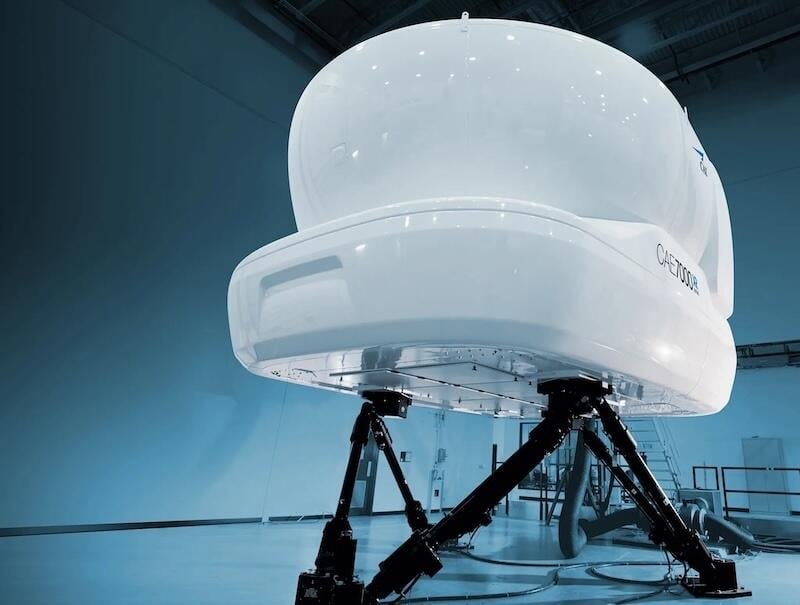
LAS VEGAS—Flight simulation specialist CAE is expanding its business aviation training capacity by adding extra full-flight simulators around its U.S. network and, at the same time, has unveiled a digital training platform aimed at easing the shortage of maintenance technicians.
The additional simulators include full-flight systems for the Bombardier Global 6500, Textron Citation CJ4 and Pilatus PC-24 at CAE’s Orlando, Florida, facility, and an Embraer Praetor 600 system at the company’s Dallas site.
The new units take the number of full-flight simulators across CAE’s global business aviation training network to more than 130 systems, and form part of an ongoing expansion that has seen capacity almost double over the last decade.
“As our [original equipment manufacturer] partners are delivering aircraft in every part of the world, we also want to leverage our network to bring training capacity where it's needed,” says Alexandre Prévost, president of CAE Civil Aviation.
“From a CAE standpoint, having the ability to do this is where the civil network comes in as a strength because we can leverage both,” he adds, referring to colocation of business aviation training assets with the company’s global network of commercial aviation training sites.
“For example, in Singapore we have a Gulfstream G650 simulator that we were able to deploy in our existing partnership with Singapore Airlines, so we can leverage the larger network for that,” says Prévost, who was speaking to Aviation Week at NBAA-BACE.
For expansion in the immediate future, CAE is “going to be very selective, based on where we see the demand,” Prévost says. “But we are not done yet. We're going to keep growing with the market, and I think a lot of our new centers can still expand. We have here in Las Vegas our new center, and there is room for us to double capacity over the coming years as we see the need. We can also deploy more devices into our sites in Savannah and Orlando. The majority of our sites have room to expand.”
CAE also used NBAA-BACE to showcase a newly developed iPad-based maintenance training system dubbed “Ready for Work,” which is designed to accelerate the induction of new technicians. “It is a suite of computer-based training offerings, both aircraft-specific and also non-aircraft-specific,” says David Bienvenu, senior director of business aviation maintenance training and aftermarket sales.
The system is designed to speed up training to help bridge a coming shortfall in the number of trained maintenance technicians in business aviation. “CAE has identified that over the next 10 years we're going to have a gap of about 69,000 business aviation technicians. That’s driven by people leaving, putting their tools down, retiring and a smaller number of people joining aviation,” Bienvenu says.
“The intent is really to help get these newer technicians ramp up faster,” he says. “The on-the-job training portion is not going away, but there's a technical skills piece that we can help drive forward. And all that's delivered on a digital platform through computer-based training, which includes examinations, as well as being underpinned through a learning management system,” he says.
“We see the ‘Ready for Work’ training system as a huge enabler that will allow our customers to free up some time for their experienced technicians and make the time that they do have with the newer generation more valuable,” Bienvenu adds.
CAE has developed the training syllabus over the past year and a half. “Our biggest challenge was making sure that what we developed resonated with the newer generation—individuals that don't have multiple years of experience. We had to go back to the drawing board on some courses up to three times,” he says.
The initial training system includes five non-aircraft-specific courses and five that are aircraft-specific—all of them Bombardier models for now. “We are set to roll out more over the next six to eight months. We are going to expand the number of aircraft-specific platforms as well as expand on the non-aircraft-specific courses,” Bienvenu says.

Related Content